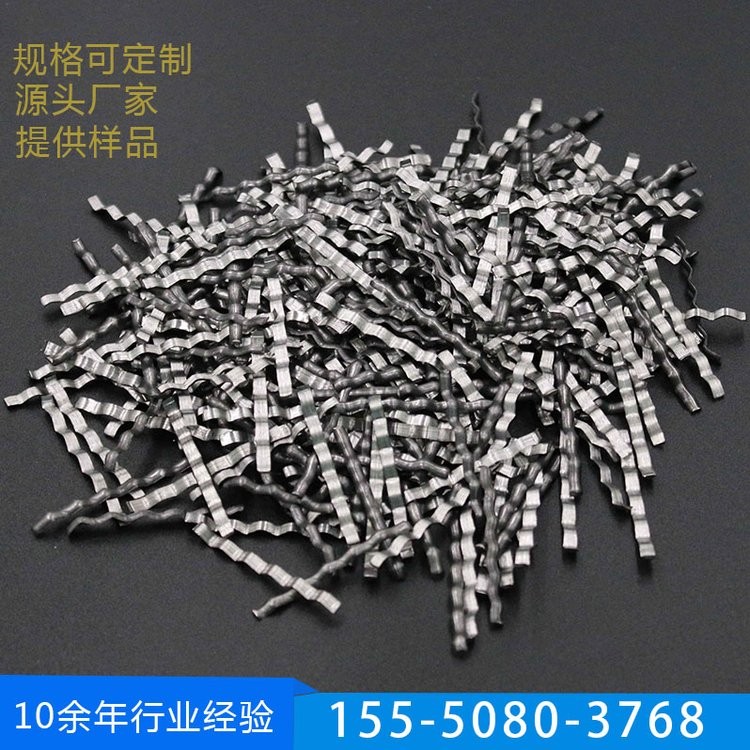







Steel fiber refers to fibers with a length-to-diameter ratio of 40 to 80, which are produced by cutting fine steel wires, cold-rolling steel strip shearing, steel ingot milling, or rapid cooling of molten steel. When the fiber cross-section is not circular, the diameter is calculated based on the equivalent circular area of the cross-section.
Steel fiber performance varies depending on the different production methods. Although steel fiber has been in existence for a short time, its applications are becoming increasingly widespread, and the variety is also expanding.
Steel fiber is a new, high-performance variety of steel fiber. The mixing ratio design method for steel fiber roads is generally similar to that of ordinary concrete, with the difference being: double-controlled strength standards (compressive strength and tensile strength under bending); the dosage of steel fiber is determined based on the design-required tensile strength under bending; the unit water consumption and sand ratio are related to the fiber dosage, with an increase of 6kg in unit water consumption and a 2% increase in sand ratio for each 0.5% (by volume) of steel fiber added.
Steel fibers are primarily used in the production of steel fiber reinforced concrete; any steel fiber produced by any method can serve to reinforce concrete.
The reinforcing effect of fibers primarily depends on the matrix strength (fm), the length-to-diameter ratio of the fibers (the ratio of steel fiber length l to diameter d, i.e., l/d), the volume fraction of the fibers (the percentage of volume occupied by steel fibers in steel fiber concrete), the bonding strength between the fiber and matrix (τ), and the distribution and orientation of the fibers within the matrix (η). When steel fiber concrete fails, it is usually due to the fibers being pulled out rather than broken, hence improving the bonding strength between the fiber and matrix is one of the main controlling factors for enhancing the reinforcing effect.
Concrete reinforced with steel fibers exhibits significantly improved compressive strength, tensile strength, flexural strength, impact strength, toughness, and impact toughness.