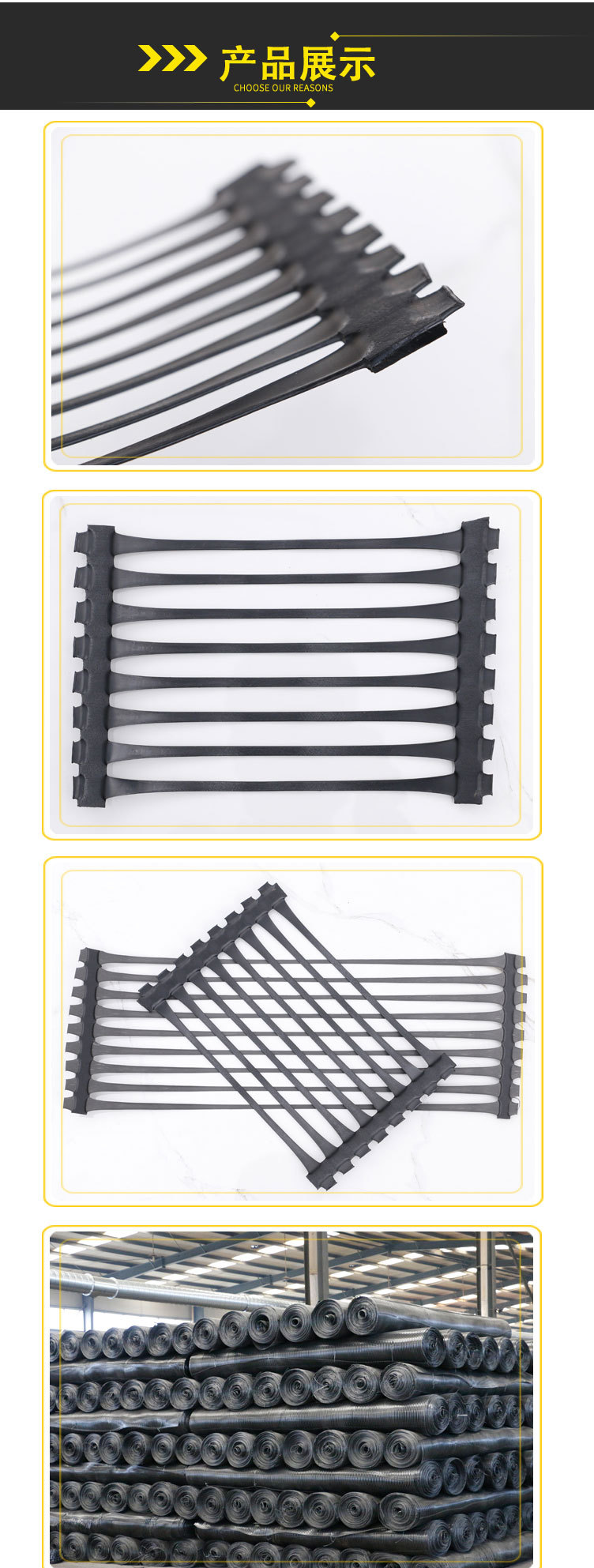

Unidirectional Stretch Geotextile Mesh
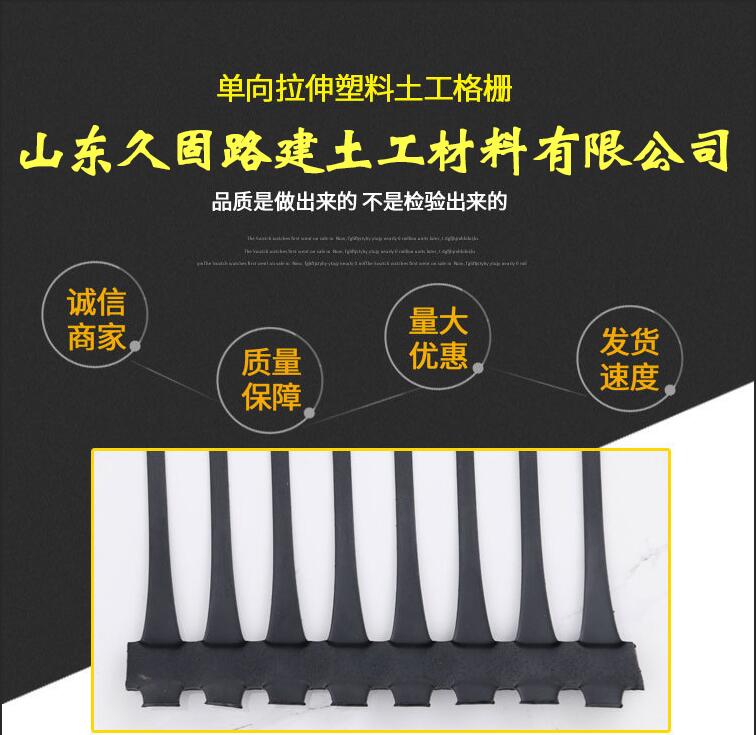
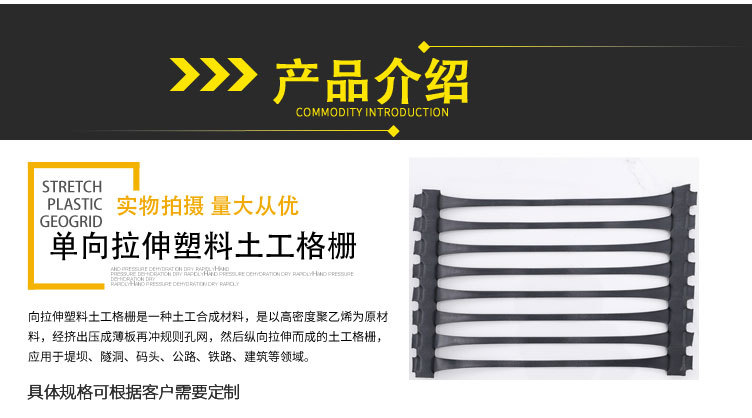
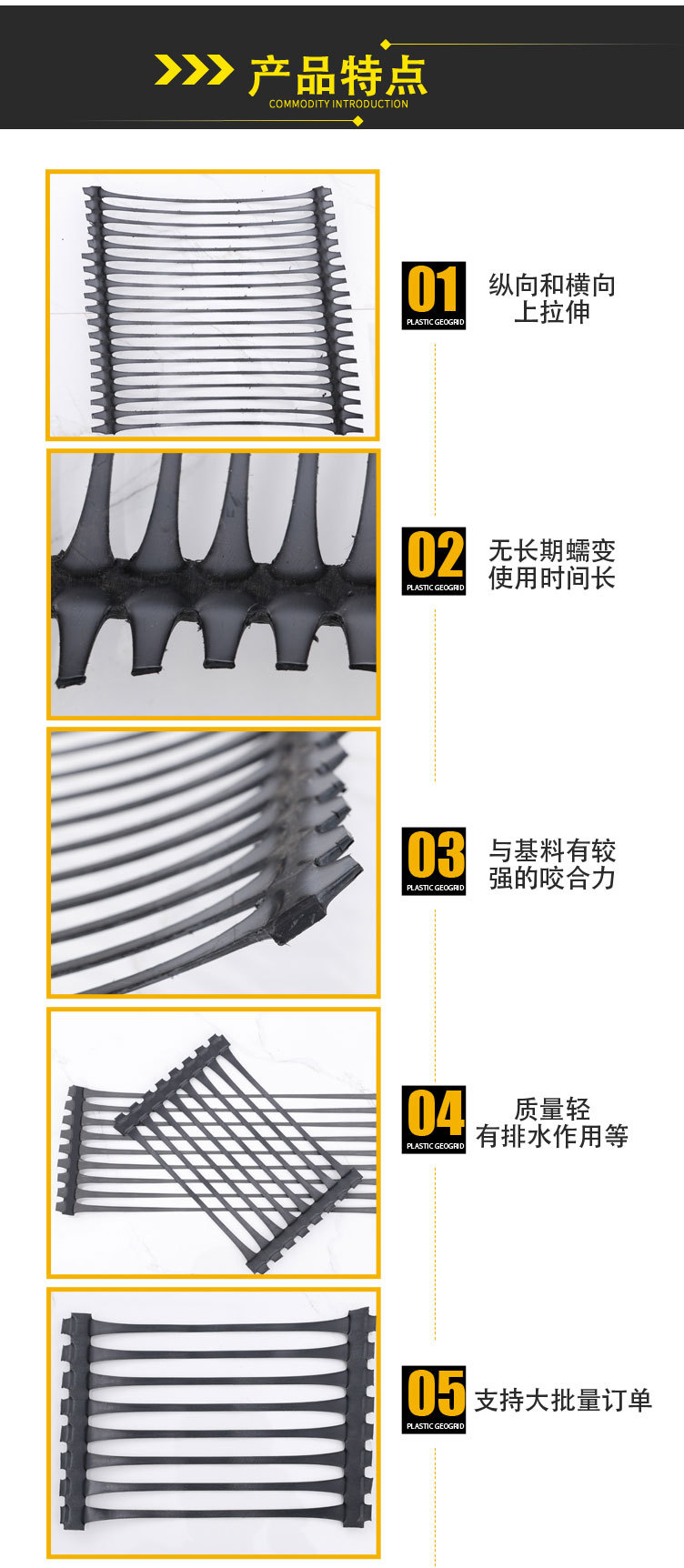
Unidirectional geosynthetic plastic grating is formed by extruding and pressing high molecular polymer (PP or HDPE) into a thin plate, followed by punching it into a regular grid pattern, and then stretching it longitudinally. This process aligns the high molecular polymer into a directional linear state, forming a uniformly distributed, high node strength, long elliptical meshed structural integrity. Unidirectional stretched geosynthetic grating is a high-strength geosynthetic material.
Unidirectional stretched plastic geogrid, incorporating UV and anti-aging additives, reorients the originally scattered chain molecules into a linear arrangement through unidirectional stretching. This material is then extruded into a thin plate, punched into a regular perforated mesh, and further stretched longitudinally to form a high-strength geosynthetic. This process results in a high-molecular linear state with a uniformly distributed, high-node-strength, elongated elliptical mesh structure. This structure boasts a high tensile strength and modulus, with tensile strength reaching 100-200 MPa, nearly matching that of low-carbon steel, significantly outperforming traditional or existing reinforced materials. It provides an ideal force-bearing and diffusing连锁 system for soil. The product has a high tensile strength (>150 MPa), adapts to various soils, and is widely used as a reinforcing and strengthening material. Its main features are: high tensile strength, good creep resistance, ease of construction, and low cost.
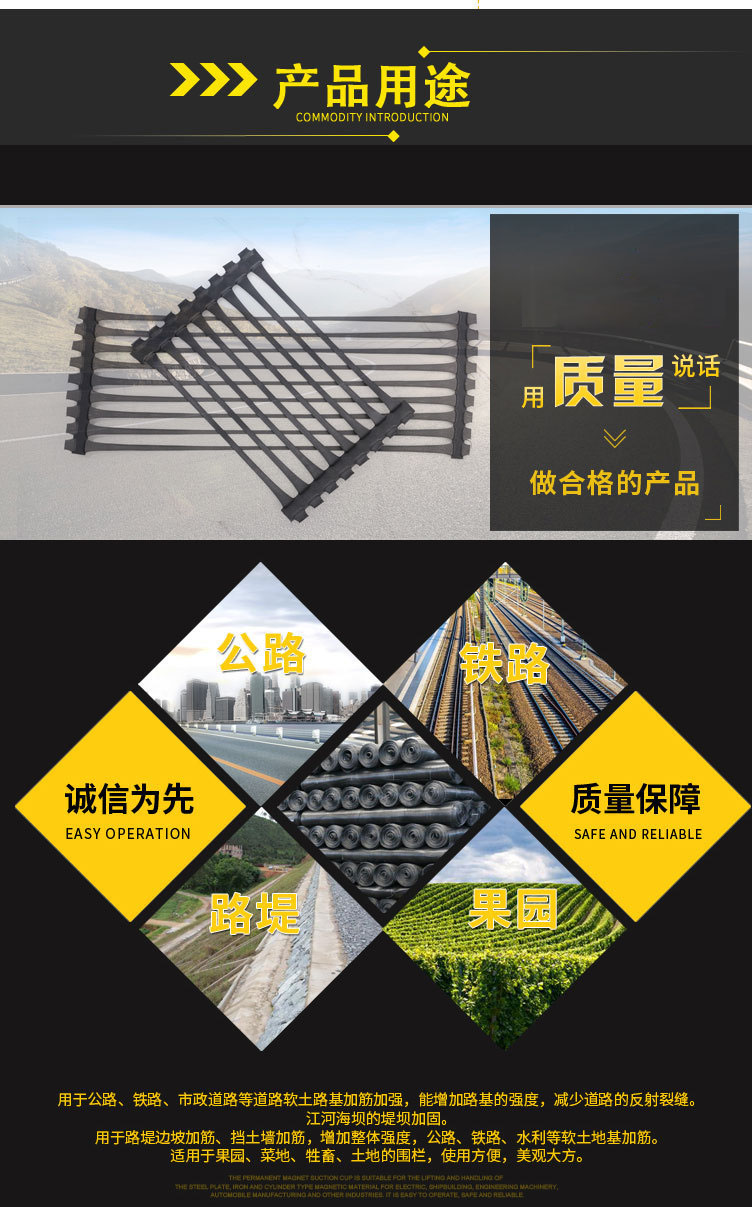
Primary Application
1. Single-direction geogrid for reinforcing soft soil foundation: Geogrid rapidly enhances the bearing capacity of the foundation, controls the settlement progression, and effectively distributes loads over a wider subgrade, thereby reducing the thickness of the subgrade, lowering construction costs, shortening project duration, and extending service life.
2. Single-Direction Geogrid for Reinforcing Asphalt or Concrete Pavements: Laid at the bottom of asphalt or concrete layers, the geogrid reduces rutting depth, extends the pavement's fatigue life, and also decreases the thickness of asphalt or concrete layers to save costs.
3. Single-direction geogrids are used for reinforcing embankment slopes and retaining walls: Traditional embankment construction, especially for high embankments, often requires overfilling and the shoulder edges are difficult to compact, leading to frequent occurrences of slope erosion and instability due to rainwater, as well as the need for gentler slopes, which occupy a large area. Retaining walls face similar issues. Reinforcing embankment slopes or retaining walls with geogrids can reduce land area by half, extend service life, and lower construction costs by 20-50%.
4. Unidirectional geogrid for reinforcing river, lake, and sea embankments: Can be made into gabions, combined with the grid to prevent embankments from collapsing due to sea erosion. Gabions are permeable, reducing wave impact and extending the embankment's lifespan, while saving labor and materials, and shortening construction time.
5. Single-axial geogrid for waste landfill treatment: When used in combination with other geomaterials, the geogrid effectively addresses issues such as uneven ground settlement and the emission of generated gases in waste landfills, while significantly enhancing the storage capacity of the landfill.
6. Special Application of Single-Way Geogrid: Low-Temperature Resistance. After 200 cycles of repeated cold and hot temperatures from -45℃ to -50℃, all performance indicators meet the requirements and have passed the test of the Qinghai-Tibet Railway. Suitable for northern areas with low-frozen soil, rich-frozen soil, and high-ice-content frozen soil with poor geological conditions.
Construction Method
When used for subgrade or pavement, the construction method is the same as that for two-way geogrid.
○When used for reinforced earth retaining walls, the construction method is as follows:
1. Establish the foundation, constructing according to the designed wall system. When using precast reinforced concrete panels, they are typically 12-15 cm thick and supported on a precast concrete foundation. The width should not exceed 30 cm, the thickness not less than 20 cm, and the burial depth not less than 60 cm to prevent ground frost heave.
2. Level the foundation wall, excavate and level according to design requirements. Soft soil must be compacted or replaced, compacted to the required density, slightly extending beyond the wall's perimeter.
3. Rebar Laying: The main strength direction of the rebar should be perpendicular to the wall, and secured with nail pins.
4. Wall backfilling should use mechanical backfilling, with a minimum distance of 15 cm between the wheel and the reinforcement. After compaction, the thickness of the soil layer should be approximately 20-15 cm.
5. During wall construction, the wall area should be wrapped with geotextile to prevent soil erosion.