

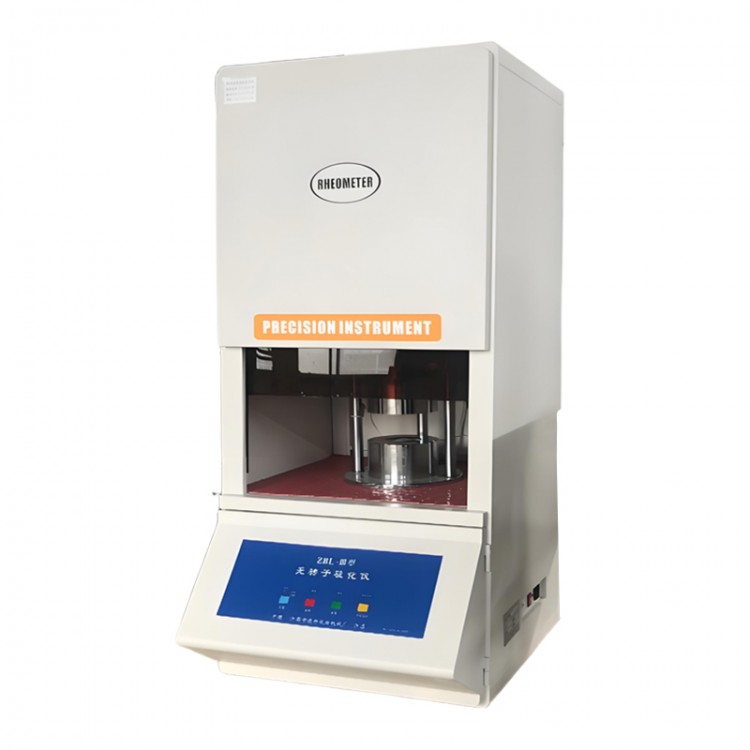

ZBL-III Type转子式硫磺测定仪
(1) Feature Introduction:
This unit meets the requirements of GB/T 16584 "Rubber No-rotor Viscosity Recorder - Requirements for Determining Vulcanization Characteristics," ISO 6502, and the Italian standard's T10, T60, T90 data. It is used to determine the characteristics of unvulcanized rubber and to find the optimal vulcanization time for rubber compounds. Featuring an imported intelligent digital temperature control instrument, it offers easy adjustment, a wide temperature control range, high control precision, and superior stability, reproducibility, and accuracy compared to general rotor vulcanizers. The no-rotor vulcanization analysis system utilizes the Windows 10 operating platform, a graphical user interface, flexible data processing methods, and modular VB programming techniques. It supports the English version feature, fully reflecting its highly automated characteristics. This instrument is widely used in the rubber processing industry for quality control, rapid testing, and fundamental rubber research applications. It provides data for optimizing rubber formula combinations, accurately measuring parameters such as curing time, scorch time, vulcanization index, and low torque. Suitable for research departments, colleges and universities, and industrial and mining enterprises.
(2) Technical Specifications:
Standard: GB/T3709-2003, ISO-6502 and others
Mold Structure: Full-sealed mold cavity, top-mounted sensor
Temperature Control Range: Room temperature - 200℃ (other higher temperatures require notification)
Temperature Fluctuation: ≤±0.2℃
Temperature Display Resolution: 0.01℃
Torque Range: 0-20 N·m
Torque display accuracy: 0.001 N.M
Power: 50Hz, ~220V ±10%
Compressed Air: ≥0.40 Mpa
Swing Frequency: 100 cpm (1.7 Hz)
Swing Angle: ±0.5, ±1
Total Power: 700W
Print Content: Date, Time, Temperature, Sulfur Curve, Temperature Curve, ML, MH, ts1, ts2, t10, t90, Vc1, Vc2
3. Main Functions of the Control Software
3.1 Operation Software: Chinese software, English software; (switchable)
3.2 Unit Selection: kgf-cm, lbf-in, N-m, dN-m
3.3 Testable Data: ML (N.m) low torque; MH (N.m) high torque, TS1 (min) initial vulcanization time; TS2 (min) initial vulcanization time, T10, T30, T50, T60, T90 vulcanization time; Vc1, Vc2 vulcanization speed index.
3.4 Testable Curves: Vulcanization Curve, Upper and Lower Mold Temperature Curves
3.5 Modify testing time during the process.
3.6 Test data can be automatically saved.
3.7 Multiple test data and curves can be displayed on a single sheet, and values at any point on the curve can be selected and read using a mouse click.
3.8 Historical data can be combined for comparative analysis and can be printed.
(4) Key Features:
1. This instrument features a genuinely sealed mold cavity.
2. This instrument is developed based on a large-scale database platform, with the temperature control unit directly controlled and processed by software. This technology leads the international new trend.
3. This instrument features statistical, analytical, storage, and comparison functions. User-friendly design with easy operation.
4. The mold cavity is made of standard 45# steel material with nickel plating, while the mold core is made of chrome steel.
(5) Host Specifications:
Dimensions: 580*620*1175
Overall Weight: 175KG
