

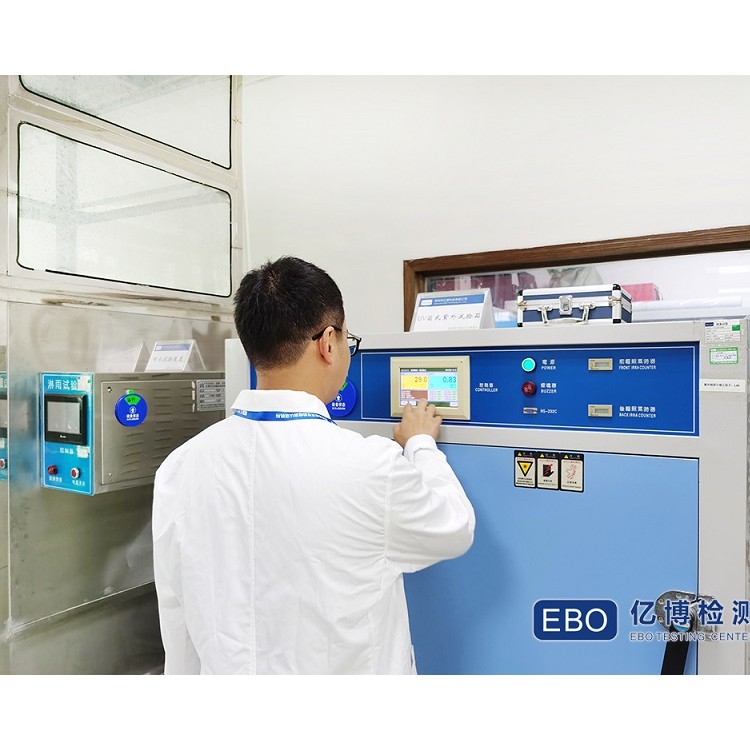
Battery UN38.3 test report determines the qualification standards. To ensure safe air transportation and meet the customer's transportation requirements for lithium-ion battery goods, in accordance with the relevant provisions of the International Air Transport Association's "Regulations for Dangerous Goods," operational specifications for rechargeable lithium-ion batteries, i.e., UN38.3 (UNDOT) testing, are established.
In compliance with aviation regulations, airlines and airport cargo handling departments must review transport documents for lithium batteries, with particular emphasis on the UN38.3 safety test reports for each battery model. These reports can be provided by a third-party testing facility designated by the aviation authority (such as Power Test), or by battery manufacturers with testing capabilities. Failure to provide this test report will result in the prohibition of lithium batteries from being transported by air.
UN38.3 refers to Article 38.3 of Part 3 in the "United Nations Manual of Tests and Criteria for the Transport of Dangerous Goods," specifically designed by the United Nations for hazardous materials transportation. It mandates that lithium-ion batteries must pass rigorous tests, including high and low-temperature cycling, vibration tests, impact tests, external short-circuiting at 55°C, shock tests, overcharge tests, and forced discharge tests before transportation to ensure safety. If the batteries are not installed with the equipment, they must also pass a 1.2-meter free-fall test.
UN38.3 Certified Product Range
A variety of power lithium secondary batteries (such as batteries for power vehicles, electric road vehicle batteries, electric tool batteries, and hybrid vehicle batteries, etc.)
2. Various mobile phone batteries (such as lithium-ion batteries, lithium polymer batteries, etc.)
3. Various small secondary batteries (such as laptop batteries, digital camera batteries, video camera batteries, various cylindrical batteries, wireless communication batteries, portable DVD batteries, CD and MP3 player batteries, etc.)
4. Various single-use batteries (such as lithium-manganese batteries)
UN38.3 Testing Requirement
T.1 Full-scale Simulation Test
T.2 Heat Test
T.3 Vibration Test
T.4 Impact Test
T.5 External Short Circuit Test
T.6 Impact Test
T.7 Overcharge Test
T.8 Forced Discharge Test
Criteria for qualification of testing assessment
a. T.1-T.4: No quality loss, no leakage, no exhaust, no disassembly, no cracking, no ignition, open circuit voltage not less than 90% of the pre-test value
b.T.5–T.6 Surface temperature does not exceed 170°C, no disassembly, no cracking, no ignition within 6 hours of testing
c.T.7–T.8: No disassembly or fire within 7 days of testing.
