Specializing in DC power supplies, DC voltage regulators,...

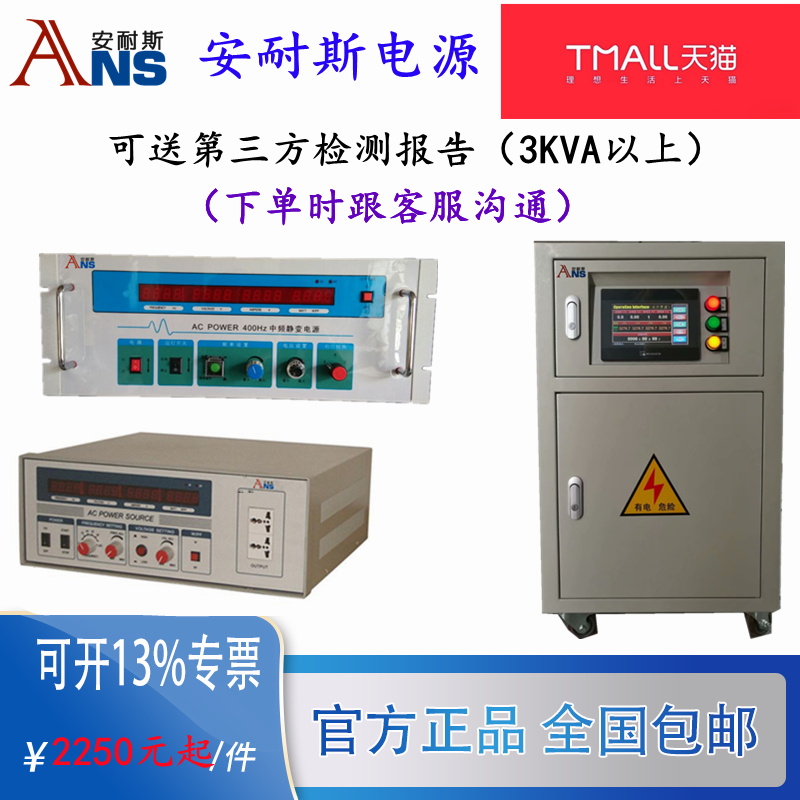
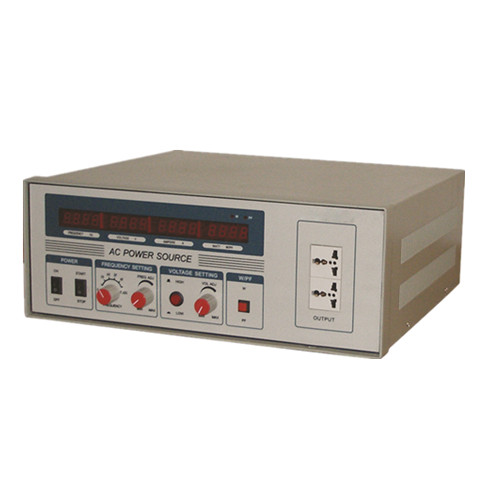
The characteristics of an ideal AC power source include stable frequency, stable voltage, zero internal resistance, and a pure sine wave voltage waveform (no distortion). Variable frequency power supplies are very close to ideal AC power sources, which is why advanced developed countries are increasingly using them as standard power supplies to provide excellent power supply environments for electrical appliances, facilitating objective assessment of their technical performance. Variable frequency power supplies mainly consist of two types: linear amplifying and PWM switching type HY series programmable variable frequency power supplies. These are designed with a microprocessor at their core, utilizing MPWM technology and active IGBT module design. They incorporate digital frequency division, D/A conversion, instantaneous value feedback, and sine pulse width modulation techniques, enabling individual unit capacities up to 100kVA. The use of isolation transformers enhances overall system stability. They feature strong load adaptability, excellent output waveform quality, ease of operation, compact size, and lightweight. They also include protection functions such as short circuit, overcurrent, overload, and overheating to ensure reliable operation of the power supply.
How to Choose Load Type and Capacity for Variable Frequency Power Supplies
Variable frequency power supplies can accommodate loads with various impedance characteristics, including common inductive, resistive, and rectifying loads. It is important to note that different load types require significantly different power capacity of the variable frequency power supplies.
Types of load characteristics:
③. Power Capacity Selection Method
· Resistance: Power Rating = 1.1 x Load Power
· Sensitivity: Power Capacity = Load Start Current / Load Rated Current × Load Power
· Rectification: Power Capacity = Load Current Peak Factor / 1.5 × Load Power
Hybrid: Please select appropriately based on the proportion of different loads.
Note: For inductive loads such as refrigerators and air conditioners, the power supply capacity should be selected based on the starting power.
The startup power is typically 5-7 times the rated power.
Three-phase AC power IGBT PWM system structure, commonly seen structure
①. Split-core (standalone) three-phase AC power supply, without transformer structure, input non-isolated, output isolated
Structural Diagram:
Features:
·Three independent output transformers, three sets of inverters, and up to 12 IGBTs used.
·Three inverters can share a single rectifier.
· The three-phase system is integrated from complete single-phase connections, and can be used in single-phase mode (using any one phase) or in three-phase mode.
Suitable for three-phase balanced and unbalanced (unbalanced) loads, customizable to be mounted in one or three enclosures as required.
Structures vary, costs differ, and of course, performance varies too!!
②. Low-cost three-phase AC power supply with no power transformer structure; input unisolated, output isolated
Structural Diagram:
Feature:
· A power transformer with three winding sets, one converter, and only 6 IGBTs used.
· Designed for three-phase loads only (not individually selectable per phase), not suitable for unbalanced three-phase loads.
· This structure can only be produced in one cabinet.
③. Standalone three-phase AC power supply, transformerless output structure, input isolation, output non-isolated
Structural Diagram: Features:
· A power transformer, three sets of inverters, and 12 IGBTs used

Company Name
Wuxi Annes New Energy Equipment Co., Ltd.

Service Hotline
18912368040
Company Phone
18912368040

Company Address
566 Xitai Road, 2nd Building, 4th Floor, Xincheng District, Wuxi City, Jiangsu Province
b2b.china9.net © Zhongshang 114 Hebei Network Technology Co., Ltd.Address: Room 6009, Oriental New World Center, No.118 East Zhongshan Road, Qiaoxi District, Shijiazhuang City, Hebei ProvincePlatform Service Hotline: 4006299930