Our company is a high-tech engineering firm specializing ...

The design of electric vehicle parking shelters should combine their functions (rain protection, sunshade, charging needs, etc.) with safety considerations. Below is a detailed production process and key注意事项:
---
### **One: Electric Vehicle Parking Shelter Manufacturing Process**
#### **1. Preparations**
- **Requirement Confirmation:**
- Determine the purpose of the parking shed (parking only or with charging capabilities), dimensions (planned based on the number of electric vehicles and parking space), and location (avoid low-lying, water-prone areas).
- Select Type: Membrane Structure, Steel Structure, Aluminum Alloy Structure, or Simple Sunshade Shelter (e.g., waterproof fabric + steel frame).
- **Design Drawings**
- Draft construction drawings, marking the foundation location, column spacing, roof pitch (recommended ≥10% drainage slope), and material specifications.
- Reserve electrical wiring and outlet locations for charging capabilities.
#### **2. Foundation Construction**
- **Subsurface Treatment**
- Excavate foundation trenches (depth varies with soil quality, typically 30-50cm), pour concrete foundations (with a strength of C20 or above), and pre-bury anchor bolts or steel plates.
- The foundation must be level and sturdy with an error of ≤5mm, and it should be cured for 7 days before proceeding to the next step.
- Pre-embedded component installation
- Pre-bolted steel plates or bolts require calibration of elevation and level to ensure precise installation of subsequent steel frames.
#### **3. Main Structure Installation**
- Steel frame/frame assembly:
- Steel Selection: Columns and beams can be made of galvanized square tubes (such as 60×60×3mm) or aluminum alloy profiles, which are resistant to rust and corrosion.
- Steel frame welding or bolted connections, reinforced with ribbed plates at the joints to ensure structural stability.
When installing charging stations, it is necessary to reserve a distribution box and cable protection pipe within the shed.
Ceiling Covering
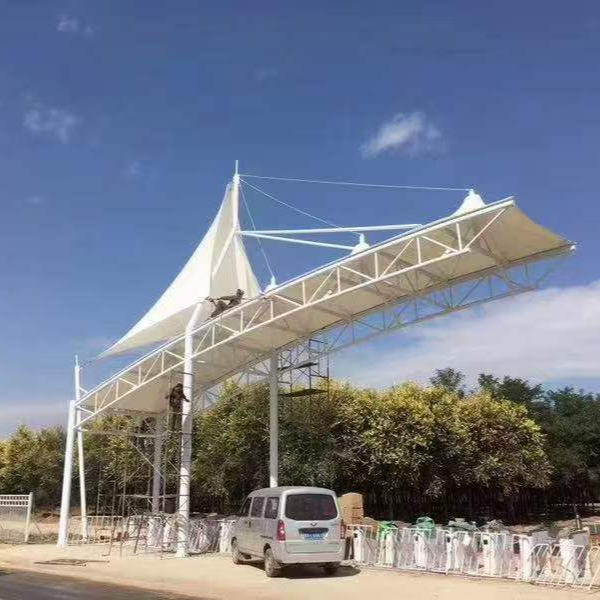
- **Membrane Structure**: Cutting high-strength membrane materials (such as PVC/PVDF), heat-sealing joints, and tensioning for fixation ensure a tight, wrinkle-free membrane surface.
- **Color-steel Sheet/Polycarbonate Sheet**: Leave expansion joints when assembling the panels to prevent deformation due to thermal expansion and contraction; apply sealing glue for waterproofing treatment.
- **Rainproof Canvas**: Utilizing durable canvas or shade cloth, the edges are secured to a steel frame, and a drainage channel is set at the hem.
#### **4. Electrical System (For Charging Needs)**
- **Layout Design**:
- Conduit pre-burial with flame-retardant copper-core wire (e.g., RVV 2.5mm²) and waterproof boxes for socket installation.
- Charging桩 must be grounded for safety, and distribution boxes are equipped with a residual current circuit breaker.
-Lighting and Charging Facilities
- Optional LED energy-saving lights (top or wall-mounted) can be installed, and the electricity consumption for night lighting must be incorporated into the design.
- Charging stations are positioned to avoid rain and are no more than 3 meters from the electric vehicle parking area.
#### **5. Inspection and Closure**
Structural Inspection:
- The steel frame has a verticality error of ≤2mm, the foundation has no settlement, and the membrane surface/ceiling has no collapse or light leakage.
- Vibration Test: The canopy is vigorously pushed and pulled without any noticeable sway or unusual noise.
- **Functional Testing**:
Drainage Test: Simulated rainfall to ensure water flows smoothly without any ponding.
- Charging Test: Ensured that the outlets are properly powered and the charging stations operate stably.
---
### **II. Cautionary Notes**
#### **1. Safety and Compliance**
Fire Safety Compliance
- If equipped with charging functionality, a fire extinguisher (such as a dry chemical extinguisher) must be provided, and flammable materials are prohibited from being stacked within the shed.
Electrical wiring must comply with the "Electrical Installation Code," utilize conduit protection, and avoid unauthorized connections.
Structural Safety:
- Wind-pressure-resistant design: Based on the local wind speed grade (such as 8-grade strong wind), calculate the steel frame load, and reinforce the tensioning force for the membrane structure.
- Snow Load Protection: Northern regions should consider snow depth (such as 50 kg/m²), increase the slope, or set up deicing channels.
#### **2. Material Selection**
- **Corrosion Treatment**
- Steel frames must be galvanized or coated with rust-proof paint (such as epoxy zinc-rich primer + topcoat), and bolts must be made of stainless steel.
- The membrane structure is made with weather-resistant materials (such as UV-resistant aging-resistant membrane materials), with a lifespan of over 10 years.
**Transparency and Insulation**
- Polycarbonate or membrane structures must have UV filtering capabilities to prevent damage to electric vehicle batteries during the summer heat.
#### **3. Construction Details**
Drainage Priority
Roof pitch must be ≥10% with drainage channels or diverting pipes installed around the perimeter to prevent water backflow.
- Basic peripheral hardening treatments (such as laying cement floors) are implemented to prevent soil erosion and accumulation.
- Edge Protection
The edges of the membrane structure must be secured with clamps or strips, and sharp corners should be wrapped with anti-scratch layers, such as rubber strips.
The exposed steel frame parts must be sanded smooth to prevent injury to users or vehicles.
#### **4. Post-Maintenance**
- **Regular Inspections**
- Monthly inspections are conducted to check for loose steel frame bolts, any damage or water accumulation on the membrane or ceiling.
Quarterly cleaning of drainage ditches and removal of blockages.
- **Cleaning and Maintenance**:
- Clean membrane structures with a soft cloth dipped in clean water, avoiding high-pressure water jets; clean steel plates with a neutral cleaning agent.
---
### **III. Summary**
The construction of electric vehicle parking shelters must balance **safety, durability**, and **functionality** (such as charging requirements). Key steps include precise foundation construction, corrosion-resistant frame installation, waterproof roof coverage, and compliant electrical systems. Pay attention to site-specific design (such as drainage slope, wind resistance level) and choose a professional team for construction to ensure long-term stable use.

Company Name
Shandong Huayi Membrane Structure Engineering Co., Ltd.

Service Hotline
18363678076
Company Phone
18363678076

Company Address
No. 9, Commercial Building, Zhongjing Community, Qingchi Sub-district, Weifang High-Tech Development Zone, Shandong Province
b2b.china9.net © Zhongshang 114 Hebei Network Technology Co., Ltd.Address: Room 6009, Oriental New World Center, No.118 East Zhongshan Road, Qiaoxi District, Shijiazhuang City, Hebei ProvincePlatform Service Hotline: 4006299930