Our company is a high-tech engineering firm specializing ...

Installing a membrane structure parking canopy requires specialized tools and equipment, as well as adherence to a standardized operational process. Below is a detailed list of tools and the corresponding steps for operation:
---
### **I. Main Tools and Equipment**
#### **1. Basic Construction Tools**
- **Measurement Tools**: Level, Total Station, Tape Measure, and Chalk Line (used for basic positioning and elevation control).
- **Construction Tools**: Excavators, concrete mixers, vibrators, and formwork (for foundation pouring).
- **Fasteners**: Anchor bolts, rebated steel plates, wrenches (for securing foundation embedments).
#### **2. Steel Frame Installation Tools**
- **Lifting Equipment**: Small cranes or gantry cranes (used for lifting steel frame components).
- **Connection Tools**: Welding machines, angle grinders, torque wrenches, screw guns (used for welding and bolt tightening).
- **Measurement Tools**: Theodolite, level, laser distance meter (ensuring the verticality of the steel frame and installation accuracy).
#### **3. Membrane Installation Tools**
- **Heat Sealing Equipment**: Film Heat Sealing Machines (such as specialized heat sealing machines for PVC/PVDF films, with temperatures up to 400-500℃).
- **Tensioning Tools**: Hydraulic Jacks, Nylon Ropes, Tensioning Wires (for membrane material tensioning and prestress application).
- **Cutting Tools**: Film cutter, steel ruler, layout tools (cutting film materials to design dimensions).
- **Auxiliary Tools**: Clamps, pressure plates, sealing adhesives (for securing membrane edges, sealing joints).
#### **4. Other Tools**
- **Safety Equipment**: Safety helmets, safety belts, anti-slip shoes (essential for high-altitude work).
- **Supporting Equipment**: Scaffoldings, scissor lifts (used for high-altitude steel frame and membrane installation).
---
### **Part Two: Operational Steps and Tool Usage**
#### **1. Foundation Construction**
- **Positioning and Excavation**:
- Utilize leveling and total station equipment to measure foundation locations and mark the coordinates of embedded components.
Excavators are digging foundation trenches, followed by cleaning the bottom of the pit and then formwork and concrete pouring.
Pre-poured Anchor Installation
- Anchor pre-buried steel plates or anchor bolts within the steel cage, level the elevation using a leveling instrument, and cure the concrete for 7 days after pouring.
#### **2. Steel Frame Installation**
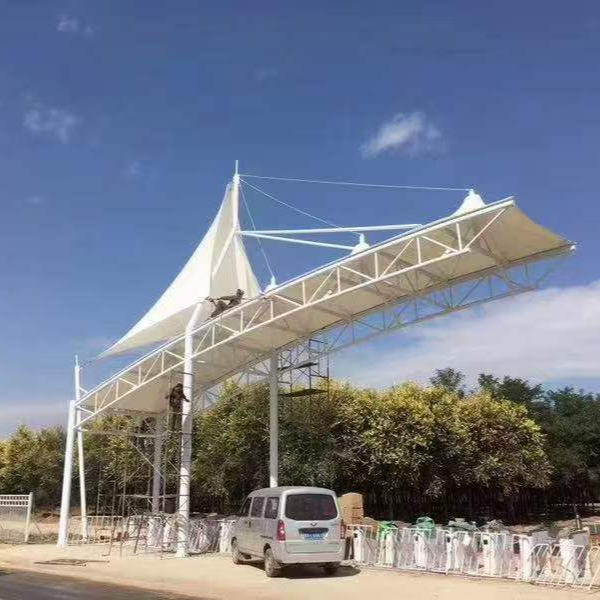
- **Component Assembly**
On-site, steel frame units (such as trusses, columns) are assembled, weld seams are trimmed with angle grinders, and nodes are welded with electric welders.
Torque the bolts with a torque wrench to ensure connection strength.
**Hoisting and Adjustment**
- The steel frame units are hoisted into place using a crane, then the level is used to ensure vertical alignment (error ≤ 2mm). After temporary fixation, they are welded or bolted together.
#### **3. Membrane Material Installation**
- **Cutting and Heat Sealing**
- Cut the film material to the design size and join the seams using a hot sealer (adjusting temperature, pressure, and time according to the film type, such as 400-450°C for PVC film).
- Inspect the seam strength after hot fusion to prevent under-welding or over-welding.
- **Film Material Unfolding and Fixation**
- The membrane material is hoisted to the steel frame using nylon rope or a crane, unrolling it from one end to the other to prevent tearing.
- Secure the edges of the film material with clamps or pressure plates to maintain a taut and wrinkle-free membrane surface.
- **Tensioning and Prestressing**:
- Apply prestress to the membrane material using a hydraulic jack, and monitor the curvature of the membrane surface with a laser distance meter to ensure even tensioning (e.g., for a membrane surface with a span of 10 meters, the central sag should be ≤50mm).
- After tensioning, use a tensioning device to secure the membrane material to prevent relaxation.
#### **4. Detail Handling**
- **Waterproofing and Sealing**
Sealant is used to treat the seams and edges of the membrane material to prevent water leakage.
- Inspect the drainage outlets for proper flow and ensure the slopes meet design specifications.
- **Anti-corrosion Treatment**
- The steel frame surface is coated with anti-corrosion paint, and the bolts and other accessories are replaced with stainless steel material.
---
### **III. Operation Precautions**
**Safety Standards**
- Elevated work must be performed with a safety harness, scaffolding must be secure, and construction is prohibited during inclement weather.
- When operating the heat sealer, wear heat-resistant gloves and keep away from flammable materials.
2. **Precision Control**:
- The steel frame's verticality error should be ≤2mm, and the membrane material tensioning must be carried out symmetrically and simultaneously to prevent uneven force distribution on one side.
Material Protection:
- Avoid dragging when handling film materials to prevent scratches; cover with protective cloth before installation to shield from sun and rain.
4. **Environmental Requirements**:
- Hot-melt bonding of film materials must be carried out in a dry environment (humidity ≤ 80%), and construction should be halted during rainy or snowy days.
---
### **IV. Summary**
The core tools for installing membrane structure carports include hot-air welders, tensioning equipment, measuring instruments, and lifting equipment. The operation should adhere to the principle of "precise measurement, step-by-step installation, and symmetrical tensioning." It is recommended to have a professional team handle the construction to ensure structural safety, a flat and aesthetically pleasing membrane surface, and durability.

Company Name
Shandong Huayi Membrane Structure Engineering Co., Ltd.

Service Hotline
18363678076
Company Phone
18363678076

Company Address
No. 9, Commercial Building, Zhongjing Community, Qingchi Sub-district, Weifang High-Tech Development Zone, Shandong Province
b2b.china9.net © Zhongshang 114 Hebei Network Technology Co., Ltd.Address: Room 6009, Oriental New World Center, No.118 East Zhongshan Road, Qiaoxi District, Shijiazhuang City, Hebei ProvincePlatform Service Hotline: 4006299930