


- AllProduct Category
-
UV Curing Repair
Non-Dig Pipeline Replacement and Repair
Industry News
FIPP Thermoplastic Molding
Municipal Pipeline Cleaning and Maintenance
Local Resin Repair
Helical Winding





详情描述
Trenchless Pipe Jacking Construction Technique
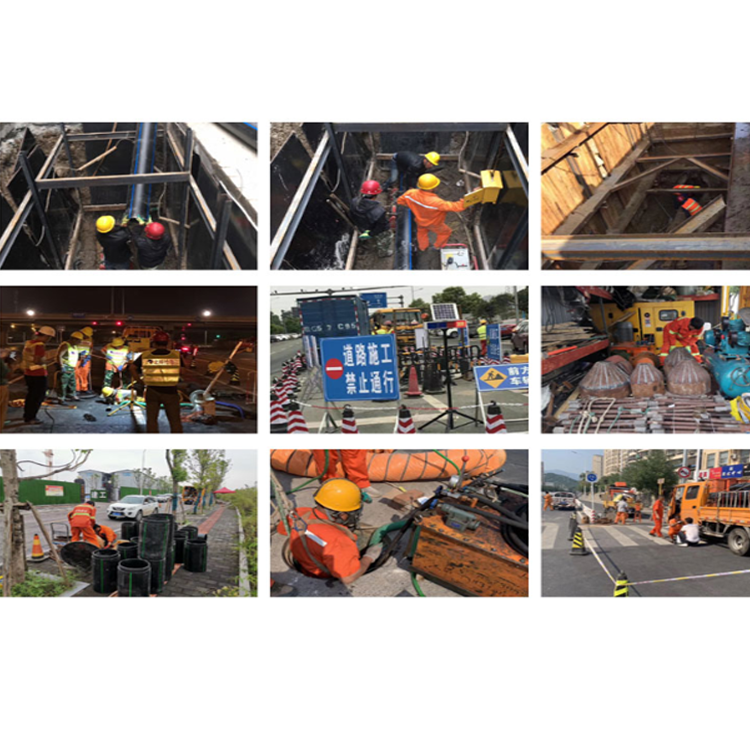
Process Flow: Enclose and manually dig the upper part of the pipe trench soil, support a platform, set up four corner frames and lifting equipment → dig the lower part of the soil and select supports → install pipe jacking equipment → jacking → well masonry → excavation and backfill → pipeline cleaning and cutting.
Prior to pipe jacking, carefully study the drawings, then locate the pipe jacking axis, lay out the working pit, and conduct elevation measurements.
According to the released axis and plane position, pre-buried the guide rail. The guide rail is made of 10048x5mm I-beam exposed 1.0 cm, track spacing of 0.57 meters.
Upon completion of the track installation, proceed with the assembly and adjustment of the jacking equipment and hydraulic jacks. Simultaneously, set up the crane equipment, hydraulic oil tanks, and power units on the caisson. After the concrete slab reaches the required design strength, begin the pipe jacking operation.
One. Pipe Jacking
The pipeline alignment and elevation should be carefully reviewed during the placement of the pipe jacking machine. Ensure accuracy before proceeding with the pipe jacking. The control points should be set in areas that are not easily disturbed and have a clear line of sight.
Please mark convenient locations for verification and protect them.
Construction Survey: Conduct a current pipeline investigation before the project starts, and review the pipeline's location and elevation. Tunneling surveyors are all certified. Water level points must be closed on-site before use.
Section II: Rear Installation
⑴ The back is tightly adhered to the wall with reinforced concrete, measuring 2m x 2m x 400mm, followed by a 2m x 2m x 50mm steel plate attached to the wall. The back plane must be perpendicular to the pipeline centerline. ⑵ The jacking equipment is a 300t hydraulic jack with a stroke L=700mm. Based on the jacking force calculation, two jacks are installed symmetrically around the pipeline centerline. During pipe jacking, the jacking force must not exceed 5000KN.
Section 3: Guide Rail Installation
The guide rail elevation is set using the leveling point within the pipe pit, and the steel guide rail, bottom, and sides are securely fixed with channel welding.
4. Excavation Prior to Pipe Installation and Jacking Construction
The pipe jacking deviation in elevation is controlled within +1cm to -2cm, and the plane centerline is maintained around 3cm.
The recommended excavation length before pipe laying in this project is 30cm, with no more than 50cm.
⑵ Regarding the excess excavation around pipes: An excess excavation of 3cm is permitted above the pipe top in this project, ensuring a perfect fit between the pipe wall and the soil base surface.
③ The elevation and center of the first section pipe should be measured to ensure they meet the requirements before being pushed into place. After the first section pipe is inserted into the ground, the center elevation should be measured with a laser ruler once every 100cm.
Timely and meticulous operation to prevent deviations.
(4) The two leveling points and central points set within the working pit for verification should be properly protected during construction to prevent collisions. (s) During the jacking process, round-the-clock three-shift work is carried out to prevent increased friction due to mid-process interruptions, which could cause difficulties in jacking.
(5) Stop jacking and take immediate action when any of the following conditions occur: a cave-in or foreign object in front of the pipe; rear slope or severe deformation; distortion or deformation of the jacking iron; excessive misalignment with no effective correction; or an increased jacking force beyond the allowable capacity of the pipe mouth.
V. Pipe Jacking Measurement Records
During the jacking process, the pipeline remains dynamic. Strengthening dynamic management during jacking construction is the primary guarantee for improving jacking quality. The jacking construction records serve as the basis for reflecting the dynamic conditions of the pipeline during jacking. Therefore, it is essential to fill out the jacking construction records carefully, ensure smooth handovers, grasp the dynamic situation of jacking, be clear about the situation, identify problems, have countermeasures, and handle them promptly.
⑵] Each shift during jacking must fill out the records truthfully, which should include jacking length, soil conditions, jacking force values, measurement records for each occasion, calibration status, machinery operation conditions, and other precautions.
③ Strictly adhere to the handover system; during handover, the on-duty supervisor must fully hand over the records to the incoming supervisor and explain any issues and their resolutions encountered during the push-in operation.
(⒁) The entire construction section's jacking process should be inspected in stages, not only after the entire section is jacked. Daily jacking original records (handover records) only reflect the current shift's situation. However, the changes in the jacking pipeline during the dynamic process should be understood. Therefore, the construction quality should be inspected each time a section of pipe is jacked, and existing issues should be resolved during the continued jacking.
S-tube records are collected by quality inspectors daily and the quality progress is promptly reported to the project manager.
Six, Clean and Receive
After the jacking operation is completed, organize forces to clean the pipeline and well. Demolish the temporary brick barrier walls, pour the channel and install the secondary concrete cover plates, backfill the earthwork, and restore to the natural ground level. The quality requirement for jacking is that the pipeline should not be offset, the joints should not be misaligned, and there should be no backwater at the bottom of the pipe. The jacking joint ring should be properly aligned with the pipe seam and tightly sealed against the outer circumference of the pipe. The pipe end pads should be securely adhered and not fall off. The pipes should not crack or leak, and there should be no soil or construction debris inside the pipeline.
Section 7: Handling Special Cases
1. In case smaller diameter blocks or sandstone are encountered during the jacking construction process, the following handling method applies: If the block diameter is less than 80 cm, use an artificial homemade small trolley to directly transport them out.
2. For blocks with a diameter over 80cm, utilize the working principle of water drills to cut them into smaller pieces, then manually transport them out using homemade small carts.
3. When encountering sandstone during construction, utilize the water drilling principle to cut the rock mass into holes with a diameter larger than the outer pipe diameter, then proceed with jacking using machinery.

询价单


