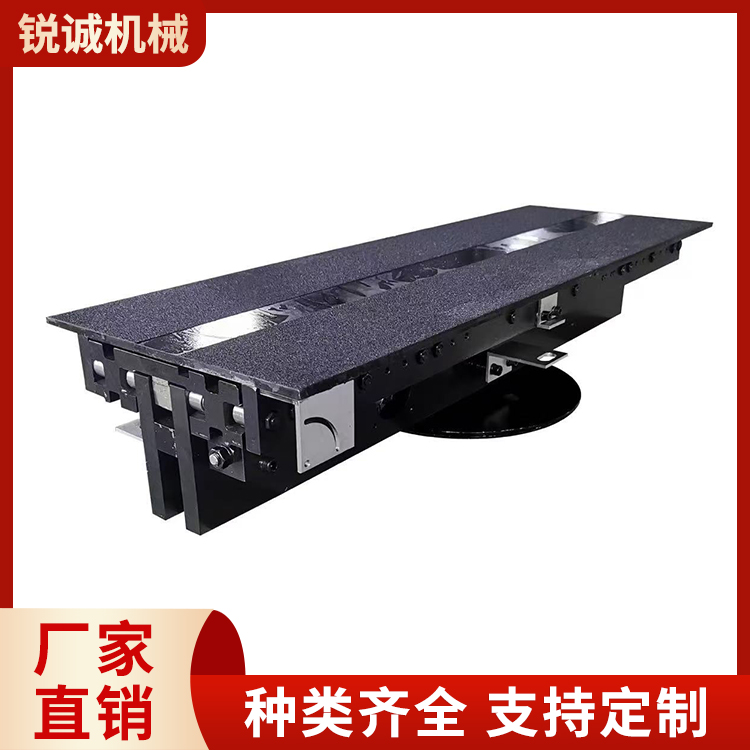
Stacker Forks with Extendable Forks, Automatic Extendable...

In the field of industrial material handling, high speed and high stability of telescopic forks are not opposing goals, but rather a collaborative breakthrough achieved through multidimensional technological innovation. The following explores the key pathways to achieving both, from four core dimensions: mechanical design, drive systems, intelligent control, and material application, combining cutting-edge industry technology and real-world case studies.
Revolutionary Breakthrough in Mechanical Structure
Multi-level telescopic and dynamic balance design
Modern telescopic forks commonly employ a four-section double-deep structure (such as Mia's 30-ton forklift), controlling the self-weight deflection within ±1.5mm during the 1800mm extension by a pre-curved design (arm body preset with an upward arc) and combined with auxiliary support wheels. Additionally, the three-stage hydraulic cushioning system (like Anhui Jiewei intelligent fork) can keep the load offset during an emergency stop within 5cm, with a dynamic load-bearing capacity of up to 8 tons.
2. Helical double-tooth differential drive technology
A lightweight forklift uses oblique double-tooth differential transmission (Patent No.: 202411351855), which simultaneously engages the left and right oblique teeth of the lower and upper forks with rolling oblique gears, achieving high-speed extension and retraction at twice the differential speed. The transmission impact is reduced by 60% compared to traditional gear racks, while also counteracting axial force, extending the guide rail lifespan threefold. In an application at a logistics center, this design has reduced the single transfer time from 2 minutes to 45 seconds, with the equipment's MTBF (Mean Time Between Failures) reaching 1800 hours (industry average is 500 hours).
3. Adaptive Leveling Mechanism
An automatic leveling system for forklift trucks (Patent No.: 202411285381) connects the oil chambers of the compensation cylinder and the tilting cylinder in an interlocking manner, automatically adjusting the fork angle during the telescopic arm's lift or lower, achieving ±0.5° leveling accuracy without additional sensors, and reducing the cost of traditional PID feedback control by 40%.
Precision Coordination of Drivetrains and Propulsion Systems
Servo motor and precision screw combination
The high-speed stacker fork (Patent No.: 202221532962) utilizes a reversible servo motor to drive a rotating screw, paired with a displacement-driven block to achieve high-precision motion of the telescopic track bracket. The repeat positioning accuracy reaches ±2mm, offering a 50% speed increase over traditional chain drives and a 15dB noise reduction. In a car parts production line, this fork completes the adjustment of irregular workpieces in 45 seconds and supports adaptive adjustment within a load range of 5%-120%.
2. Dual Closed-loop Synchronization Control
Dual ARM Cortex-M7 processors collaborate to control the dual deep-position transmission system, monitoring both sides' displacement in real-time through encoders. By combining an adaptive PID algorithm, it dynamically compensates for temperature variations (+/- 50℃) and mechanical wear-induced deviations, ensuring synchronization error ≤ 0.5mm (industry average ≤ 2mm) and maintaining a clamping precision retention rate > 99%. In a certain three-dimensional storage project, this technology achieves an efficiency of 132 picks per hour for four double-deep fork lift trucks, processing an average of 900 tons of goods daily.
3. Magnetic Levitation Drive Innovation
The latest generation of forklifts explores magnetic levitation drive technology, utilizing electromagnetic force to suspend the fork body and provide driving power, eliminating mechanical contact wear, reducing operating noise to below 40dB, and cutting energy consumption by 30% compared to traditional solutions. Although still in the laboratory phase, its potential application in clean rooms (such as semiconductor storage) has garnered industry attention.
III. Intelligent Perception and Precision Control System
Multimodal sensor fusion
A deep-slot forklift integrates a 3D ToF camera (accuracy ±1mm), fiber optic stress sensor, and wire encoder to create an environmental perception matrix. In dusty environments, it employs a 1550nm fiber laser radar (interference resistance increased by 10 times), combined with ultrasonic and infrared sensors, achieving ±0.2mm repeatable positioning accuracy, which is three times more reliable than traditional laser radar.
2. Edge Computing and Deep Learning
The real-time correction system utilizes a two-tier algorithm (primary filtering point cloud data and secondary calculating compensation values) to dynamically adjust the fork posture within a 50cm travel of the AGV, enhancing the picking accuracy from ±5mm to ±1mm. Equipped with an edge computing module, it achieves localized path planning with a response time of less than 10ms.
3. Human-Machine Collaborative Control
The capacitive 3D force feedback gloves (such as a single-finger dual-deep fork) support thumb sliding for ±0.3mm level of fine control, improving operational efficiency by 200% compared to traditional handle operation. Operators can feel the fork's load status through haptic feedback in real-time, significantly reducing the risk of human error.
Section IV: Breakthroughs in Materials and Manufacturing Techniques
Lightweight composite materials
Utilizing a carbon fiber-aluminum alloy hybrid structure (such as a food-grade fork), the weight is reduced by 40%, with a tensile strength of up to 1.2 GPa. It also features a food-grade 304 stainless steel interior and polyurethane insulation, enabling stable operation in a wide temperature range of -25℃ to 60℃, and has passed FDA certification. In a dairy product cold storage facility, this fork handles thousands of tons of奶粉tubs daily, with a failure rate of less than 0.7%.
2. Surface Reinforcement Technology
The laser cladding tungsten carbide coating (such as Anhui Jiwai's intelligent fork) reduces the wear on the fork surface to less than 0.02mm per 10,000 cycles, with a theoretical lifespan of up to 5 million cycles. During port container operations, the fork experiences less than 1° of cargo movement over a 3cm uneven surface, achieving an energy conversion efficiency of 92%.
3. Smart Lubrication System
Self-lubricating slides and intelligent wear monitoring systems (such as the Miaas fork) extend maintenance cycles from 800 hours to 3,000 hours, while integrating an energy recovery system, reducing continuous operation energy consumption by 41%. In a 1 million square foot automated warehouse, the fork completes over 2,000 cycles per day, increasing equipment utilization by 40%.
V. Industry Practice and Technical Verification
1. Reinforced logistics scenarios
The Miaas 30-ton stacker features a dual-drive structure (4 lifting motors), with a running speed of 210m/min, positioning accuracy of ±5mm, and deflection change under full load of less than 8mm. In non-ferrous metal industry projects, the equipment achieves the retrieval of aluminum coils in high-temperature environments (hundreds of degrees Celsius), with the bearing and lubrication system insulated against heat conduction by special materials to ensure long-term stable operation.
2. Smart Warehouse Upgrade
The Flexibox intelligent bin storage system (Modula) integrates telescopic forks and a central hoist, delivering 180 bins per hour, increasing sorting efficiency by 300% compared to traditional manual methods. With a vertical height of 20 meters and a 70% reduction in floor space, it achieves ±10cm group positioning through 5G+UWB and supports seamless integration with AGVs and collaborative robots.
3. High-Risk Environment Applications
A non-metallic material fork with explosion-proof features (ATEX Zone 1 certified) boasts over 95% non-metallic content and passes the MIL-STD-461G electromagnetic compatibility test, making it suitable for flammable and explosive environments in chemical factories. In the Qinghai-Tibet Railway Logistics Project, its turbocharged hydraulic system maintains its rated performance at an altitude of 3,000 meters and has been mass-applied.
b2b.china9.net © Zhongshang 114 Hebei Network Technology Co., Ltd.Address: Room 6009, Oriental New World Center, No.118 East Zhongshan Road, Qiaoxi District, Shijiazhuang City, Hebei ProvincePlatform Service Hotline: 4006299930