


- AllProduct Category
-
Sludge Aerobic Digestion Equipment
Organic Fertilizer Fermentation Equipment
Organic Fertilizer Equipment
Organic Fertilizer Fermentation Vessel



详情描述
In wastewater treatment, various separation methods are used to remove dissolved, suspended, or colloidal solid matter, with the resulting sludge being referred to as biosolids. The disposal of large amounts of active sludge during urban wastewater treatment has long been a challenging environmental issue. The organic matter content, nitrogen, phosphorus, and potassium nutrients in sludge are often comparable to those in animal and poultry manure, and sometimes even higher. Therefore, it is a valuable nutrient resource. Currently, the primary focus is on domestic wastewater, which contains a high organic matter content and is rich in nitrogen, phosphorus, potassium, active bacteria, and low levels of harmful heavy metals. After fermentation, composting, stabilization, and detoxification, sludge can be fully utilized as an organic fertilizer, thereby avoiding secondary pollution from sludge and effectively converting waste into a resource.
Currently, sludge originates from the excess sludge of wastewater treatment plants. The main sludge treatment technologies include landfilling or incineration. Landfilling occupies a large area and poses a risk of secondary pollution. Incineration consumes high energy, wastes resources by burning organic matter, and increases carbon emissions. However, by subjecting sludge to aerobic fermentation and adding shredded leaves, straw, etc., the sludge's nutritional balance is achieved, reaching the level of fertilizer, and realizing the recycling of waste.
One: Short fermentation cycle, space-saving
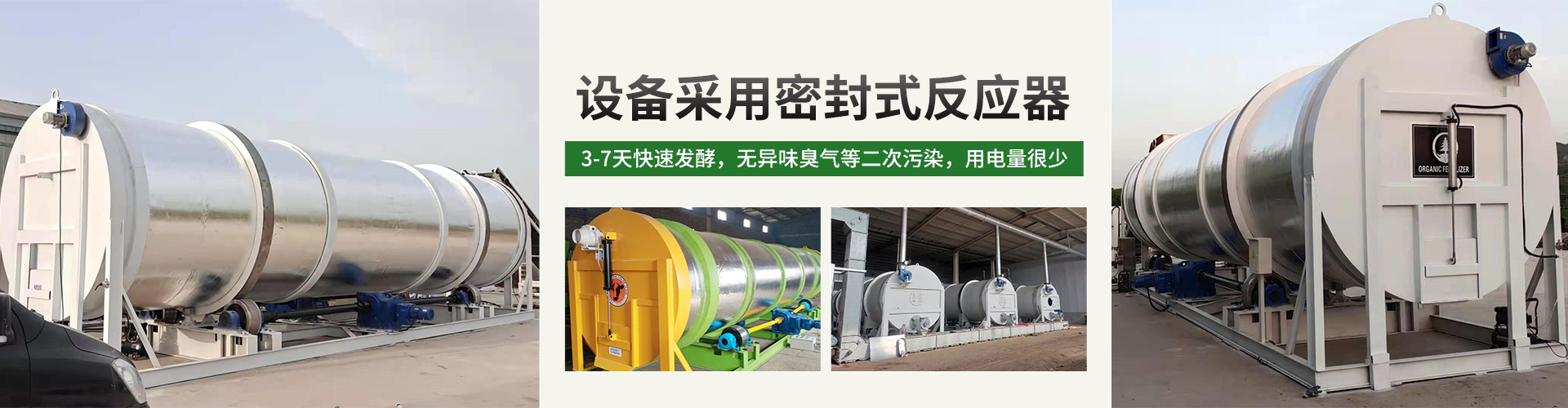
The high-temperature aerobic fermentation process is a dynamic fermentation treatment technology that achieves continuous and dynamic operation of sludge treatment. Compared to the traditional aerobic fermentation treatment model for sludge, it implements a dynamic aerobic fermentation process with continuous feeding and discharge of materials, significantly shortening the fermentation cycle and reducing the space required for material storage. Fermentation can be completed in 7 days. The equipment is compact with minimal space requirements.
Two, the enclosed design fermentation equipment, without odor emitting, utilizes an enclosed fermentation drum and is insulated. The steam and odors produced are directly drawn into the deodorization system by a fan, effectively addressing the issue of strong odor in aerobic sludge fermentation technology.
High yield, compact size
Compared to similar products, higher yield per volume and smaller volume for the same yield.
High degree of mechanization and automation
The fermentation process is fully mechanized, easy to operate, and convenient for maintenance and management.
For a long time, in China, there has been a tendency in wastewater treatment plants, from design to operation, to prioritize water over sludge. Although the effluent quality of wastewater treatment plants meets standards, the treatment and disposal of sludge is largely in a slow development phase. Sludge treatment involves concentrating, dewatering, and subsequent biological activation to stabilize the sludge. Sludge disposal is conducted after the sludge has been reduced in volume and rendered harmless. Chinese urban wastewater treatment plants commonly use mechanical dewatering methods, with the dewatered sludge having a moisture content of generally 75-85%, appearing as a gelatinous, sticky mass. Sludge exhibits "four high" characteristics: high moisture content, high organic matter content, which is prone to decay and produce foul odors; high levels of heavy metals; and high levels of pathogens, including a large number of viruses. Without being treated to be harmless, sludge disposed of arbitrarily or simply buried can easily contaminate air, soil, and water sources, posing a serious threat to human health and the environment. Many countries regard sludge as a "hazardous material," and treating secondary pollution caused by sludge requires a higher cost. Currently, 80% of the sludge produced by China's wastewater treatment plants has not been properly disposed of, and there is an urgent need to develop sludge disposal technologies and facilities of different scales.
With the rapid economic growth and urbanization in our country, cities have produced a large amount of urban organic waste, such as sludge from wastewater treatment plants, domestic garbage, kitchen waste, and garden waste, leading to phenomena like "waste encircling cities" and "random dumping of sludge." An incomplete statistic shows that in 2010 alone, 100 million tons of domestic garbage were generated (including 60 million tons of kitchen waste) and 30 million tons of dewatered sludge. These pollutants contain high levels of organic matter, eggs, pathogenic microorganisms, heavy metals, and others, which, if not properly handled, can cause severe environmental pollution and public health incidents. On the other hand, due to the high content of organic matter and nutrients in these urban pollutants, improper utilization can disrupt the Earth's material cycle system and lead to resource waste. Currently, China commonly uses landfilling, aerobic fermentation, anaerobic digestion, and incineration for the treatment of urban organic waste. Among them, aerobic fermentation technology can fully utilize the high organic matter content and abundant nutrients like N, P, and trace elements necessary for plant growth in the waste. It emphasizes resource recovery while ensuring safety, reduction, and stabilization, and it boasts low technical and economic barriers with a wide application range, drawing increasing attention.
The general process flow for aerobic fermentation of organic waste such as animal feces, kitchen waste, and sludge is as follows:
1) Pretreatment: Mainly adjusts moisture, nutrient ratio, breakage, sorting, and screening, etc.
2) Primary Fermentation: Also known as first fermentation, it involves supplying oxygen to the composting material inside the fermentation unit through forced aeration. Most of the organic matter within the material is decomposed during this stage.
3) Post-fermentation: Also known as secondary fermentation, primarily involves the further decomposition of easily and less easily decomposable organic matter that was not fully broken down during primary fermentation, converting them into more stable organic compounds such as humic acid and amino acids, resulting in a fully mature compost product.
4) Post-treatment: Primarily involves sieving to remove impurities and partially decomposed compost lumps from the compost.
5) Odor Control: Odor is produced during the composting process, which requires treatment of these odors.
6) Storage or Utilization: Store or produce organic fertilizers in a dry, breathable environment.
In the aerobic fermentation (composting) treatment of urban sludge, feces, and organic industrial by-products, it is necessary to use aerobic fermentation (composting) to process organic waste, achieving material harmlessification, reduction, stabilization, and resource utilization. The harmlessification process is achieved through the proliferation of microorganisms in the material, metabolizing organic matter, generating heat, raising the material's temperature to above 55 degrees, and maintaining it for over 5 days to eliminate harmful substances and pathogenic bacteria within the material; reduction is primarily manifested through the degradation of the material by microorganisms and the evaporation of moisture; stabilization refers mainly to the degradation of easily degradable organic matter in the material by microorganisms, and the synthesis of humus; the material treated by aerobic fermentation (composting) can be used for resource utilization, mainly for landscaping, land improvement, and the production of organic fertilizers.
Aerobic fermentation (traditionally known as composting) is the primary method for processing organic solid waste and is widely used domestically and internationally. Traditional aerobic fermentation processes consist of several workshops with different functions, equipped with dozens of mechanical devices. Fermentation materials are stacked on the ground or in reinforced concrete troughs within the fermentation workshops. Oxygen is supplied to the pile through aeration and turning operations, thereby achieving the fermentation treatment process of the materials. Due to the large land area required, numerous mechanical devices, and the need for a significant number of personnel, the project demands a high technical proficiency from operators.
However, for small and medium-sized towns' sludge treatment, medium-scale farming waste management, and industrial organic byproduct processing, etc., applying the traditional large-scale project construction model would lead to uneconomical investment and inconvenient operation and management. To avoid the economic inefficiency of using large-scale project implementation for small and medium-sized projects, integrated aerobic fermentation equipment has emerged in the industry in recent years, with implementation methods mainly including horizontal, tower, and drum types. The operating principle of the horizontal integrated equipment is that the material moves horizontally within the device, with raw fermentation material entering from one end and matured material exiting from the other; the operating principle of the tower integrated equipment is that the material enters from the top and matured material exits from the bottom; the operating principle of the drum integrated equipment is that the material enters from the feeding end, and matured material is discharged from the discharge end through the rotation of the drum.
Composting technology, through high-temperature aerobic fermentation, achieves harmless and reduced treatment of organic waste, while producing organic fertilizer, realizing the resource utilization of fermentation residues, and is an important measure for the agricultural planting and breeding cycle. The existing composting equipment for fermentation residues mainly includes pile, trench, and reactor types. Among them, the reactor-type aerobic fermentation reactor boasts the advantages of ease of operation, high processing efficiency, small land occupation, and wide adaptability, and is gaining more and more widespread application.
询价单


