


- AllProduct Category
-
Sludge Aerobic Digestion Equipment
Organic Fertilizer Fermentation Equipment
Organic Fertilizer Equipment
Organic Fertilizer Fermentation Vessel



详情描述
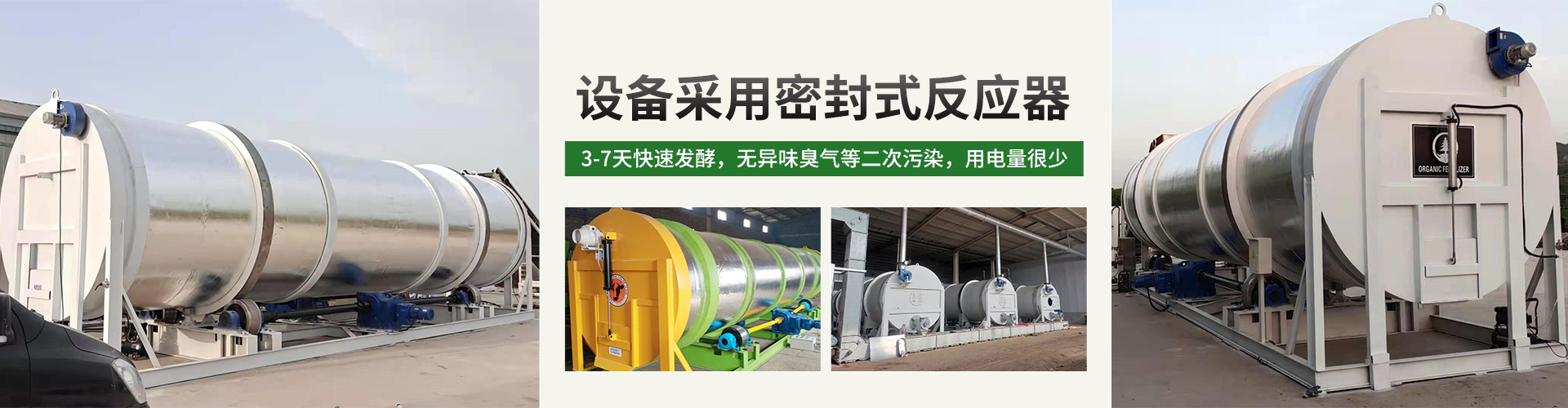
Anaerobic fermentation utilizes microorganisms to degrade organic matter, achieving reduction, innocuity, and resourceful treatment of organic waste. Currently, the widely-used composting technology has drawbacks such as large land occupation, long fermentation time, and decreased fermentation speed in cold weather. Although efficiency or effect of aerobic composting is enhanced through means like forced aeration, turning, or stirring during composting, the heat and odors generated during fermentation are emitted into the atmosphere, causing environmental pollution. The equipmentized Dano drum aerobic fermentation reactor features high fermentation efficiency and less land area usage compared to on-site fermentation.
Large quantities of untreated sludge are being disposed of and emitted at will, not only wasting the useful nutrients within the sludge but also causing new environmental pollution. Therefore, how to scientifically treat the large amounts and complex compositions of sludge to reduce, render harmless, resourceify, and stabilize it has become one of the topics of concern in our country. Sludge utilization in agriculture requires low investment, energy consumption, and operating costs, and some components can be converted into soil conditioner ingredients, making sludge agriculture a disposal method with significant development potential. However, the composition of sludge is extremely complex, containing not only abundant organic matter and trace elements essential for plant growth but also a large number of pathogenic bacteria, (eggs), heavy metals like copper, zinc, chromium, and mercury, salts, and highly toxic and difficult-to-degrade substances such as dioxins and radioactive nuclides. Direct agricultural use poses a significant risk, and sludge must be thoroughly treated to be harmless before it can be used in agriculture. Therefore, an urgently needed novel and scientific aerobic composting treatment system for sludge is required to provide a technical model for the rational and effective utilization of regional sludge and establish an effective approach for the disposal and use of urban sludge.
Common household and industrial waste, such as animal excrement, kitchen waste, sludge, etc., is typically processed through high-temperature aerobic fermentation, usually in the form of windrow compost piles or fermentation tanks (tanks). In traditional technology, materials are left to settle or are assisted with turning operations, and oxygen is supplied to the fermentation system through natural ventilation or forced ventilation. During the composting process, turning operations are usually fixed or shifting, with the latter involving moving materials a few meters towards the discharge direction within the designated fermentation area or tank with each turn, and filling the space with fresh material. The displaced material is then transported out using loaders or辅助 by conveying equipment (usually conveyor belts). In fixed or non-turning composting processes, the fermented material must be emptied from the fermentation area or tank, and then new material is placed. Although the aforementioned methods are relatively simple to implement in industry, they do have the following issues:
1. Due to the traditional aerobic fermentation process using a semi-batch operation, each batch of material undergoes a microbial culture process, resulting in longer processing time, higher workload, and significant material handling within the facility.
2. Insufficient thermal insulation and breathability; traditional processing methods directly expose materials to the atmosphere, leading to rapid heat dissipation and unfavorable temperature retention. To enhance processing capacity per unit area, materials are often stacked higher and more densely. However, due to the material's self-compaction, especially for materials with high moisture content, increased stacking height results in poor breathability and increased ventilation resistance, causing insufficient oxygen supply, severe odors, and prolonged dwell times that degrade processing capacity.
3. During high moisture content of materials and the initial fermentation stage, traditional turning operations can actually make the materials denser under mechanical force, thereby affecting processing capacity.
For a long time, in China, there has been a tendency in wastewater treatment plants, from design to operation, to prioritize water over sludge. Although the effluent quality of wastewater treatment plants meets standards, the treatment and disposal of sludge is largely in a slow development phase. Sludge treatment involves concentrating, dewatering, and subsequent biological activation to stabilize the sludge. Sludge disposal is carried out after the sludge has been reduced in volume and rendered harmless. Chinese urban wastewater treatment plants commonly use mechanical methods for sludge dewatering, with the moisture content of the dewatered sludge typically ranging from 75% to 85%, appearing as a gelatinous, sticky mass. Sludge has "four high" characteristics: high moisture content, high organic matter content, which is prone to rot and produce恶臭; high levels of heavy metals; and high levels of pathogens, including a large number of viruses. Without being treated to be harmless, sludge disposed of arbitrarily or simply buried can easily pollute the air, soil, and water sources, posing a severe threat to human health and the environment. Many countries consider sludge as a "hazardous material," and treating secondary pollution caused by sludge requires a higher cost. Currently, 80% of the sludge produced by China's wastewater treatment plants has not been properly disposed of, and there is an urgent need to develop sludge disposal technologies and facilities of various scales.
Anaerobic digestion of sludge is a biological process that utilizes microbial action to controlledly promote the conversion of biodegradable organic matter into stable humus-like substances. This involves adding a certain proportion of bulking agents and conditioners (such as straw, rice husks, wood chips, or garden waste, etc.) to sludge to enable microbial communities to oxidize and decompose a variety of organic matter under moist conditions and convert them into humus-like substances. The aerobic digestion process of sludge can effectively kill pathogens, eggs, and weed seeds, and facilitate the evaporation of moisture, achieving stabilization, reduction, and harmless treatment of sludge. Furthermore, sludge treated through aerobic digestion becomes loose, with significantly increased cation exchange capacity, reduced bulk density, and increased nutrients available for plant utilization. China's research and application of aerobic digestion of sludge started late, and has mainly focused on forced aeration tank static aerobic digestion, with limited research on dynamic aerobic digestion methods and continuous, automated production equipment. The main issues with the existing widely-used tank static aerobic digestion technology include: (1) Large land area requirement, making it difficult for wastewater treatment plants to provide additional land for sludge treatment facilities expansion; (2) Poor airtightness of treatment facilities, resulting in severe odor emission, environmental pollution, and severe corrosion of surrounding equipment; (3) Numerous equipment required for operations like spreading, moving, turning, aeration, etc., leading to high investment and operational costs; (4) Inability to operate automatically, resulting in poor continuous production capacity; (5) Low fermentation temperature, long cycle, and incomplete killing of pathogens; (6) Poor on-site environment, posing serious threats to the occupational health of employees.
Commercial aerobic compost reactors are primarily categorized based on ventilation methods, presence of agitation, and structural features into passive ventilation reactors, forced ventilation non-agitated reactors, forced ventilation agitated reactors, and drum reactors. Passive ventilation utilizes the difference in oxygen concentration and temperature between the compost mass and the external environment, relying on wind action to diffuse external air into the mass. A significant issue with passive ventilation reactors is the inability to effectively control changes in ventilation volume. Forced ventilation non-agitated reactors do not turn or agitate the material during the composting process, instead providing oxygen to the mass through forced ventilation. Forced ventilation agitated reactors are similar to forced ventilation non-agitated reactors but differ in that they have agitation capabilities, allowing for thorough contact between the material and air during the composting process, reducing temperature and oxygen concentration differences, and leading to more complete reactions. Drum reactors have a horizontal or slightly inclined axis, and through the rotation of the drum, the material is repeatedly agitated (picking up and dropping), to achieve uniform temperature and moisture distribution in the material, and to ensure that the material has sufficient contact with oxygen, which is beneficial for aerobic composting.
询价单


