Main Products: Refrigerated Storage, Fresh-Keeping Cold S...

What is a Fruit and Vegetable Fresh-keeping Cold Storage?
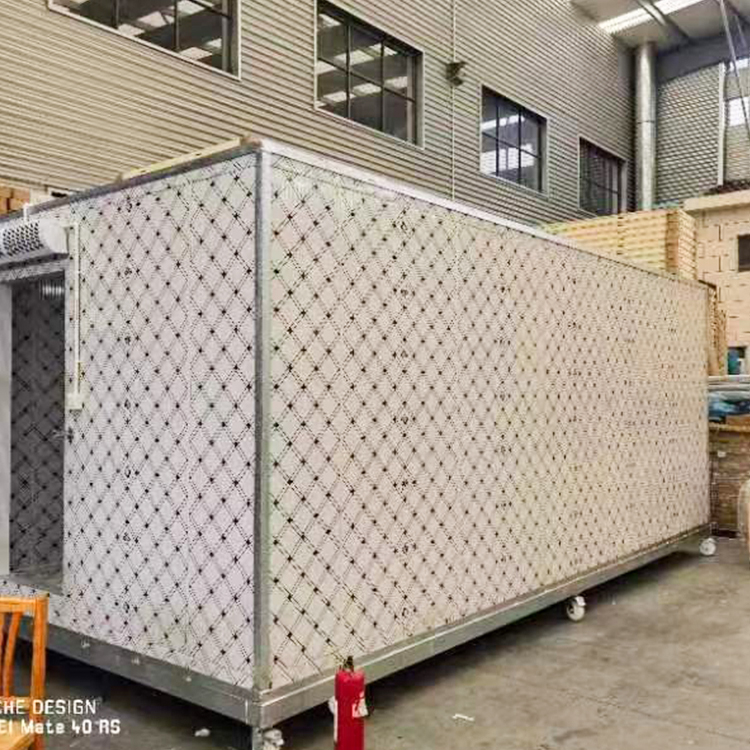
Vegetable and Fruit Cold Storage is a facility designed for the refrigeration and preservation of fruits and vegetables. Typically, it achieves a certain low temperature indoors through manual refrigeration methods. Insulation materials of a certain thickness are applied to the walls, floors, and flat roofs of the cold storage to reduce the heat transmitted from the outside. To minimize solar radiation, the exterior walls of most Nanjing cold storage facilities are painted white or in lighter shades. Therefore, cold storage buildings generally differ from residential buildings.
Such cold storage facilities must also possess excellent sealing and moisture-proof properties. If outdoor air infiltrates, it not only increases the cold storage's energy consumption but also introduces moisture. The condensation of moisture can lead to damp and frozen damage to the building structure, particularly the insulation.
The floor of the cold storage not only requires an insulating layer but also treatment beneath it to prevent soil freezing. The foundation of the cold storage, affected by low temperatures, causes moisture in the soil to freeze easily. This frozen soil expands, potentially leading to ground cracking and deformation of the regular building structure. In severe cases, it may render the cold storage unusable.
Building materials for cold storage facilities must also possess sufficient frost resistance. Since cold storage is consistently exposed to low temperatures, during the cyclic freeze-thaw cycles, the building structure can be easily damaged if it lacks adequate frost resistance.
Poorly designed cold storage can affect the normal operation of the cold storage.
The issue of rational configuration for the evaporator and refrigeration unit of modular cold storage equipment.
The evaporator evaporative area configuration of the modular cold storage equipment is not reasonable.
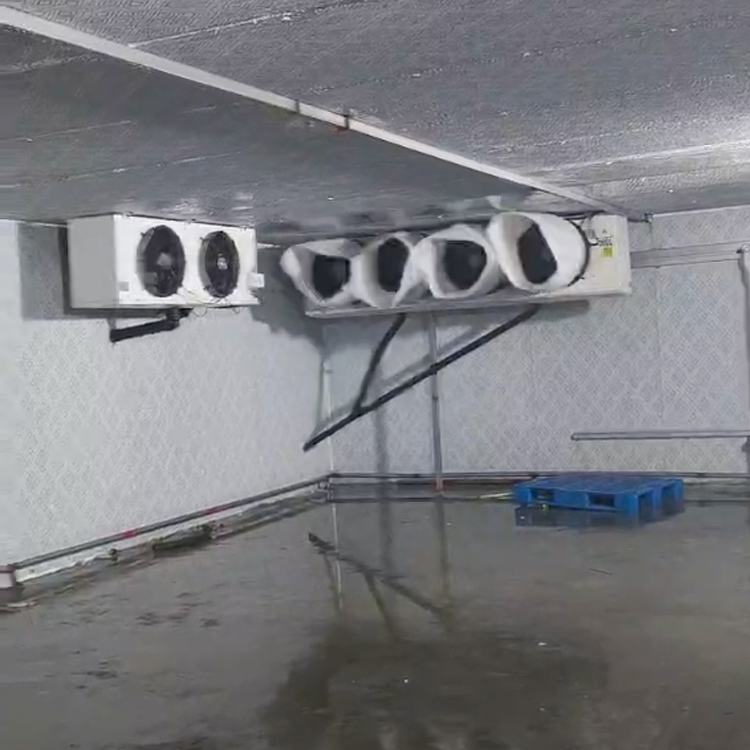
The evaporative area of the evaporator in modular cold storage units significantly deviates from the actual refrigeration process technical requirements. Field observations of some modular cold storage units reveal that their evaporative area is only about 75% of the recommended configuration. We understand that the configuration of evaporators in modular cold storage units should be based on the design temperature requirements, calculating various heat loads to determine the evaporative area, and then configuring according to the refrigeration process requirements. Blindly reducing the evaporative area without reasonable configuration according to design specifications will lead to a significant decrease in the refrigeration coefficient per unit area of the modular cold storage evaporators, increased refrigeration loads, and a marked drop in energy efficiency ratio. This results in slow temperature drop inside the modular cold storage, rising operating coefficients of the refrigeration units, and increased operational costs, among other adverse factors. Therefore, when selecting evaporators for modular cold storage, the area should be configured based on the optimal heat transfer temperature difference.
The refrigeration unit configuration of the cold storage equipment for the event is not reasonable.
Some manufacturers have configured the refrigeration units for their modular cold storage facilities without adequately considering the total refrigeration load calculated for the storage and the insulation thickness of the modular cold storage's envelope. Instead, they meet the requirement for rapid cooling within the storage by simply increasing the number of refrigeration units. Taking the BZL-3×4 mobile cold storage as an example, it measures 4 meters in length, 3 meters in width, and 2.7 meters in height, with a net volume of 28.723 cubic meters. It is equipped with two 2F6.3 series refrigeration units and two separate serpentine tube evaporators, each unit paired with a dedicated evaporator to form a complete refrigeration system. Estimation and analysis of the machine load for the refrigerated storage indicate that the machine load for this mobile cold storage is approximately 140 (W/m3), with an actual total load of 4021.22 (W) (3458.25 kcal). Based on these figures, one 2F6.3 series refrigeration unit (standard cooling capacity of 4000 kcal/h) is sufficient to meet the refrigeration process requirements of the mobile cold storage (achievable temperatures of -15℃ to -18℃). Therefore, adding an extra refrigeration unit to this storage is unnecessary and would also increase maintenance costs for the units.
How to achieve the best results for energy-saving cold storage that meet customers' needs?
We provide an initial estimate of the construction cost based on the type and size required. If the client has high demands, we typically offer several sets of plans for their selection to better align with and meet their needs. In addition to the costs incurred during construction, the energy consumption of the cold storage during its later operation is a major concern for clients. So, what needs to be done during the construction of a cold storage to achieve optimal energy-saving effects?
Firstly, cold storage builders should engage in comprehensive communication with clients to understand the requirements for the products that need to be stored in terms of temperature and the amount of storage space required. Knowing the temperature requirements of the goods to be stored is a necessary condition for determining the type of refrigeration equipment to purchase. If the storage requirements call for ultra-low temperatures, buying specialized refrigeration equipment can solve the problem with low energy consumption. Understanding the quantity of goods to be stored is to determine the size of the cold storage facility. If the quantity of goods to be stored is not particularly high but the storage facility is oversized, it means more energy will be needed to maintain a stable low-temperature environment inside the cold storage.
Then, the construction materials used in the cold storage building should also be of great concern, focusing on insulation materials with good thermal performance. Once the refrigeration equipment lowers the temperature inside the cold storage to an appropriate range, the insulation materials play a crucial role in maintaining the low temperature. The better the thermal insulation performance, the less energy is required to maintain the indoor temperature, significantly reducing the customer's energy consumption costs.
Secondly, the scientific optimization of refrigeration equipment is crucial for reducing energy consumption. Kuhua Refrigeration selects the most optimized combination scheme during the design, installation, and debugging of refrigeration equipment, ensuring that all devices operate in the best state to collectively maintain the low-temperature environment of cold storage. It's clear that only when refrigeration equipment operates at its best can the most energy-efficient mode be achieved, allowing customers to achieve the best product quality with the lowest energy consumption.
Understanding customer needs, selecting high-quality insulation materials, and optimizing the combination of refrigeration equipment are common methods to reduce energy consumption during the construction of most cold storage facilities. However, some customers have unique storage requirements or construction locations, aiming to achieve the best energy-saving effect while meeting their specific needs.
What are the key factors required to build a low-temperature cold storage facility?
The construction of cold storage facilities will have a more pronounced impact on the vegetable and fruit industry. Why is that? Because these cold storage units offer excellent storage quality, long lifespan, and importantly, they have spacious areas with adjustable temperatures and are not limited to single functions. Many people may ask, while these cold storage constructions have a certain application in most industries, they are even more crucial in places like South Korea, the United States, or Japan, where the demand is greater!
Construction of ultra-low temperature cold storage facilities is generally required for storing precious seafood products, such as tuna. A cold storage with ultra-low temperatures is necessary to ensure the quality of the tuna. Cold storage construction
To prevent the spread of steam and air infiltration, when outdoor air intrudes, it brings moisture into the storage room, leading to condensation that causes damage to the building structure, particularly the insulation, due to dampening and freezing.
2. The ultra-low temperature cold storage facility must maintain specific low temperatures, such as -60℃ for tuna storage. The cold storage must be equipped with moisture-proof and insulating layers to ensure the building has good airtightness and moisture-proof properties.
3. To minimize the absorption of solar radiation by the warehouse, the exterior surface of cold storage facilities is typically coated in white or light colors.
4. When selecting the foundation structure for the construction of ultra-low temperature cold storage, it should be robust and capable of bearing significant loads, as it needs to accommodate large quantities of goods and facilitate the passage of various loading and unloading transportation equipment.
5. Ultra-low temperature cold storage buildings are guaranteed in quality by their strict thermal insulation, sealing, strength, and frost resistance.
6. Our specialized cold storage construction team designs and builds professional ultra-low temperature cold storage floors. In addition to an effective insulation layer, the layer underneath must be treated to prevent soil freezing, ensuring the quality of stored items is preserved.
7. The construction materials and components of a cold storage facility must possess adequate frost-resistant properties. The requirements for constructing ultra-low temperature cold storage facilities necessitate understanding that the price of a cold storage unit is directly related to its temperature requirements, size, and the materials used. Larger cold storage units with lower temperature demands come with higher construction costs.


b2b.china9.net © Zhongshang 114 Hebei Network Technology Co., Ltd.Address: Room 6009, Oriental New World Center, No.118 East Zhongshan Road, Qiaoxi District, Shijiazhuang City, Hebei ProvincePlatform Service Hotline: 4006299930