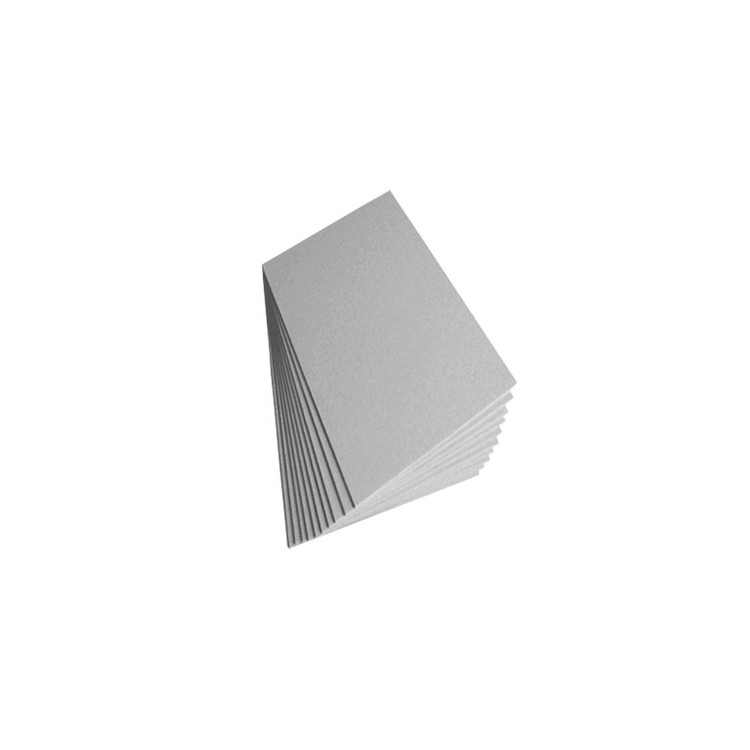
Low grammage dual gray board paper

Grey cardboard is made from recycled waste paper. The products are categorized into single grey, double grey, and full grey, and are considered environmentally friendly packaging materials. Main applications include packaging boxes, advertising boards, folders, picture frame backs, bags, high-quality books, storage boxes, samples, backers, dividers, etc.
Characteristics of Paper
1. Quantitative
It refers to the weight per unit area of paper, indicated as g/m2, meaning the weight in grams of a square meter of paper. The quantity of paper determines its physical properties, such as tensile strength, tear resistance, tightness, stiffness, and thickness. Therefore, arranging the production of printing items with quantities and properties corresponding to the equipment characteristics is essential to better reduce consumption and improve product quality and equipment efficiency.
2. Thickness
It is the thickness of the paper, usually measured in millimeters. The thickness is closely related to the basis weight and density; generally speaking, thicker paper has a higher basis weight. Some papers may be thin but have a basis weight equal to or greater than thicker ones. This indicates that the tightness of the paper's fiber structure determines its basis weight and thickness. From the perspective of usage effectiveness, having consistent and uniform paper thickness is crucial. Otherwise, it can affect automatic paper feeding and glue application consistency.
3. Tensile strength
It refers to the weight of paper per cubic centimeter, measured in g/cm³. The compactness of the paper is calculated based on the grammage and thickness using the following formula: D = G/d * 1000, where: G represents the grammage of the paper; d is the thickness of the paper.
Tightness is a measure of the degree to which the paper structure is dense. If the tightness is too high, the paper tends to crack easily, and its opacity and water absorbency will significantly decrease, making it difficult to dry.
The cardboard thickness can also be easily calculated based on the above formula. The formula is: d = G/D.
Seek thickness of 500g/m2 double gray cardboard (with a density tabulation of 0.625g/cm3, which is also our standard specification). 500g/m2 ÷ 0.625g/cm3 = 0.0008m = 0.8mm.
The unit conversion from the previously mentioned m2 and cm3, remember to do so, as it can easily lead to misunderstandings. The method is: cm3/m2 = (1 * 0.000001)m, which converts to our actual thickness in mm.
4. Stiffness
It indicates the paper's ability to resist indentation by another object, as well as the coarseness and hardness of its fiber structure.
5. Smoothness
It refers to the degree of convexity on the paper surface, measured in seconds and is quantifiable. The testing principle is: the time taken for a certain solvent's air to pass through the gap between the glass plate and the sample surface under specific vacuum and pressure conditions. The smoother the paper surface, the slower the air passes through, and conversely, the faster the air passes through.
6. Elasticity
It refers to the dimensional variation of paper after moisture absorption or water dispersion. The softer and looser the paper's fiber structure, the higher its elongation rate; conversely, the lower the elongation rate.
7. Moisture content
Moisture content of the cardboard. Generally, it is standardized. The moisture content of double gray cardboard is 8-12%.
8. Longitudinal and transverse
It refers to the direction in which the paper fiber tissues are arranged. During the papermaking process, the fibers that run along the direction of the paper machine are known as the paper's longitudinal direction. It can be identified from the acute angle presented by the wire mark. Perpendicular to the longitudinal direction is the transverse direction. The longitudinal paper grain has a smaller deformation value, while the transverse paper grain experiences a larger variation in elongation and contraction during use.
9. Breathability
Generally speaking, the thinner and less dense the paper, the greater its breathability. The unit of breathability is ml/min (milliliters per minute) or s/100ml (seconds per 100 milliliters), indicating the amount of air passing through the paper surface in one minute or the time required to pass through 100 milliliters of air.
10. Front and back
During papermaking, the pulp adheres to the steel wire mesh to be fixed by filtering and dewatering. Consequently, if the fine fibers and fillers are washed away with the water on one side of the mesh, it leaves a mesh mark, resulting in a coarser paper surface. The other side, not contacting the mesh, is finer and smoother. This creates a difference in the front and back of the paper, even after drying and calendaring during production.
 Punched Paper
 Greyboard
 Kraft paper

 Newsprint
 White Cardboard
 Garment Tag Paper