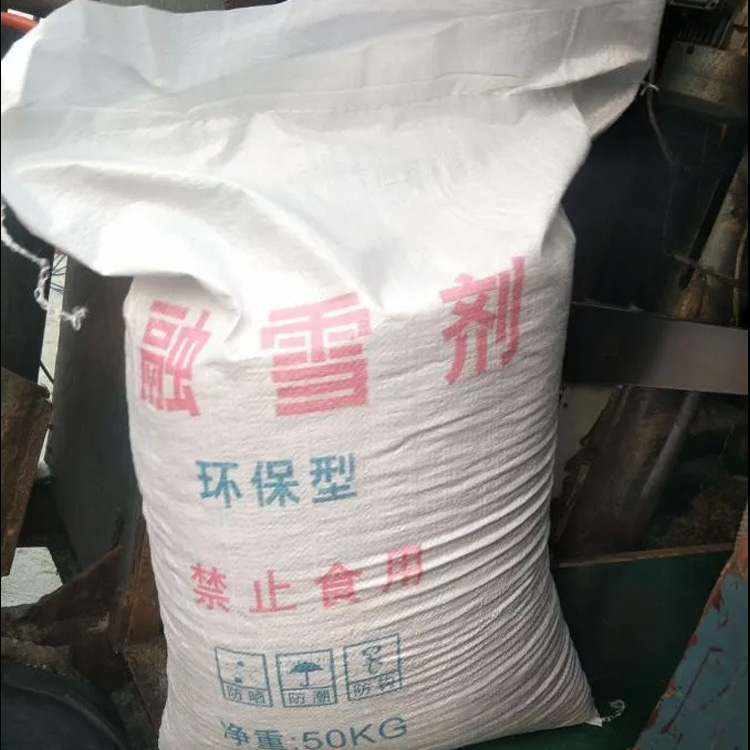
Ice Melter, Baking Soda, Soda Ash, Calcium Chloride, Magn...

Calcium chloride should be familiar to us, as it often appears in our daily lives, commonly found as a desiccant in our snack bags. Moreover, it is also present in modern industries and other applications. Besides that, there are many lesser-known uses, such as:
Calcium chloride hexahydrate, in its solid form, can be utilized as a phase change energy storage material. For instance, calcium chloride dihydrate, with a melting point of 30°C and a melting enthalpy of 190 KJ/mol, is suitable for low to medium-temperature industrial waste heat recovery and the absorption of solar radiant heat. However, like all inorganic hydrated salt phase change materials, it faces a significant problem of supercooling (reaching 20°C), which requires the addition of a nucleating agent to overcome.
Calcium chloride aids in accelerating the initial setting of concrete, but it can cause corrosion of steel reinforcement, hence it is not suitable for reinforced concrete structures. Anhydrous calcium chloride can provide a certain amount of moisture to concrete due to its hygroscopic properties.
Calcium chloride is also an additive in plastics and fire extinguishers, serving as a filter aid in wastewater treatment, and as an additive in blast furnaces to control the aggregation and adhesion of raw materials, thus preventing the settling of furnace charge. It acts as a diluent in fabric softeners.
Calcium chloride's exothermic property when dissolved makes it suitable for use in self-heating cans and heat pads.
5. In the petroleum industry, calcium chloride is used to increase the density of anhydrous brine and can also be added to the aqueous phase of emulsion drilling fluids to inhibit clay swelling. As a flux, it plays a role in lowering the melting point during the Davy process electrolysis of molten sodium chloride to produce metallic sodium. Calcium chloride is also used as an ingredient in making ceramics, as it keeps clay particles suspended in solution, making it easier to use clay particles during the casting process.
Editor's Reminder: When handling calcium chloride, never inhale or ingest the dust. The dust can burn and irritate the nose, mouth, and throat, potentially causing nosebleeds and damaging nasal tissue. Dry powder can irritate the skin, while the solution can severely irritate or even burn the skin.


b2b.china9.net © Zhongshang 114 Hebei Network Technology Co., Ltd.Address: Room 6009, Oriental New World Center, No.118 East Zhongshan Road, Qiaoxi District, Shijiazhuang City, Hebei ProvincePlatform Service Hotline: 4006299930