




Technical Features:
The central station can be activated without complex system configuration. Once powered on at the site, it automatically forms a network and can establish communication in "seconds."
Any topology, multi-hop relay, relay forwarding
Flexible configuration of logical properties for each node.
Currently, the same-frequency networking supports interconnection among 1024 nodes.
The channel employs AES encryption.
System data bandwidth peak is 32Mbps.
Equipment Technical Specifications:
1) Technical Advantages and Features
Long transmission distance: Utilizing COFDM modulation, space-time coding, and diversity techniques, the receiving sensitivity reaches -104dBm. Under a 2W transmission power, line-of-sight communication between ground and air or air-to-air can reach up to 40km, while ground-to-ground line-of-sight communication can reach 20km. It also offers good multipath interference resistance and strong diffraction capability in non-line-of-sight environments.
High transmission rate: Utilizes adaptive modulation techniques such as BPSK/QPSK/16QAM/64QAM and diversity reception, achieving a peak rate of up to 32Mbps, suitable for high-volume multi-hop transmission.
Large network scale: channel resources dynamically allocated, capable of supporting 1024 nodes for networking in actual testing.
High number of relay hops: Data relay hops can reach up to 16, expanding network coverage and enhancing applicability of network applications.
Software Architecture: A decentralized, distributed wireless ad-hoc network based on the IP framework.
l Multi-path Interference Resistance: The TDD-COFDM multi-carrier modulation boasts strong resistance to multi-path interference.
L Diffraction Capability: Strong diffraction and penetration capabilities.
Dynamic Routing: Layer 2 Intelligent Routing Protocol
Flexibility: High scalability, with nodes capable of dynamic addition and removal.
Mobility: The tested node mobility rate is ≥ 4000 km/h.
L Self-healing and Destructive Resistance: Individual terminal damage will not affect the normal operation of the network, demonstrating strong resistance to destruction.
Operation Modes: Star Network, Chain Network, Point-to-Point, Point-to-Multipoint, Multipoint-to-Multipoint
IP Transparent Transmission: Supports network port to network port, network port to serial port, and serial port to serial port IP transparent transmission.
Internet Expansion: Effectively extends the coverage of the internet, where any terminal within the network can serve as a gateway, allowing all network nodes to access the internet through gateway nodes.
Map display: Supports map location display under external GPS/BD conditions.
Configuration Management: Allows setting parameters such as radio channels, bandwidth, power, speed, IP, and keys.
Status Display: Dynamically shows network topology, link quality, signal strength, environmental noise floor, etc.
Performance Parameters:
Network Scale: Single frequency supports 1024 nodes.
Communication Frequency: 1415~1465MHz (2.3G/4G), adjustable in 1MHz steps.
Transmission Power: 2 x 30 dBm (2 x 1W), adjustable in 1 dBm steps.
Bandwidth Mode: 4/8 MHz
Modulation Method: Multi-carrier TDD-COFDM
Carrier Modulation: BPSK/QPSK/16QAM/64QAM (Adaptive or Fixed)
Reception Sensitivity: -110 dBm @ 1 MHz
Transmission Latency: Approximately 2ms per hop.
Startup Time: Point-to-point, Point-to-multipoint ≤ 5S (AD-Hoc startup time 25S)
L Time to Connect: Less than 1 second
Routing Switch: Less than 1 second.
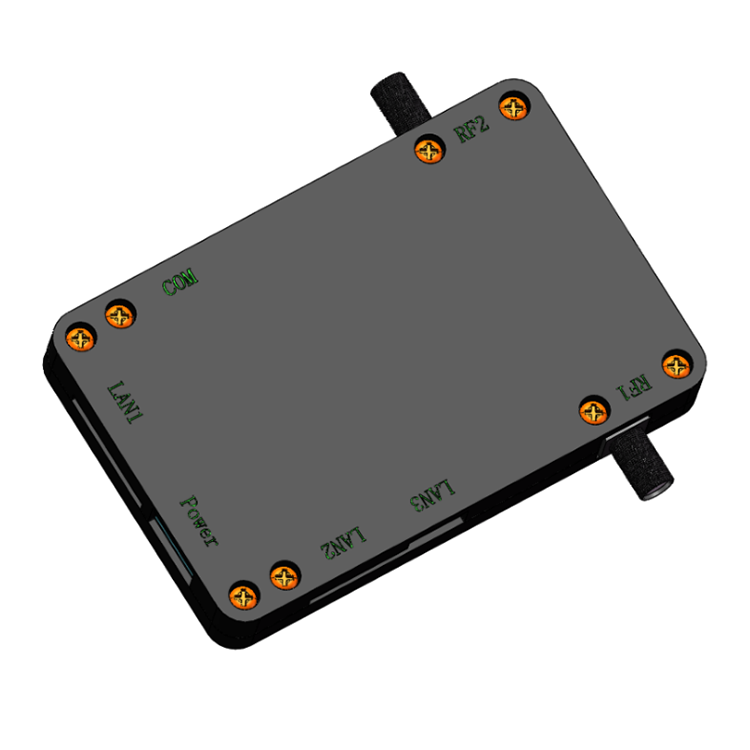
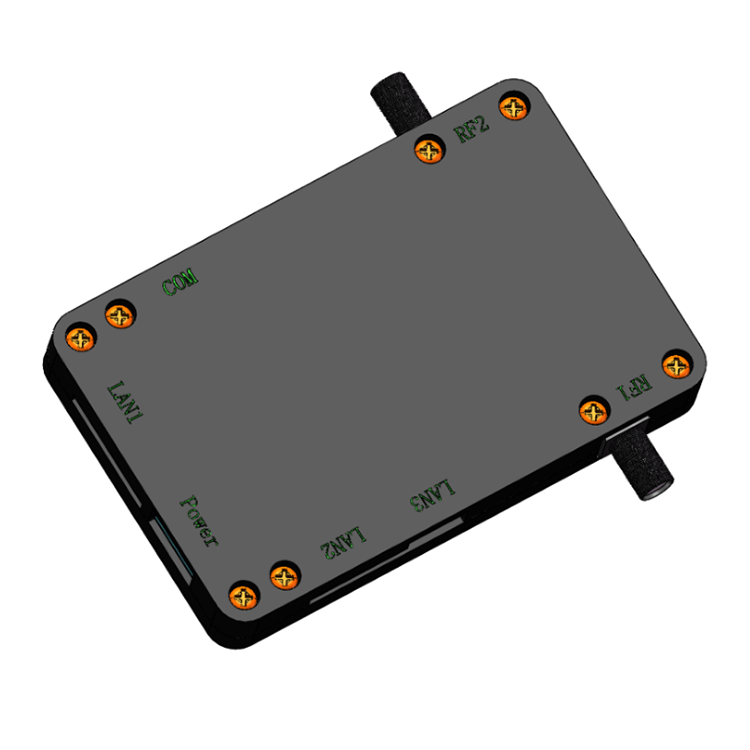
Data Interface: Network port x 2, RS232 x 2
Battery-powered: 12V/1A
Overall power consumption: 6~12W, standby 6W, receiving 8W, full load sending 12W.
Protection Level: IP65
Operating Temperature: -40~+70℃
Dimensions: Length: 73mm x Width: 47mm x Height: 10mm
