




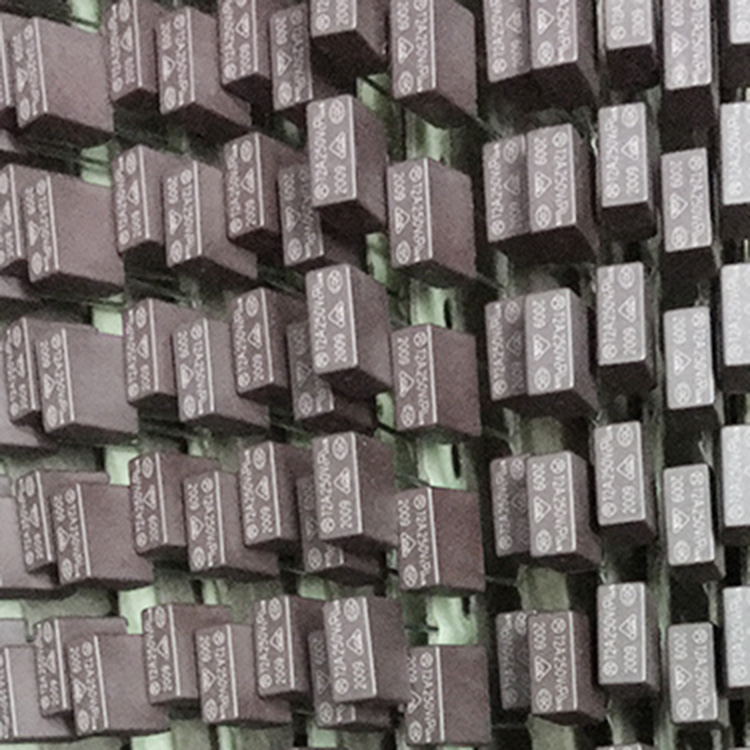


A Brief Overview of Fuse Resistance Detection and Repair
Fuses have the function of a normal resistor under normal conditions. Once a circuit fault occurs and exceeds its rated power, it will break the circuit within the specified time, thereby protecting other components. Fuse resistors are divided into two types: non-repairable and repairable.
Fusible resistor, also known as a fuse resistor, is widely used in electrical appliances such as televisions, VCRs, CD and VCD players, as well as instruments and meters. It serves dual functions in a circuit: as a resistor under normal conditions, and as a fuse when the circuit malfunctions (e.g., exceeds the protected circuit's rated load). The fusible material on the resistor body reacts with the resistive film layer (the reaction time is measured in seconds), causing the film layer to break, significantly or infinitely increasing the resistance of the fuse resistor, thereby protecting the related components in the circuit from damage. There is no unified standard for the circuit symbol and packaging of fusible resistors at present.
Insulation Resistance Test Method for Fuses
1. Appearance is inspected by visual means under normal lighting conditions.
2. The outer dimensions of the resistor are inspected using a caliper with an accuracy of 0.02mm under normal lighting conditions.
3. Electrical parameters are measured using the "YD2810D Type LCR Digital Bridge" at a frequency of 1KHz. High-temperature testing involves placing the component under test in an electric heating constant-temperature鼓风干燥箱 at 130°C for 5 minutes before measurement.
4. Electrical performance: Use a "shock test bench (self-made, with insurance resistor)" to undergo 30 consecutive shocks at room temperature, followed by a short-circuit melting test.
5. After three wipes with alcohol-soaked cotton on the resistor surface印记 should still be clearly legible.

6. Bend Resistance of Leads: Clamp the middle of any lead of the resistor with a pair of tweezers, bend it 90°, then straighten it out. This counts as one bend. The requirement is for three bends to be performed in the same plane and in the same direction, without any breakage occurring.
7. Weldability shall be tested in accordance with the welding test specifications and should comply with the requirements of 5.2.1.
How to deal with a blown fuse's resistor damage?
Once the fuse resistor is found to be burned, the original cause of the fuse resistor burn should be investigated first. Blind replacement is strictly prohibited, and ordinary resistors should not be used as substitutes. If there are no fuse resistors of the same specification available, an emergency substitute can be made using the following method.
1. Substituting a resistor and a fuse (or fuse wire) in series, the resistance value and power of the resistor should match the specifications of the fuse resistor. For instance, if the original fuse resistor is specified as 10Ω, 2W, then a resistor with 10Ω/2W specifications can be used. The rated current of the fuse, I, can be calculated using the formula I^2 * R = 56% * P, where R is the resistance value (Ω) and P is the rated power (w). In this case, the rated current should be 0.3A.
2. In the event of a blown fuse resistor with a lower resistance value, a fuse can be directly substituted. This method is suitable for fuse resistors below 1Ω, with the melting current value of the fuse calculated using the aforementioned formula based on the original fuse resistor.
3. Substituting Small Electric Beads: Small electric beads have a certain resistance value. When the current increases to a certain level, their filament will light up or burn out. Leveraging this characteristic, they can effectively replace fuse resistors. The cold resistance of commonly used flashlight small electric beads ranges from several ohms to dozens of ohms, with a rated current of several hundred milliamperes. The resistance of the fuse wire for inspection can be determined based on the actual situation.
