




The circuit breakers and shell resistors on the circuit diagram offer bidirectional functionality, crucially applied in the output circuits of switch-mode power supplies and secondary switch-mode power supplies. They typically feature low resistance (a few ohms to several tens of ohms) and low power (1/8 to 1W), serving the purpose of immediately melting and breaking in case of overcurrent, thereby protecting other components within the circuit from damage.
In the event of a short circuit fault due to circuit overload, when an overcurrent occurs, the temperature of the Lu shell resistor quickly rises to 500~600°C. At this point, the Lu shell resistor layer overheats and detaches, melting, thus serving as a safety feature to enhance the overall safety coefficient of the equipment.
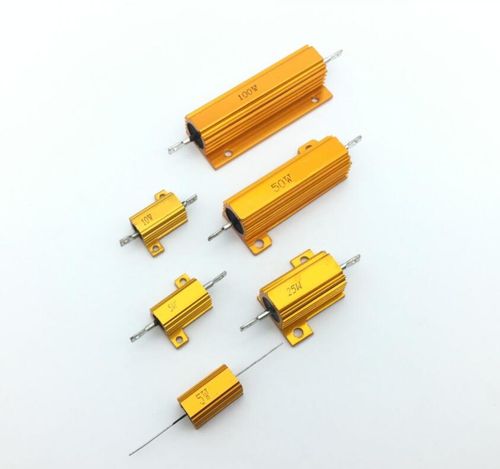
Distinguishing Methods
Although the use of Lü shell resistors is very common in switching power supply circuits, the marking methods on circuit diagrams vary among different countries and manufacturers. Although the marking symbols are not unified at present, they do share a common characteristic:
They are distinctly different from standard L-type resistors, easily identifiable on a circuit diagram.
It is generally used in power supply circuits where the current volume is large or in low-voltage or high-voltage circuits caused by secondary switch-mode power supplies.
(3) The insurance case resistor features only one color disc on top. As shown in the attached image, the color of the disc indicates the resistance value.
(4) In the circuit, the fuse shell resistor is焊接 onto the circuit board with long legs (usually, the fuse shell resistor is焊接 closely to the circuit board), positioned further away from the board to facilitate heat dissipation and differentiation.
Specification Model Standards
RN1/4W, 10Ω fuse resistor, color disc is gray-black, output power is 1/4W; when 8.5V AC voltage is applied to both sides of the fuse resistor, the resistance increases to over 50 times its initial value within 60 seconds.
(2) RN1/4W, 2.2Ω fuse resistor, with a bright red color disc, featuring an output power of 1/4W; when the 3.5A electronic product current lags, the resistance expands to over 50 times its initial value within 2 seconds.
(3) RN1/4W, 1Ω fuse resistor, with a milky white color disc, featuring an output power of 1/4W; when subjected to a 2.8A AC circuit, the resistance expands to approximately 400 times its initial value within 10 seconds.
How to differentiate between general resistors and fuse resistors
Resistors have the function of resistance, and the fuse link is essentially a combination of resistance and a fuse. When the applied output power exceeds the efficiency of the resistor, the fuse link will burn out, making it less likely for the entire resistor to smoke and burn. However, a resistor will burn and smoke when the applied output power surpasses its own output power.
How to Test the Quality of Insurance Resistors
The fuse fuse resistor, also known as the fuse case resistor, is widely used in household appliances such as televisions, video recorders, CD, VCD players, and instruments, as well as instrument panels. The fuse fuse resistor serves both as a resistor and a fuse in the circuit; under normal conditions, it functions as a fuse resistor; when the circuit experiences an abnormality (such as exceeding the load requirements of the protected circuit), the fuse material inside the resistor will react with the resistive film layer (the reaction time is measured in seconds), causing the resistive film layer to break, making the resistance of the fuse resistor extremely high or infinite, thereby protecting the relevant electronic components in the circuit from damage. The circuit symbol and packaging type of the fuse resistor are currently not standardized for the fuse case resistor.
