

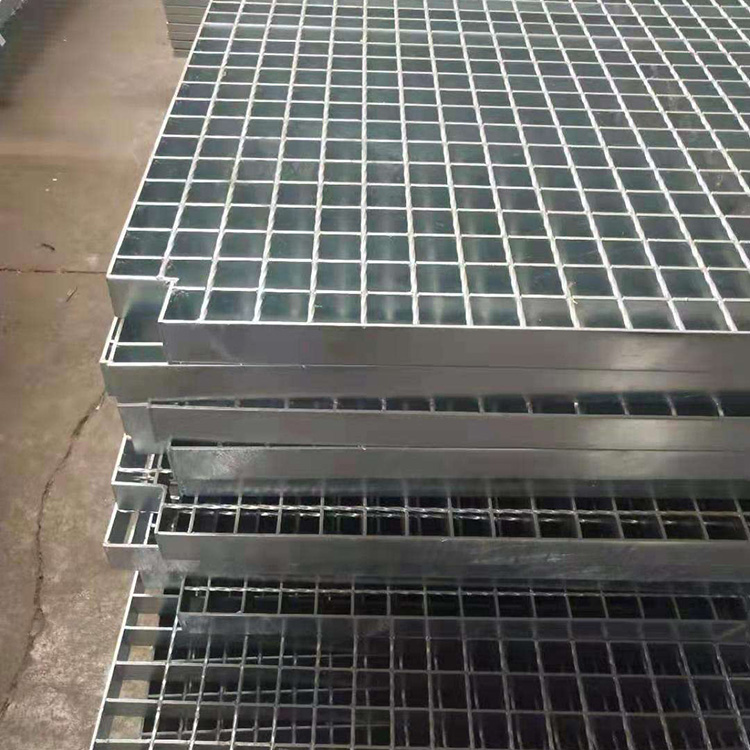
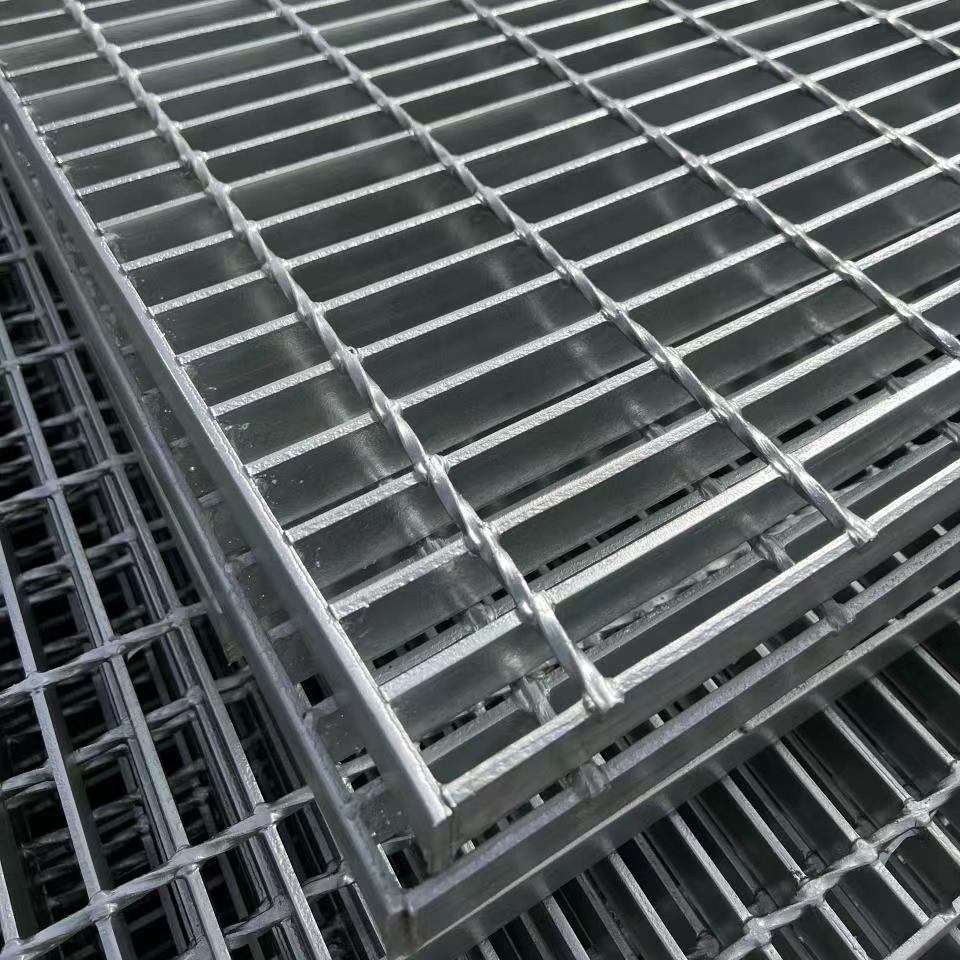














Press-welded steel grating is a metal grid structure composed of flat steel and crossbars arranged at a certain spacing, joined together by high-voltage resistance welding.
Material and Specifications:
MaterialTypically made of Q235A steel or stainless steel, offering high strength and corrosion resistance.
Specification:Center distance of flat steelIncorporating the 30mm and 40mm series, common specifications include 20x5, 25x5, 32x5, 40x5, 50x5, 65x5, 75x6, 100x8, and 100x10, etc.
Crossbar SpacingTypically 50mm or 100mm in diameter, round bars, twisted square bars, square bars, or hexagonal bars made of Q235A or 304 stainless steel, with common sizes including 5×5, 6×6, 8×8mm, etc.
Section II: Production Process
· Machine WeldingUtilizing a 200-ton hydraulic resistance welding automation machine, the robotic arm automatically lays the crossbar evenly on the flat steel strips. The crossbar is then securely welded into the flat steel using powerful welding power and hydraulic pressure, resulting in a high-quality steel grating with strong weld points, exceptional stability, and high strength. Ideal for mass production of standard products such as platform plates and channel covers.
· Hand-weldedFirst, punch holes in the flat steel, then insert the crossbar into the holes and spot-weld it. There will be gaps between the crossbar and the flat steel, but each contact point can be welded, achieving an equivalent melting connection between the flat steel and the twisted steel, ensuring a strong weld with increased strength. However, the appearance is not as attractive as that of pressure welding. Suitable for custom-shaped parts.
Surface Treatment
· Hot-Dip GalvanizedThe steel components are immersed in molten zinc at 500°C after being de-rusted, forming a zinc coating on the surface of the steel structures for corrosion prevention. In an environment with a pH value of 6 to 12.5, the corrosion resistance can last for 30 years without maintenance.
· Spray PaintingSpray anti-corrosion paint, suitable for environments with low corrosion resistance requirements.
· Other processingIncludes electrostatic powder coating, hot-dip aluminum, and Dacromet treatment, etc., options available according to specific requirements.
Section 4: Application Fields
· Industrial SectorWidely used in fields such as alloys, construction materials, power stations, boilers, shipbuilding, petrochemicals, chemical industries, and general industrial buildings, serving as platforms, gangways, bridges, highway guardrails, manhole covers, fences, and gates, etc.
· Construction Industry: Suitable for sawtooth anti-slip variant in humid environments, such as stair treads, walkway boards, etc.
· Municipal SectorPlatforms, walkways, bridge covers, manhole covers, ladders, fences, railings, etc., for municipal engineering and environmental protection projects.