







Provide SIL certification and SIL grading consulting services - Shenzhen ZhongNuo Testing Technology Co., Ltd.
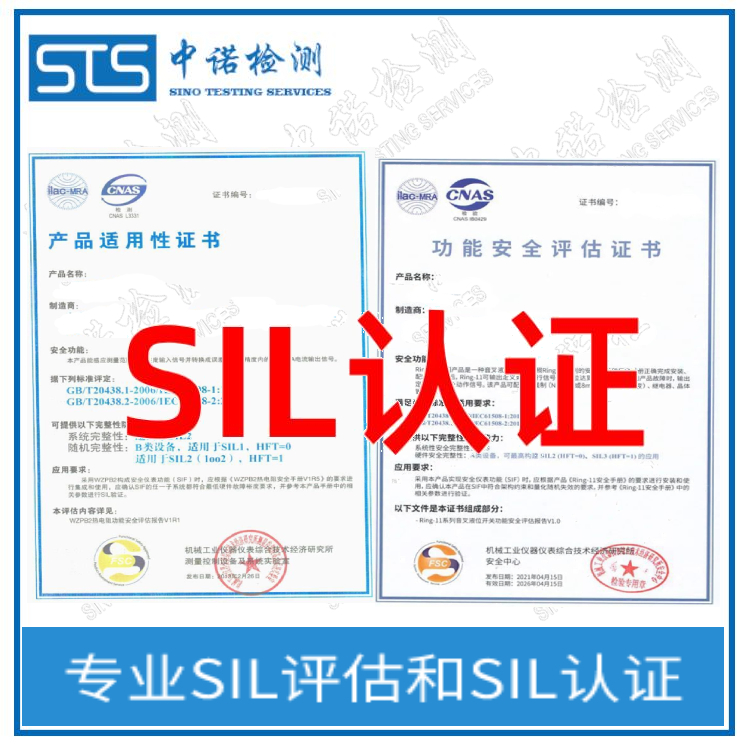
SIL certification, also known as Functional Safety Certification, focuses on the safety functions of a product. Obtaining SIL certification is to verify whether these safety functions can be reliably and safely implemented.
For instance, with a lighting fixture, we're concerned with its lighting function, whether its light intensity can reliably and safely meet our requirements.
The significance of obtaining SIL certification for products
1. SIL Certification's Impact on Product Integrity:
We guarantee the accuracy of the product's specific features.
(2) Enhances product acceptance and recognition within the industry.
(3) Certified products offer higher safety, enhancing the competitiveness of the products.
(4) Customers typically believe: Certified = Acknowledged = The.
2. The cumulative impact of SIL certification on the enterprise:
Enhance corporate safety experience and proficiency.
(3) The R&D process of the company is more standardized and verifiable.
(4) Enhanced safety guarantees are in place during incidents.
(5) Throughout the certification process, ensure the company maintains a high level of research and development.
If a project, system, or product achieves SIL certification, its product quality and safety are also recognized, enhancing the company's market competitiveness while significantly boosting customer confidence in the product. Therefore, it is necessary to obtain SIL certification for a product that has a significant impact on life and property safety.
SIL Functional Safety Certification is one of the crucial certifications for modern enterprises. In the industrial production that is increasingly mechanized, while instruments and machinery enhance production efficiency, uncontrollable variables and factors are inevitably present in the process due to the complexity of production processes and the precision of equipment. For instance, equipment failures, instrument shorts, and system malfunctions can lead to explosions, fires, and toxic gas leaks, posing severe threats to people's lives, property safety, and the environment, and even resulting in catastrophic consequences.
How can we control this series of disasters and their consequences to minimize them or keep them within an acceptable range?
Therefore, the SIL certification has emerged.
In fact, equipment failures occur at various stages of the product lifecycle, with varying probabilities. SIL certification involves intervening at the outset of product design, implementing manageable control over the entire lifecycle of the product according to specific standards and mature regulations, thereby reducing the likelihood of failures. This ultimately aims to control risks.
SIL Certification Level Pre-Assessment Submission Document Checklist
Product User Manual
2. Product Safety Feature List
3. Product Safety Manual
4. Failure Mode and Effects Analysis (FMEDA) Excel File
5. Quality Management System Certificate (ISO 9001)
6. Product Photos (including front and side views of representative model)
7. Product Design Documents (drawings, material reports, calculation sheets, etc.)
8. Additional Information
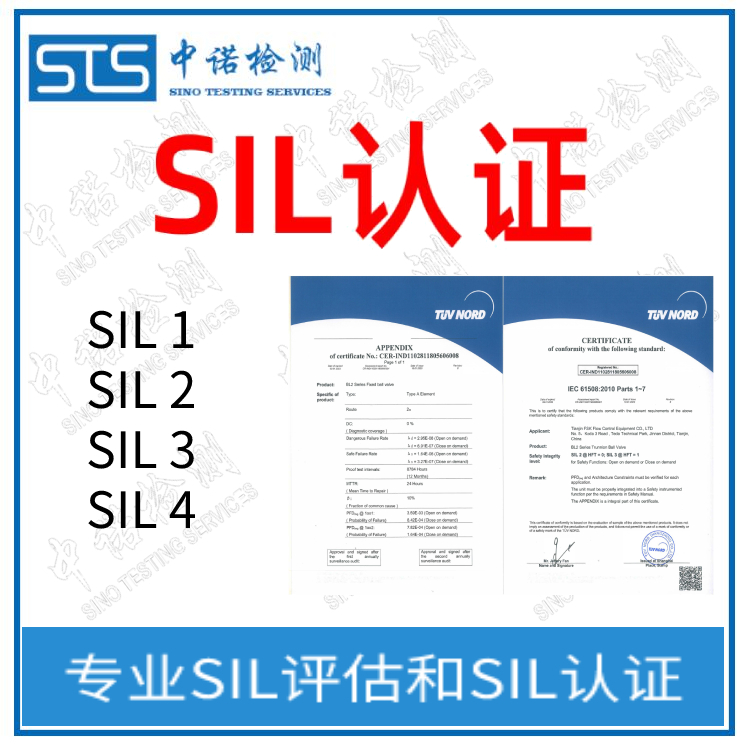
SIL certification is a third-party assessment, verification, and certification based on standards such as IEC 61508 (GB/T 20438), IEC 61511 (GB/T 21109), IEC 61513, IEC 13849-1, IEC 62061, and IEC 61800-5-2, which evaluate and confirm the Safety Integrity Level (SIL) or Performance Level (PL) of safety equipment. Functional safety certification primarily involves the assessment of document management (FSM) for the development process of safety equipment, hardware reliability calculations and assessments, software evaluations, environmental testing, and EMC electromagnetic compatibility testing. SIL certification is divided into four levels: SIL1, SIL2, SIL3, and SIL4, encompassing both product and system levels, with SIL4 being the most stringent.
WeChat Official Account

Scan to follow Official Account