


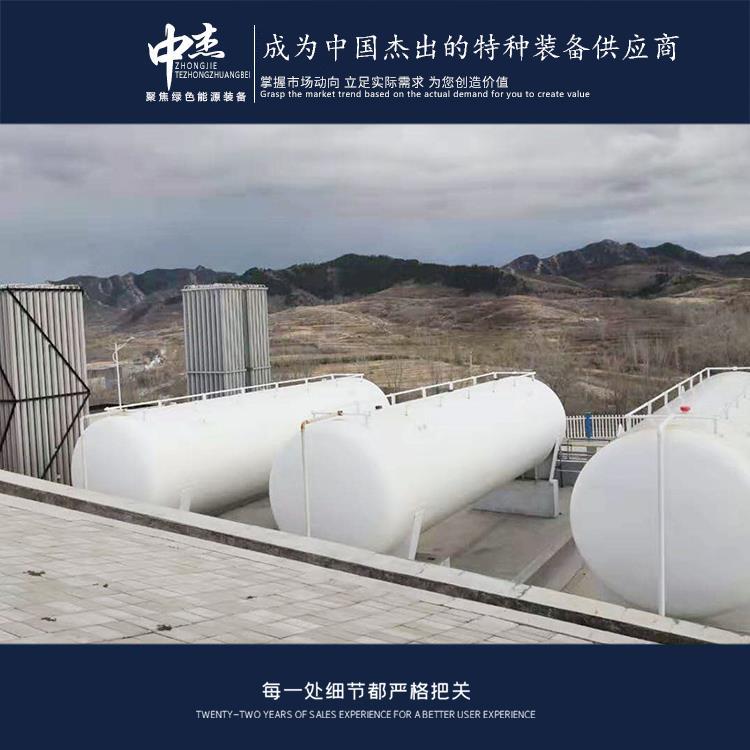

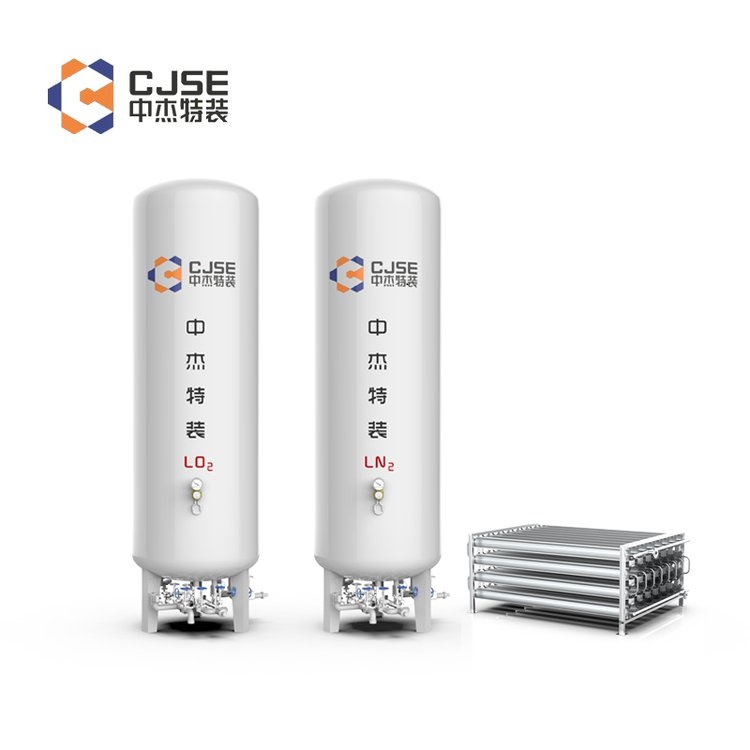
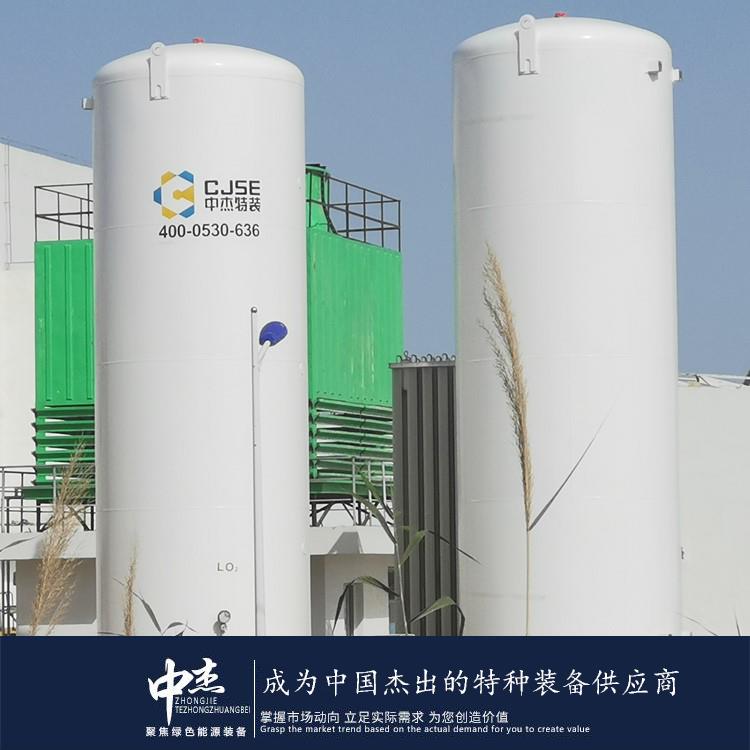


















Shandong Zhongjie Special Equipment Co., Ltd. specializes in: fuel (gas) boilers, organic heat carrier boilers, biomass boilers, waste heat recovery boilers, and other boiler products; vacuum insulated cryogenic pressure vessels such as LNG storage tanks, oxygen/nitrogen/argon storage tanks, and CO2 storage tanks; pressure vessel products including denitrification engineering equipment, heat storage and energy storage equipment, and complete chemical equipment sets; central air conditioning and ventilation equipment such as ground (water) source heat pumps, air source units, water-cooled screw units, and air-cooled modular units. Planned products include large-scale energy centers, LNG transport vehicles, LNG tank containers, and other green energy equipment.
A cryogenic liquid storage tank is a device designed for storing cryogenic liquids, commonly used for storing liquid oxygen, liquid nitrogen, liquid argon, and other cryogenic liquids. These liquids are in a gaseous state at room temperature but are cooled to a liquid state at low temperatures for better storage and use. Cryogenic liquid storage tanks are typically made from high-strength materials such as stainless steel or aluminum alloy to withstand the demands of low temperatures and high pressures. The interior often features an insulating layer to minimize evaporation and maintain the低温 state. Applications of cryogenic liquid storage tanks include but are not limited to: They are widely used in rocket and spacecraft fuel and propulsion systems, such as liquid oxygen, liquid nitrogen, and liquid hydrogen storage tanks, to store and supply cryogenic liquids as fuels and oxidizers for propulsion and operation. Industrial Production: Cryogenic liquid storage tanks are used in industrial production to store and supply cryogenic liquids like liquid oxygen, liquid nitrogen, and liquid argon, serving as coolants, gases for separation, and raw materials for chemical reactions. Medical Applications: In the medical field, cryogenic liquid storage tanks are used to store and supply liquid oxygen for oxygen therapy, inhalation therapy, and operating rooms. Laboratory Research: In scientific research and laboratories, cryogenic liquid storage tanks provide cryogenic liquids as coolants and refrigerants for laboratory equipment, material research, superconducting electronics, and low-temperature physics. In summary, cryogenic liquid storage tanks have extensive applications in various fields such as space, industrial production, and laboratory research, used for storing and supplying cryogenic liquids to meet the needs of different industries.
Determine the design pressure and calculated pressure for liquid oxygen storage tanks requires considering the following factors:
Design Pressure: Design pressure refers to the maximum pressure a tank can withstand under normal operating conditions. When determining the design pressure, factors such as the working pressure range of liquid oxygen, the material strength of the tank, and safety factors must be considered. Generally, the design pressure should be slightly higher than the high working pressure of liquid oxygen to ensure the tank's safety and reliability within the normal operating range.
Calculated Pressure: The calculated pressure refers to the actual working pressure of the tank under its design pressure. It is determined by calculating factors such as the properties of liquid oxygen, the geometric shape of the tank, and the material strength. The calculated pressure should consider factors like the expansion coefficient of liquid oxygen, temperature changes, and pressure fluctuations to ensure the safety and stability of the tank under actual operating conditions.
Determining the design and calculation pressures for liquid oxygen storage tanks typically requires adherence to relevant standards and specifications, such as Standard GB150 for Steel Pressure Vessels and GB18442 for Technical Conditions of Storage Tanks for Liquid Oxygen, Liquid Nitrogen, and Liquid Argon. These standards and specifications provide detailed design and calculation methods to ensure the safety and reliability of the tanks.
In practical application, the design and calculated pressures of liquid oxygen storage tanks should be calculated and determined by pressure vessel designers. They will consider various factors such as specific engineering requirements, tank dimensions, and materials to ensure that the tank's design and use comply with relevant safety standards and regulations.
To extend the service life of liquid argon storage tanks, the following measures can be taken:
Regular inspections and maintenance: Conduct periodic visual inspections of the liquid argon storage tank, check valves and connections, and perform leak detection and pressure tests. Identify and repair potential issues promptly to ensure the normal operation of the tank.
Maintain Insulation: The insulation is crucial for the thermal preservation of liquid argon tanks. Regularly inspect the integrity and insulating performance of the insulation, repair or replace damaged insulation materials to ensure the tank's insulating effectiveness.
Regulate Liquid Argon Temperature: Maintain the liquid argon temperature within an appropriate range to prevent damage to the storage tank from excessive or low temperatures. Implement suitable cooling or heating measures to ensure stable liquid argon temperature.
Corrosion Protection: The outer shell and internal structure of the liquid argon tank should be protected against corrosion and oxidation. Regularly inspect and maintain the protective coating to ensure its integrity.
Avoid excessive pressure and overfilling: Prevent excessive internal pressure or underpressure in the tank, as well as overfilling of liquid argon. Excessive pressure and overfilling can lead to structural cracking or damage to the tank.
Regular cleaning and waste removal: Regularly clean the interior of the tank to remove accumulated impurities and dirt. Regularly remove waste to prevent contaminants and sediments in liquid argon from damaging the tank.
Safety Operations and Training: Ensure operators are knowledgeable and skilled in the safe operation of liquid argon tanks. Enhance safety training to boost operators' awareness and emergency response capabilities.
Establish comprehensive management records and documents, including the usage of tanks, inspection logs, maintenance records, etc. Regularly review and update the management records to ensure the safe management and maintenance of the tanks.
These measures can help extend the service life of liquid argon storage tanks, but specific operations and management are required based on the type and application of the tank. When conducting maintenance and operation, please adhere to relevant regulations and standards, and consult with experts to ensure safety and effectiveness.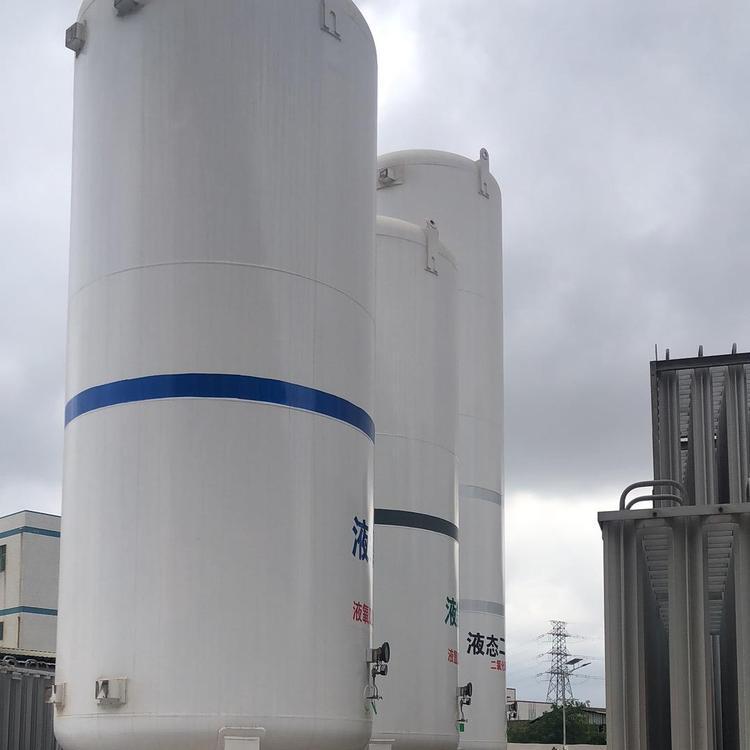
In the welding process of low-temperature liquid storage tanks, controlling the occurrence of welding cracks is crucial. The following are some methods and measures for controlling welding cracks:
Appropriate Welding Techniques: Selecting the right welding process and parameters helps reduce welding heat input and thermal stress. Methods with low heat input, such as pulse welding and laser welding, can lower the temperature gradient and residual stress in the heat-affected zone.
Preheating and Post-heat Treatment: Perform appropriate preheating before welding to enhance material toughness and reduce thermal stress. Conduct a suitable post-heat treatment, such as annealing or stress-relief heat treatment, after welding to minimize residual stress and improve the toughness of the weld.
Select appropriate welding materials: Choose welding materials with good toughness and crack resistance to minimize the occurrence of welding cracks. Select suitable welding materials based on the storage tank's operating conditions and requirements, such as low-alloy steel, stainless steel, etc.
Control Welding Process: Monitor and regulate parameters and operations during the welding process to minimize the risk of welding cracks. Pay attention to factors such as welding speed, current, voltage, and welding sequence to avoid overheating or rapid welding, thereby reducing the accumulation of thermal and residual stresses.
Non-destructive Testing and Evaluation: After welding, conduct non-destructive tests on the welds, such as ultrasonic testing and X-ray testing, to assess welding quality and the presence of cracks. Promptly identify and repair welding cracks to ensure the integrity and safety of the weld joints.
It's important to note that controlling welding cracks is a complex process that requires considering multiple factors, such as materials, welding techniques, and operations. When welding low-temperature liquid storage tanks, it's advisable to consult with a welding engineer or relevant institutions for guidance to ensure both welding quality and tank safety.
Our company attaches great importance to technological innovation and R&D design. We have one municipal-level enterprise technology center in Heze City, equipped with non-destructive testing, physical and chemical testing, welding testing, hydrostatic testing, and other testing facilities. We have over 600 various instruments and equipment, including CNC machine tools, X-ray flaw detectors, digital ultrasonic flaw detectors, mechanical property test machines, chemical analyzers, spectrometers, tensile testing machines, plasma welding machines, etc. The key products and technologies we have developed, such as temperature and pressure vessel welding, biomass boiler emission reduction, and waste heat utilization, have successively been shortlisted for multiple Shandong Provincial Department of Industry and Information Technology science and technology projects, Shandong Provincial key projects, and Heze City innovative and excellent projects. We have cumulatively obtained 27 authorized utility model patents, 16 authorized invention patents, participated in drafting 2 standards, 2 industry standards, and registered 15 trademarks. The technical team of our company, in collaboration with Professor Li Yajiang of Shandong University, has jointly developed deep cryogenic container processing technology, which adopts the international plasma arc + wire filling argon arc welding (PAW-GTAW) technology. After being appraised as a provincial-level scientific and technological achievement, the technology level has reached an international standard in the field of deep cryogenic container manufacturing. Choose Zhongjie Special Equipment, and let's create brilliance together!
WeChat Official Account

Scan to follow Official Account



















