





















Shandong Zhongjie Special Equipment (formerly Heze Boiler Factory Co., Ltd.) holds an A-grade boiler manufacturing license, A2-grade pressure vessel manufacturing license, A2-grade pressure vessel design license, B-grade boiler installation, and GB2/Class and GC2/Class pressure pipeline installation licenses, as well as a mechanical and electrical equipment installation contracting qualification. It is a member of the China Boiler and Water Treatment Association, the China Chemical Equipment Association, and the director unit of the Shandong Equipment Manufacturing Association. The company has also passed the ISO9001 Quality Management System, ISO14001 Environmental Management System, OHSAS18001 Occupational Health and Safety Management System certifications, and the U.S. ASME/U2 certification.
Carbon dioxide storage tanks offer the following advantages:
High storage density: CO2 storage tanks can compress CO2 gas into a liquid state, significantly increasing storage density. Compared to storing in a gaseous state, liquid CO2 can store more CO2 in relatively smaller tanks, saving space and costs.
Environmental friendly and renewable: CO2 is an environmentally friendly gas, and its increased concentration in the atmosphere can lead to warming and climate change. By storing and utilizing CO2, we can reduce its emissions into the atmosphere, promoting environmental protection and sustainable development.
Multiple application fields: CO2 storage tanks are widely used in various industries, including food and beverage, industry, fire suppression, and gas supply. CO2 can be used as a preservative, carbonation agent, gas, and fire extinguisher, with broad applications and market demand.
Safe and reliable: During design and manufacturing, CO2 storage tanks typically use high-strength materials (such as carbon steel or stainless steel), offering excellent pressure resistance and safety. The tanks are usually equipped with safety valves, pressure gauges, level indicators, and other accessories to ensure safe operation. Additionally, CO2 is a non-flammable and non-explosive gas, making it relatively safe.
These advantages make CO2 storage tanks an essential storage and supply equipment, widely used in numerous industries. However, when using CO2 storage tanks, it is crucial to follow relevant safety operation procedures and standards to ensure safe operation and usage.
Low Temperature Carbon Dioxide Storage Tank Related Knowledge
1. Structure of Low Temperature Carbon Dioxide Storage Tank
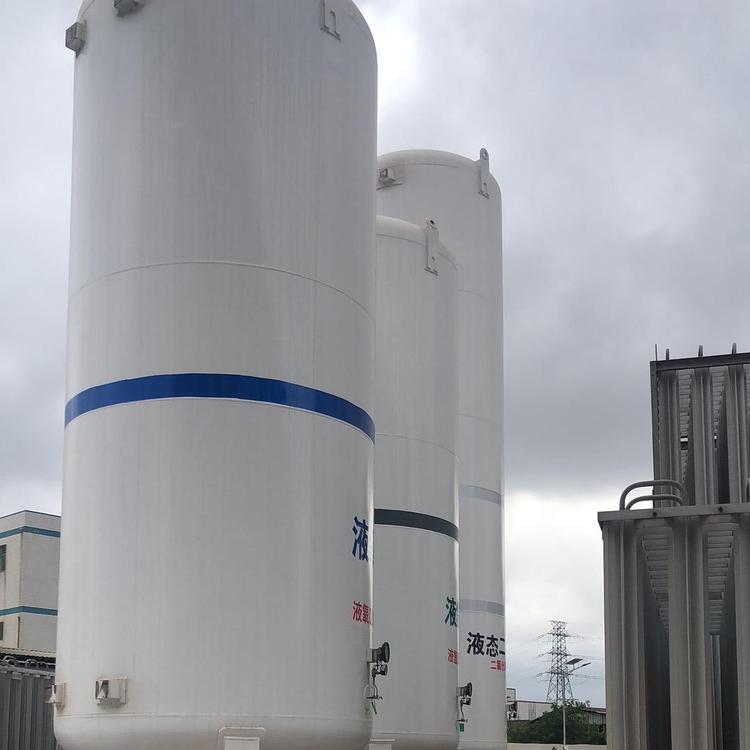
The low temperature carbon dioxide storage tank typically features a double-layer cylindrical structure. The inner cylinder is made of 6MnDR alloy steel, while the outer cylinder is constructed from Q245R or Q345R pressure vessel steel plate. The piping is made of austenitic stainless steel, and the insulation space is filled with high vacuum pearlite sand or wrapped with multiple layers for thermal insulation. The storage tank is equipped with valves for operation, which are arranged for ease of use. Pressure gauges and level indicators are also installed to monitor the internal pressure and liquid level of the low temperature carbon dioxide storage tank.
2. Key Features of Low Temperature Carbon Dioxide Storage Tank
(1) The storage tank is fitted with a connection for filling with tanker trucks, enabling liquid supply to vaporizers, tankers, and pumps.
(2) Both the inner and outer cylinders of the storage tank are equipped with safety devices to ensure safe operation for the user.
(3) The insulation material of the low temperature carbon dioxide storage tank has been specially treated to provide a longer vacuum lifespan. Additionally, the tank is equipped with a vacuum gauge for measuring the insulation space vacuum level when necessary.
3. Transportation of Low Temperature Carbon Dioxide Storage Tank
(1) During road transportation, the storage tank should be securely fastened to the vehicle and travel at moderate speeds. It is prohibited to collide the storage tank with other objects.
(2) After the storage tank arrives, the unloading personnel should work together with the equipment supervisor to develop a scientific and reasonable unloading plan.
4. Installation of Low Temperature Carbon Dioxide Storage Tank
(1) Upon arrival at the installation site, the storage tank can be placed when installation conditions are met. During the installation process, collisions and impacts should be avoided, and special attention should be paid to the explosion-proof equipment of the outer cylinder and the vacuum valve, which must not be touched.
(2) Perform a gas-tightness test on the inner cylinder system of the low temperature carbon dioxide storage tank using nitrogen to the working pressure. After confirming that there are no leaks in the valves, pipes, flanges, etc., the installation is complete.
(3) The installation dimensions of the low temperature carbon dioxide storage tank are specified in the supply materials. When considering liquid loading and unloading with tankers, the vehicle's travel path should be taken into account.
Carbon dioxide tanks are equipment used for storing and transporting CO2. They are typically sealed containers with special design and structure to ensure safe storage and use of CO2. Here are some common details about carbon dioxide tanks: Storage Form: CO2 is in a gaseous state at room temperature but can be compressed into a liquid under high pressure for easier storage and transport. Carbon dioxide tanks are usually used for storing liquid CO2. Storage Pressure: These tanks typically store high-pressure CO2 at around 20-25 bar, which helps maintain the liquid state. Storage Capacity: The capacity of carbon dioxide tanks varies, ranging from small ones with a few thousand liters to large ones with tens of thousands of liters, depending on specific application needs. Safety: CO2 is a colorless, odorless gas, but it can be dangerous to humans in high concentrations, causing asphyxiation. Therefore, appropriate safety measures like ventilation and protective gear must be taken when using carbon dioxide tanks to ensure the safety of operators. Applications: Carbon dioxide tanks are widely used in various fields, including the food and beverage industry, manufacturing, fire suppression, and gas supply. They store and provide CO2 to meet diverse industrial demands. It is important to note that the design, manufacturing, and use of carbon dioxide tanks must comply with relevant regulations, standards, and safety requirements. Operators should follow the manual and safety guidelines and cooperate with local regulatory authorities to ensure the tanks' safety and reliability.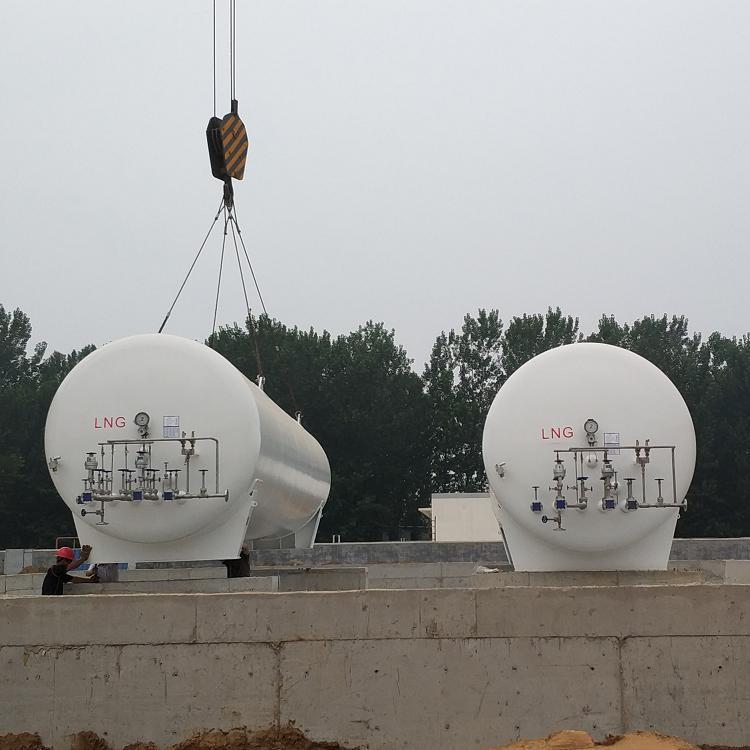
Technical specifications for carbon dioxide storage tanks can be established based on different application fields and/or regional standards. Below are some common technical specifications and standards for reference:
- ASME Standards: The American Society of Mechanical Engineers (ASME) has issued a series of standards for pressure vessels, including specifications for carbon dioxide storage tanks such as ASME BPVC Section VIII Division 1 and ASME BPVC Section VIII Division 2.
- ISO Standards: The International Organization for Standardization (ISO) has published some standards related to pressure vessels, such as ISO 9809-1 and ISO 9809-2, covering design, manufacturing, and inspection requirements for steel gas cylinders.
- GB Standards: The China National Committee for Standardization has issued a series of standards related to pressure vessels, such as GB 150 "Pressure Vessels" and GB 5099 "Steel Gas Cylinders," which include design, manufacturing, and inspection requirements for carbon dioxide storage tanks.
- DOT Standards: The United States Department of Transportation (DOT) has issued some standards related to pressure vessels and cylinders, such as DOT-3AA and DOT-4BA, covering design, manufacturing, and transportation requirements for liquefied gas storage tanks.
- EN Standards: The European Committee for Standardization (CEN) has published some standards related to pressure vessels, such as EN 13445 and EN 14382, covering design, manufacturing, and inspection requirements for liquefied gas storage tanks.
- Additionally, there may be other industry standards and specifications applicable to carbon dioxide storage tanks based on specific application needs, such as relevant standards for the food and beverage industry and industry-specific standards.
When using carbon dioxide storage tanks, it is necessary to select applicable technical specifications based on specific application requirements and local regulatory requirements, ensuring that the design, manufacturing, and use of the tanks comply with the corresponding standards and specifications.
Our company highly values technological innovation and R&D design. We possess 1 municipal-level enterprise technology center in Heze City, equipped with non-destructive testing, physical and chemical testing, welding testing, hydrostatic testing, and other testing facilities. We have over 600 pieces of equipment, including CNC machine tools, X-ray flaw detectors, digital ultrasonic flaw detectors, mechanical property testing machines, chemical analyzers, spectrometers, tensile testing machines, plasma welding machines, and more. The key products we have developed, such as temperature and pressure vessel welding, biomass boiler emissions reduction, and waste heat utilization, have successively been included in multiple Shandong Provincial Department of Industry and Information Technology science and technology projects, Shandong Provincial key projects, and Heze City innovative and excellent projects. We have accumulated 27 authorized utility model patents, 16 authorized invention patents, participated in drafting 2 standards, 2 industry standards, and registered 15 trademarks. Our technical team, in collaboration with Professor Yajiang Li of Shandong University, has developed deep cryogenic container processing technology using the internationally recognized plasma arc + filler wire tungsten inert gas (PAW-GTAW) welding technology. This technology has been appraised as internationally competitive at the provincial level in terms of deep cryogenic container manufacturing. Choose ZJ Special Equipment, and let's create brilliance together!
WeChat Official Account

Scan to follow Official Account



















