


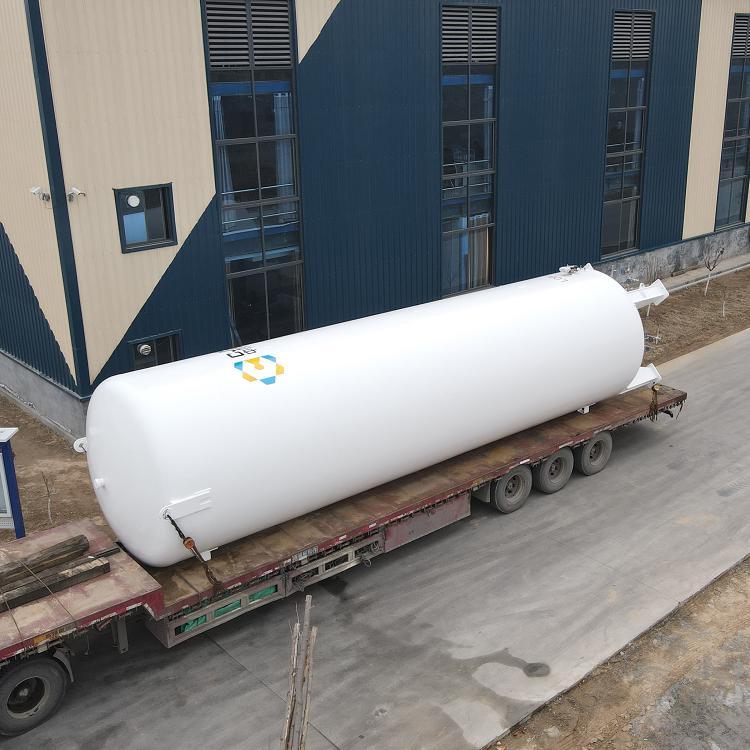


















Shandong Zhongjie Special Equipment's main products include: fuel (gas) boilers, organic heat carrier boilers, biomass boilers, waste heat boilers, and other boiler products; vacuum insulation cryogenic pressure vessels such as LNG tanks, oxygen/nitrogen/argon tanks, CO2 tanks; pressure vessel products like denitrification engineering equipment, heat storage and energy storage equipment, complete chemical equipment sets; central air conditioning and HVAC equipment such as ground (water) source heat pumps, air source units, water-cooled screw units, and air-cooled modular units. Planned products include large-scale energy centers, LNG transport vehicles, LNG tank containers, and other green energy equipment.
Liquid nitrogen tanks are widely used in various industries, primarily in the following aspects:
Industry: Liquid nitrogen tanks are used in the field for storing and supplying liquid nitrogen, which is essential for cryogenic preservation of biological samples, cells, tissues, and vaccines. They are widely applied in biopharmaceutical research institutions and biobanks, among other organizations.
Experimental Research: Liquid nitrogen tanks are used to provide low-temperature environments in scientific research and laboratories, for cryopreservation and cryogenic experiments. Liquid nitrogen tanks play a crucial role in experimental research across various fields, including physics, chemistry, biology, and materials science.
Metalworking Industry: Liquid nitrogen tanks are used in the metalworking and welding industries for providing low-temperature cooling, used in processes such as metal cutting, welding, and heat treatment. Liquid nitrogen tanks can provide low temperatures, enabling metals to achieve the required hardness and toughness during the processing.
Food Industry: Liquid nitrogen tanks are used in the food industry for freezing and refrigerating foods such as frozen meats, frozen fruits, and frozen seafood. The low temperature of liquid nitrogen can quickly freeze the food, preserving its freshness and quality.
Semiconductor Industry: Liquid nitrogen tanks are used in semiconductor manufacturing and the electronics industry to provide low-temperature environments, for the freezing and preparation of semiconductor materials. The low temperature of liquid nitrogen can enhance the purity and performance of semiconductor materials.
The configuration of liquid nitrogen tanks typically includes the following aspects:
Vessel Structure: Liquid nitrogen tanks typically feature a double or multi-layered design, filled with insulating material in between to minimize heat transfer and evaporation of the liquid nitrogen. The tank material is usually stainless steel or aluminum alloy, offering excellent corrosion and low-temperature resistance.
Insulation Layer: The insulation layer of liquid nitrogen tanks usually employs multi-layer insulating materials, such as polyethylene foam, glass fiber, and vacuum layers, to reduce heat transfer and evaporation of liquid nitrogen.
Thermal Control System: Liquid nitrogen tanks are typically equipped with a thermal control system, used to regulate the tank's temperature to maintain the liquid state.
When selecting the base for a liquid argon tank, several factors should be considered:
Load Capacity: The support must be capable of bearing the weight of the liquid argon tank. Select a support with adequate load capacity based on the tank's capacity and dimensions. Typically, the weight of the liquid argon tank is specified in the design specifications, which can be used to determine the support's load capacity.
Stability: The support must provide adequate stability to prevent the tank from tilting or swaying during use. The design of the support should take into account the tank's center of gravity and its changes to ensure stable support.
Corrosion Resistance: Liquid argon has low temperature and corrosive properties; the support material should have good corrosion resistance to prevent corrosion and damage. Common support materials include stainless steel, aluminum alloy, etc.
Insulation: Liquid argon storage tanks typically require insulation for heat preservation. The supports should possess certain insulation properties to minimize heat transfer and evaporation of liquid argon. The design of the supports should consider the installation and protection of the insulation layer.
Installation and Maintenance: The support should feature ease of installation and maintenance for convenient setup and routine maintenance of the tank.
When selecting the supports for liquid argon tanks, it's advisable to consult with engineers or suppliers. Choose the appropriate supports based on the specific tank requirements and usage environment. Additionally, adhere to relevant design specifications and safety standards to ensure the quality and reliability of the supports.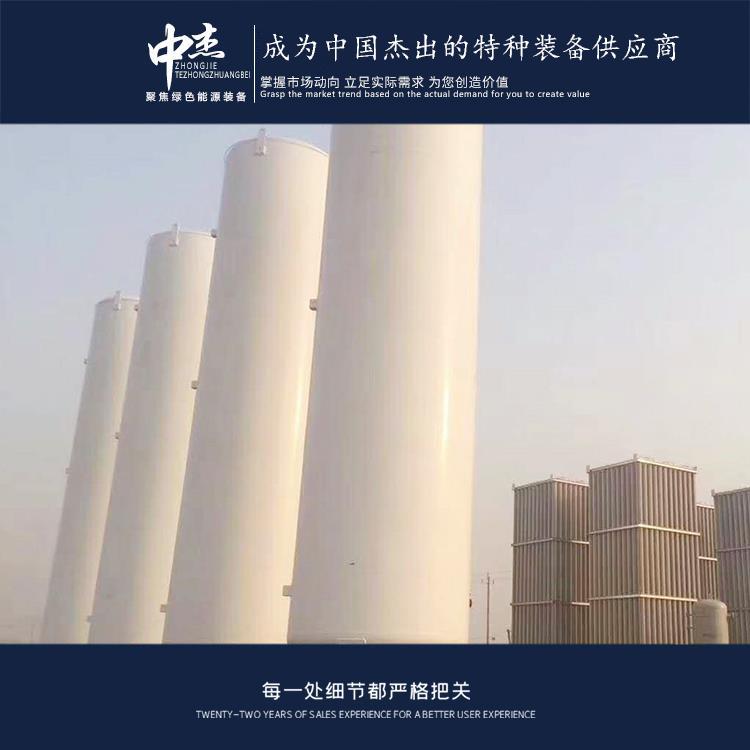
Prior to filling the liquid nitrogen tank, the following checks must be performed:
Tank exterior inspection: Check for any visible damage, deformation, corrosion, etc., on the tank's exterior, including the tank wall, valves, pipes, and joints.
Sealability Inspection: Check the sealing performance of the storage tank, including inspecting for any leakage at valves and pipe connections, to ensure the tank maintains good sealing integrity.
Pressure Check: Verify that the storage tank's pressure gauge is functioning properly and that the pressure is within the normal range to ensure the tank's normal operational status.
Level Check: Inspect the liquid level in the tank to ensure it is within the normal range, avoiding issues caused by excessive or insufficient levels.
Insulation Layer Inspection: Check for any damage or detachment in the tank's insulation layer to ensure proper insulation and reduce evaporation losses of liquid nitrogen.
Leakage Inspection: Check for signs of liquid nitrogen leakage around the storage tank, including frost, ice, or liquid nitrogen stains on the ground.
Safety Equipment Inspection: Verify that the storage tank's safety equipment, such as leak detectors, alarm systems, and safety valves, are functioning properly to ensure the tank's safety.
Clean Inspection: Ensure the interior of the tank is clean, free of accumulated impurities and dirt, to maintain the tank's cleanliness and hygiene.
Above are the checks required prior to filling a liquid nitrogen storage tank, to ensure the safe operation of the tank and the normal storage of liquid nitrogen. During the inspection process, operations should be strictly conducted in accordance with relevant operational procedures and safety requirements, ensuring the safety of the operation.
The application of strain-hardening in austenitic stainless steel on low-temperature pressure vessels is a common method, which can enhance the material's strength and durability. Here are some details regarding the application of strain-hardening in austenitic stainless steel on low-temperature pressure vessels:
Principle of Strain Hardening: Strain hardening is achieved by introducing plastic deformation into the material, which alters the crystal structure, thereby increasing the material's strength. In Austenitic stainless steel, strain can be introduced through methods such as cold working (e.g., cold rolling, cold drawing) or heat treatment (e.g., solution treatment and cold deformation), leading to dislocations and grain boundary sliding in the crystal structure, which enhances the material's strength.
Low Temperature Application Advantages: Austenitic stainless steel exhibits excellent corrosion resistance and low-temperature toughness in cold environments. Strain hardening can further enhance the strength and durability of austenitic stainless steel, enabling it to perform in low-temperature pressure vessels. Under low-temperature conditions, strain hardening effectively resists plastic deformation and fracture, improving the material's tensile strength and impact resistance.
Application Cases: Austenitic stainless steel strain-hardening is widely used in low-temperature pressure vessels. For instance, in liquid nitrogen, liquid oxygen, and liquid argon tanks, etc., strain-hardened austenitic stainless steel is commonly used as structural material. These vessels must withstand high pressure and impact loads at low temperatures; strain-hardening enhances the material's strength and durability, ensuring safe operation of the containers.
It is important to note that the strain hardening of austenitic stainless steel must be conducted at suitable temperatures and deformation conditions to avoid excessive deformation and material embrittlement. When designing and manufacturing low-temperature pressure vessels, the specific engineering requirements and material characteristics should be taken into account to reasonably select and apply strain hardening techniques for austenitic stainless steel.
ZJ Special Equipment adheres to the grand vision of "realizing employees' dreams, creating value for customers, and striving for the prosperity and strength of our motherland," and is dedicated to the development of the green energy equipment industry. We offer society high-quality products and services at competitive prices!
WeChat Official Account

Scan to follow Official Account



















