


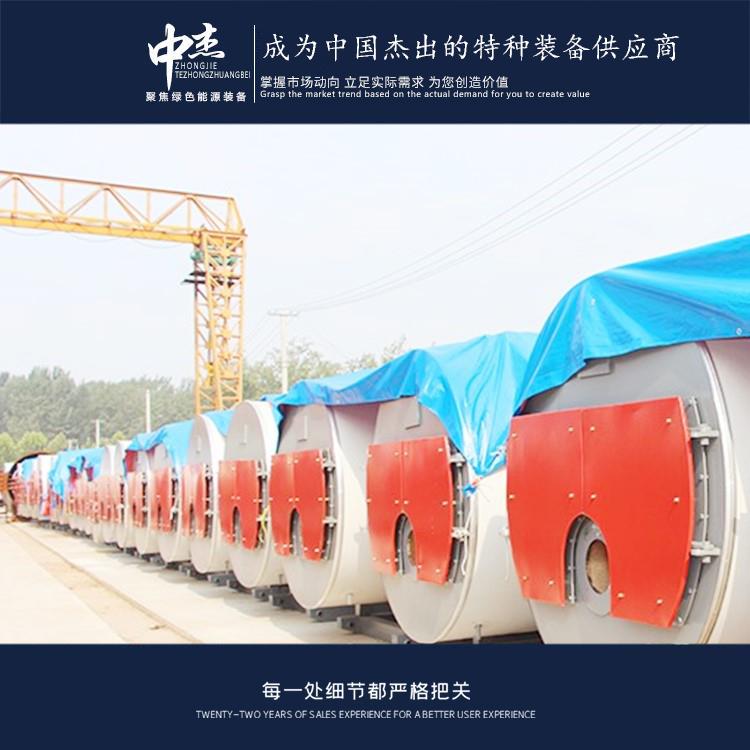

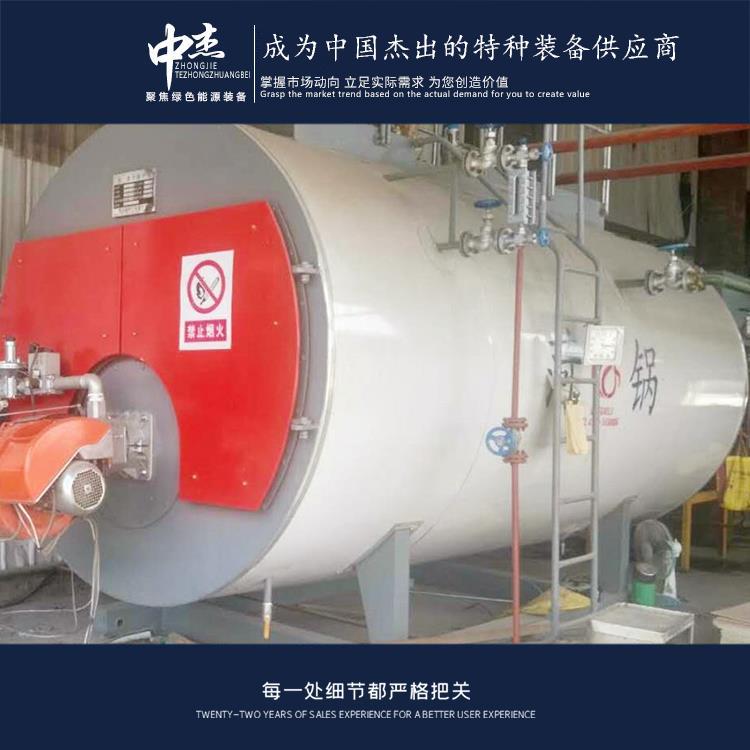
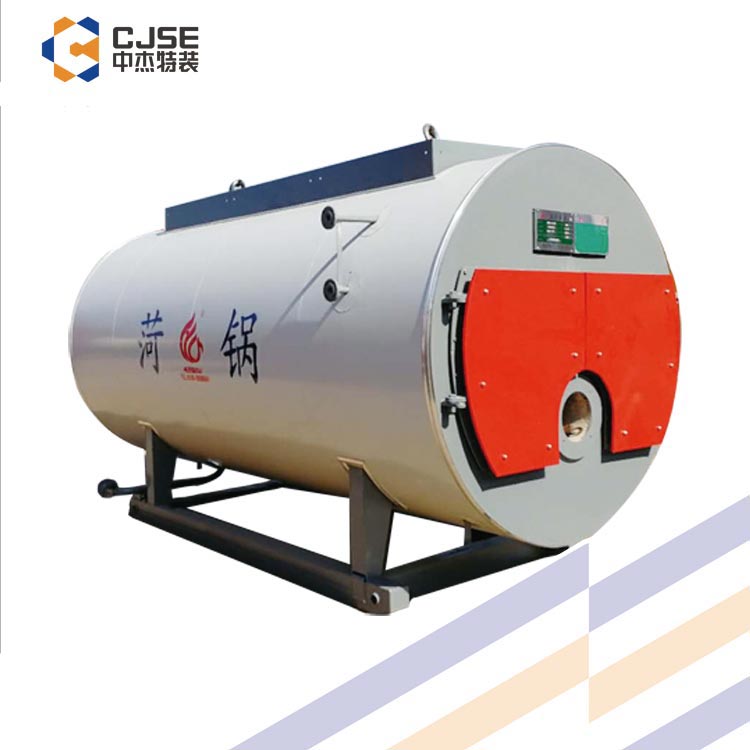


















Shandong Zhongjie Special Equipment (formerly Heze Boiler Factory Co., Ltd.) holds an A-grade boiler manufacturing license, A2-grade pressure vessel manufacturing license, A2-grade pressure vessel design license, B-grade boiler installation license, and GB2/Class and GC2/Class pressure pipeline installation licenses, as well as mechanical and electrical equipment installation contracting qualifications. It is a member of the China Boiler and Water Treatment Association, the China Chemical Equipment Association, and a council member of the Shandong Equipment Manufacturing Association. The company has also passed ISO9001 Quality Management System, ISO14001 Environmental Management System, OHSAS18001 Occupational Health and Safety Management System certifications, and the American ASME/U2 certification.
A condensing steam boiler is a energy-saving boiler equipment with the following working principle and features:
Working Principle:
- Steam Generation: The condensing steam boiler produces high-temperature flue gas by burning gas, which then exchanges heat with the water pipes inside the boiler, heating the water to produce steam.
- Steam Condensation: After steam is generated, it enters the condenser where it exchanges heat with the condensing medium (usually cold water or recycled water), releasing heat from the steam and condensing it back into water.
- Flue Gas Reuse: The flue gas after condensation still contains a certain amount of heat, which can be recovered and reused by the flue gas reuse unit to improve the boiler's thermal efficiency.
Features:
- Energy Saving: The condensing steam boiler utilizes the principle of steam condensation to fully utilize the heat in the steam, improving the efficiency of heat energy utilization and saving energy consumption.
- Low Emission: Due to the condensation process, where most of the heat is recovered, the flue gas temperature is lower, resulting in a relative decrease in emissions, reducing environmental impact.
- Compact Structure: The condensing steam boiler typically features a compact design, occupying less space, making it suitable for limited-space locations.
- Quick Start-Up: The boiler has the characteristics of quick start-up and shutdown, allowing for flexible adjustment and operation according to actual needs.
- Wide Application Range: The condensing steam boiler is suitable for heating and steam needs in industrial production processes, such as power plants, chemical plants, textile factories, etc.
It is important to note that maintenance and regular cleaning of the condenser and flue gas reuse unit are necessary during the operation of the condensing steam boiler to ensure its normal operation and performance.
For the maintenance of industrial gas boilers, here are some common methods and precautions:
- Clean the burner: Regularly clean the interior and nozzle of the burner to ensure normal combustion of gas, and avoid carbon buildup and blockages.
- Inspect the gas supply system: Regularly check the gas supply system, including gas pipes, valves, and pressure regulators, to ensure normal supply with no leaks or blockages.
- Clean the flue and heat exchanger: Regularly clean the flue and heat exchanger to remove ash and dirt, maintain heat exchange efficiency, and prevent overheating and energy loss.
- Check water level and pressure: Regularly inspect the boiler's water level and pressure to ensure safe operation within the designated range. Top up water and adjust pressure to avoid issues caused by low or high water levels.
- Inspect safety devices: Regularly check the boiler's safety devices, including safety valves, pressure switches, and water level controllers, to ensure proper functioning and ensure safe operation of the boiler.
- Check the control system: Regularly inspect the boiler's control system, including automatic controllers, sensors, and gauges, to ensure accuracy and reliability, and to detect and fix faults promptly.
- Regular maintenance: Perform regular maintenance, including lubricating parts, replacing worn-out components, and checking electrical connections, to extend the boiler's lifespan and stability.
- Keep records: Record the boiler's operating parameters, maintenance logs, and fault situations to help promptly identify problems and analyze operational conditions.
- Train operators: Ensure operators are sufficiently
A gas boiler is a heating equipment that uses gas or similar fuels. It produces heat by burning the gas, heating water into steam or hot water, and is used for heating, hot water supply, or industrial production, among other applications. The working principle of a gas boiler involves mixing gas with air, igniting it to produce high-temperature combustion gases, which then transfer heat to the water through a heat exchanger, raising the water temperature. Gas boilers are characterized by their environmental friendliness, safety, and other advantages, and are widely used in residential, commercial, and industrial sectors.
To optimize and improve the planning of gas boiler systems, consider the following aspects:
1. Energy Audit and Assessment: Conduct a comprehensive energy audit and assessment to understand the energy consumption of the gas boiler system and identify potential energy-saving opportunities. Through data analysis and energy measurement, determine the main sources of energy consumption and bottlenecks, providing a basis for subsequent optimization.
2. Combustion System Optimization: Optimize the combustion system of the gas boiler, including adjustments and cleaning of burners, control of the gas-to-air ratio, and maintenance of the combustion chamber. Ensure high combustion efficiency and high gas utilization, reducing energy waste.
3. Heat Recovery Utilization: Consider installing heat recovery devices such as waste heat recovery units or flue gas heat exchangers. These devices can utilize the excess heat from the flue gas emitted by the gas boiler to heat water or other equipment requiring heat, improving energy efficiency.
4. Pipe Insulation and Leak Inspection: Ensure that the insulation of gas and hot water pipes is effective to reduce energy loss. Regularly inspect for pipe leaks and repair them promptly to avoid energy waste and safety hazards.
5. Control System Upgrade: Consider upgrading the control system of the gas boiler with automated control technology. Through precise control and adjustment, achieve optimal operation of the gas boiler.
Our company attaches great importance to technological innovation and R&D, with 1 city-level enterprise technology center in Heze City. We have established testing facilities for non-destructive testing, physical and chemical testing, welding testing, hydrostatic testing, etc., and are equipped with over 600 various instruments and equipment such as CNC machine tools, X-ray flaw detectors, digital ultrasonic flaw detectors, mechanical property testing machines, chemical analyzers, spectrometers, tensile testing machines, and plasma welding machines. The key products and technologies we have developed, such as temperature and pressure vessel welding, biomass boiler emission reduction, and waste heat utilization, have successively been selected for multiple Shandong Provincial Department of Industry and Information Technology science and technology innovation projects, Shandong Provincial key projects, and Heze City innovation and excellence projects. We have accumulated a total of 27 authorized utility models, 16 authorized inventions, participated in drafting 2 standards, 2 industry standards, and registered 15 trademarks. The technical team of our company, in collaboration with Professor Yajiang Li of Shandong University, has developed deep cryogenic container processing technology using the international plasma arc + filler wire tungsten inert gas arc welding (PAW-GTAW) technology. After provincial-level scientific and technological achievement evaluation, the technology level has reached an international standard in the field of deep cryogenic container manufacturing.
Choose ZJET customized solutions, let's create brilliance together!
WeChat Official Account

Scan to follow Official Account



















