





















Shandong Zhongjie Special Equipment (formerly Heze Boiler Factory Co., Ltd.) was established in 2001, located at No. 2218 Jinnan Road, Development Zone, Heze City, with a registered capital of 50 million yuan and total assets of 500 million yuan. The company has 7 business centers: boilers, deep-freezing containers, pressure vessels, central air conditioning, engineering installation, international trade, and Internet of Things. It has three factory sites on Jinnan Road, East Changjiang Road, and Bohai Road, covering a total of 200,000 square meters, with the main workshop area being 83,000 square meters. It currently employs 710 people, including 247 engineers and technicians and 82 intermediate-level technicians. In December 2016, it was recognized as a "High-tech Enterprise" by the Science and Technology Department. In June 2021, it was identified as a "Specialized and New Enterprise in Shandong Province" by the Ministry of Industry and Information Technology. In June 2022, it was recognized as a "Deer Enterprise in Shandong Province" by the Ministry of Industry and Information Technology, and in August 2022, it was identified as a "Specialized and New Small Giant Enterprise" by the Ministry of Industry and Information Technology.
Here are some common protection techniques for carbon dioxide storage tanks:
Fire and Explosion Prevention Measures: A fire-resistant isolation zone should be set up around the tank, away from fire sources and flammable materials. The tank itself should adopt fire and explosion prevention measures, such as fire-resistant coatings and explosion-proof devices, to prevent fires and explosions.
Leak Detection and Alarm Systems: The tank should be equipped with leak detection and alarm systems to promptly detect and alert of any leaks. Regularly inspect and maintain the leak detection equipment to ensure proper functioning.
Regular Inspections and Maintenance: Regularly inspect the tank's exterior, valves, and fittings to ensure they are intact. Conduct regular leak detection and pressure tests to ensure the tank's safety performance meets requirements.
Waste Gas Treatment: Treat the waste gases produced by the carbon dioxide storage tank to prevent environmental pollution. Implement appropriate waste gas treatment measures, such as collecting and treating the waste gases.
Static Protection: Take static protection measures to avoid static accumulation and discharge. Use anti-static equipment and tools to ensure static safety during operations.
Safety Training and Awareness: Train operators on safety procedures to enhance their awareness and ability to handle carbon dioxide storage tanks safely. Conduct regular safety training and drills to prepare for emergencies.
Management Records and Documentation: Establish comprehensive management records and documentation, including the tank's usage, inspection, and maintenance records. Regularly review and update management records to ensure safe management and maintenance of the tank.
It should be noted that the above are common protection techniques, and specific techniques may vary depending on the type and application of the tank. When using carbon dioxide storage tanks, operate according to relevant regulations and standards and consult experts to ensure safety and effectiveness.
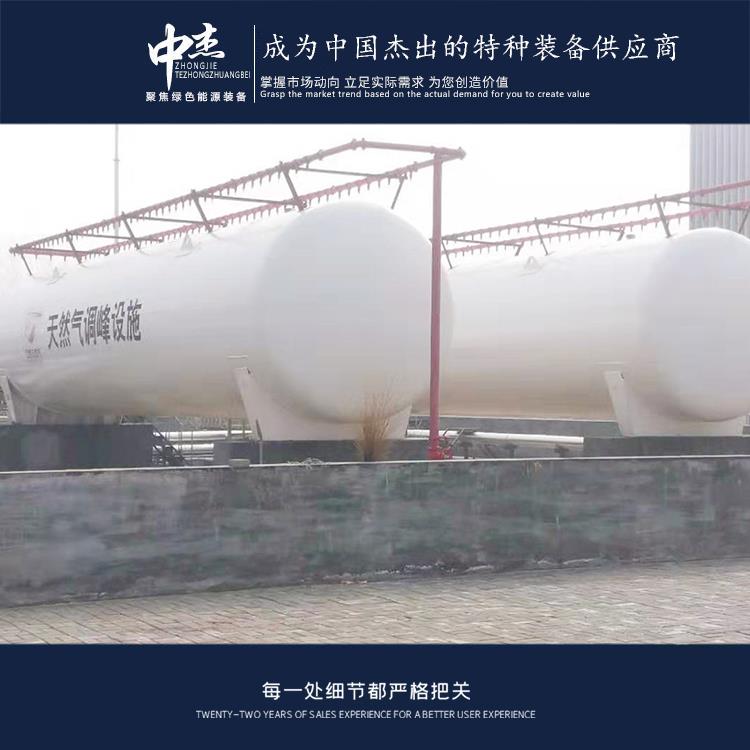
Zhongjie Special Equipment is a company engaged in the manufacturing of low-temperature liquid storage tanks. They offer design, manufacturing, and installation services for low-temperature liquid carbon dioxide storage tanks. Here is a brief introduction to the low-temperature liquid carbon dioxide storage tanks produced by Zhongjie Special Equipment: Tank Type: The low-temperature liquid carbon dioxide storage tanks produced by Zhongjie Special Equipment are typically vertical or horizontal in design, chosen based on customer requirements and site conditions. Material: The tanks are mainly made of low-temperature steel, offering excellent corrosion and low-temperature resistance. Insulation Layer: The tanks are internally insulated to reduce heat transfer and liquid evaporation. The insulation layer usually consists of multi-layer structures, including thermal insulation materials and an external protective layer. Safety Valve and Pressure Relief Device: The tanks are equipped with safety valves and pressure relief devices to control internal tank pressure, preventing overpressure and explosions. Level Indicator: The tanks are fitted with level indicators to monitor the liquid level inside, ensuring controlled and managed storage of the liquid volume. Safety Measures: Zhongjie Special Equipment's low-temperature liquid carbon dioxide storage tanks comply with relevant safety regulations and standards, implementing various safety measures such as fire and explosion prevention, leak detection, and alarm systems. Customized Design: Based on customer needs and application scenarios, Zhongjie Special Equipment can provide customized design and manufacturing services to meet the specific requirements of different customers.
A carbon dioxide storage tank pressure maintenance system is designed to maintain the internal pressure of a CO2 storage tank. As CO2 is a gas at room temperature, it must be compressed into a liquid state for storage to increase density. The primary function of the pressure maintenance system is to monitor and adjust the tank's internal pressure, ensuring the CO2 within stays within a safe and stable pressure range. The system typically consists of the following components:
- Pressure Sensor: Installed inside the tank, it monitors the pressure in real-time and transmits pressure signals to the control system.
- Control System: Receives signals from the pressure sensor and controls operations based on a predefined pressure range. It triggers appropriate control measures when the tank's pressure exceeds or falls below the set range.
- Pressure Regulating Valve: Adjusts the tank's pressure according to the control system's instructions. When pressure is too high, the valve opens to release some gas, reducing pressure. When pressure is too low, the valve closes to prevent further gas release, increasing pressure.
- Pressure Reserve Unit: Usually a pressure vessel used to store additional gas for extra pressure support as needed. When the tank's pressure drops, the reserve unit releases gas to maintain the pressure within the tank.
Through the coordinated operation of these components, the carbon dioxide storage tank pressure maintenance system ensures that the pressure inside the tank remains within a safe and stable range. This is crucial for the normal operation and safety of the tank.
When spraying on carbon dioxide storage tanks, attention should be paid to the following issues:
Surface preparation: Prior to spraying, thorough preparation of the tank surface is essential. This includes cleaning the surface, removing grease, dirt, and old coatings to ensure the adhesion and quality of the spray.
Choosing the right paint: Selecting paint suitable for carbon dioxide storage tanks is crucial. The paint should have corrosion-resistant, high-temperature-resistant, and chemical-resistant properties to protect the tank surface from corrosion and damage.
Spraying technique: The selection and operation of spraying techniques are vital for the quality and uniformity of the coating. Appropriate spraying equipment and methods should be chosen to ensure the paint is evenly applied to the entire tank surface, and to avoid drips and runs.
Coating thickness: The thickness of the coating is critical for the protective effect of the tank. The thickness of the coating should be controlled according to the paint requirements and the storage environment of the tank to ensure the protective performance and lifespan of the coating.
Drying and curing: After the coating is completed, sufficient time must be allowed for drying and curing. Follow the correct drying time and conditions according to the paint requirements to ensure the quality and performance of the coating.
Safety measures: Appropriate safety measures must be taken during the spraying process, including wearing protective goggles, respirators, and protective clothing to ensure the safety of the operators.
Quality inspection: After spraying, a quality inspection should be conducted, including the appearance, adhesion, and thickness of the coating. Any issues or defects should be addressed and repaired promptly.
It should be noted that spraying on carbon dioxide storage tanks should be performed by professionals.
Our company places great emphasis on technological innovation and R&D, boasting one municipal-level enterprise technology center in Heze City. We have established testing facilities for non-destructive testing, physical and chemical testing, welding testing, hydrostatic testing, and more. We are equipped with over 600 pieces of various instruments and equipment, including CNC machine tools, X-ray flaw detectors, digital ultrasonic flaw detectors, mechanical property testing machines, chemical analyzers, spectrometers, tensile testing machines, plasma welding machines, and more. Our key products and technologies, such as thermal pressure vessel welding, biomass boiler emission reduction, and waste heat utilization, have successively been shortlisted for multiple Shandong Provincial Department of Industry and Information Technology science and technology projects, Shandong key projects, and Heze City innovation and excellence projects. We have accumulated a total of 27 authorized utility models, 16 authorized inventions, participated in drafting 2 standards, 2 industry standards, and registered 15 trademarks. The technical team of our company, in collaboration with Professor Li Yajiang of Shandong University, has developed deep cryogenic container processing technology using the internationally recognized plasma arc + wire filling tungsten inert gas arc welding (PAW-GTAW) technology. After provincial-level scientific and technological achievement appraisal, the technology level has reached an international standard in the field of deep cryogenic container manufacturing. Choose Zhongjie Special Equipment, and let's create brilliance together!
WeChat Official Account

Scan to follow Official Account



















