



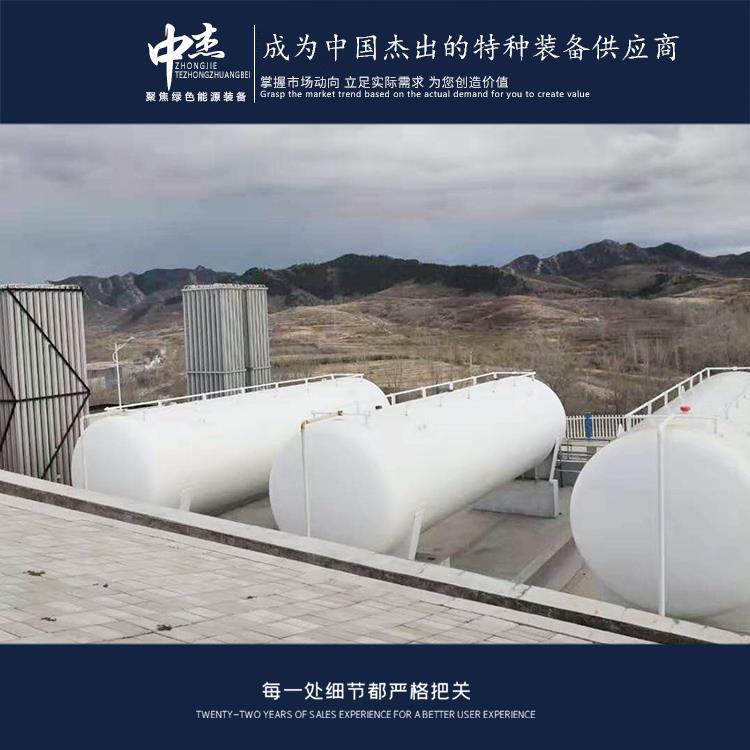


















Shandong Zhongjie Special Equipment (formerly Heze Boiler Factory Co., Ltd.) holds an A-grade boiler manufacturing license, an A2-grade pressure vessel manufacturing license, an A2-grade pressure vessel design license, a B-grade boiler installation license, and GB2/Class, GC2/Class pressure pipeline installation licenses, as well as a qualification for mechanical and electrical equipment installation contracting. It is a member of the China Boiler and Water Treatment Association, the China Chemical Equipment Association, and the council unit of the Shandong Equipment Manufacturing Association, and has passed the ISO9001 Quality Management System, ISO14001 Environmental Management System, OHSAS18001 Occupational Health and Safety Management System certifications, and the ASME/U2 certification from the United States.
Material control for low-temperature liquid storage tanks is a crucial aspect in ensuring their safety and reliability. Here are some common material control measures:
Material Selection: Choose materials suitable for low-temperature environments, such as low-temperature alloy steel, stainless steel, etc. These materials exhibit excellent low-temperature resistance and crack resistance, maintaining strength and toughness under低温 conditions.
Material Quality Control: Ensure the selected materials meet relevant standards and specifications. Conduct chemical composition analysis, mechanical property tests, and impact tests on the materials to guarantee their performance meets design requirements.
Welding Material Selection: Choose welding materials suitable for low-temperature environments, such as low-temperature welding rods or wires. The welding materials should match the storage tank material, with good welding properties and crack resistance.
Welding Process Control: Monitor welding process parameters such as welding current, voltage, and speed to ensure the quality and reliability of weld joints. Methods with low heat input, such as pulse welding and laser welding, can reduce the temperature gradient and residual stress in the heat-affected zone.
Corrosion Protection Measures: Apply corrosion-resistant treatments to both the internal and external metal surfaces of the storage tank to extend its service life. Options include corrosion-resistant coatings and paints to safeguard the tank's metal structure against corrosion.
Material Performance Monitoring: Regularly monitor the storage tank materials for performance, such as mechanical property tests,
To prevent the explosion of liquid oxygen tanks, the following measures can be taken:
Regular Inspections and Maintenance: Conduct regular inspections and maintenance on liquid oxygen tanks, including checking the tank's exterior, welds, valves, and fittings, to ensure they are intact and undamaged. Regularly clean the tank to remove any impurities and dirt adhering to its surface.
Pressure Control: Storage tanks should be equipped with pressure control devices to ensure internal pressure remains within safe limits. Regularly inspect and adjust the pressure control devices to ensure proper functioning.
Temperature Control: Liquid oxygen tanks should be maintained within an appropriate temperature range to avoid excessive heat causing increased pressure. Ensure the insulation layer of the tank is intact to minimize heat conduction and loss.
Fire Prevention Measures: Liquid oxygen has a high oxygen content and flammability, hence strict fire prevention measures are required. A fire-resistant buffer zone should be established around the storage tank, with smoking and open flames prohibited. Ensure that the storage tank maintains a safe distance from other facilities.
Pressure relief devices and safety valves: Liquid oxygen storage tanks should be equipped with pressure relief devices and safety valves to prevent overpressure and sudden pressure increases. Regularly inspect and test the operational status of the pressure relief devices and safety valves to ensure their proper functioning.
Tank Operation Standards: Adhere strictly to the operational specifications and safety requirements for liquid oxygen tanks. Operators must be trained and familiar with the tank's characteristics and operation techniques. Avoid operation errors and violations.
Emergency Preparedness: Establish emergency response plans and conduct drills to address potential accidents. Train operators in emergency response capabilities to ensure timely and effective responses.
To extend the service life of low-temperature liquid storage tanks, the following measures can be taken:
Regular inspections and maintenance: Conduct periodic visual inspections of the tank, including the shell, welds, valves, and connections. Check for any abnormalities such as cracks, corrosion, or deformation, and promptly repair or replace damaged parts.
Maintain Insulation: Insulation is crucial for the thermal preservation of low-temperature liquid storage tanks. Regularly inspect the integrity and insulating properties of the insulation, repair or replace damaged insulation materials to ensure the tank's insulating effectiveness.
Control temperature and pressure: The temperature and pressure of low-temperature liquid storage tanks should be maintained within a safe range. Avoid excessive or low temperatures and pressures that may damage the tank. Employ appropriate cooling or heating measures to ensure stable temperature and pressure of the liquid.
Corrosion Protection: The outer shell and internal structure of the storage tank should be protected against corrosion and oxidation. Regularly inspect and maintain the protective coating to ensure it remains intact.
Avoid excessive pressure and overfilling: Prevent the internal pressure of the tank from being too high or too low, as well as overfilling with liquid. Excessive pressure and overfilling can lead to structural cracks or damage to the tank.
Regular cleaning and waste removal: Periodically clean the interior of the tank to remove accumulated impurities and dirt. Regularly remove waste to prevent damage to the tank from impurities and sediments in the liquid.
Safety Operation and Training: Ensure operators are knowledgeable and skilled in the safe operation of low-temperature liquid storage tanks. Enhance safety training to boost operators' awareness and emergency response capabilities.
Manage records and documentation: Establish comprehensive management records and documentation, including the usage status of tanks
Liquid nitrogen tanks are equipment used for storing liquid nitrogen and are widely used in the following fields: Frozen Food and Refrigerated Logistics: Liquid nitrogen tanks are used in the frozen food and refrigerated logistics industry to freeze or refrigerate food and other perishable items, extending their shelf life and freshness. The low temperature of liquid nitrogen can quickly freeze food, prevent bacterial growth, and prevent food spoilage. Medical Research and Biomedical Engineering: Liquid nitrogen tanks are extensively used in the field to store biological samples, cells, tissues, and more. The low temperature of liquid nitrogen can effectively preserve the integrity and viability of biological materials, used in fields such as medical research, biomedical engineering, and transplantation. Laboratory Research: Liquid nitrogen tanks are used in scientific research and laboratories to provide liquid nitrogen as a coolant and freezing medium. The low temperature of liquid nitrogen can be used for cooling laboratory equipment, material research, superconducting electronics, and low-temperature physics. Metal Processing and Welding: Liquid nitrogen tanks are used in metal processing and welding to cool and control the temperature of metals. Liquid nitrogen can rapidly cool metals, improve the hardness and strength of metals, and reduce deformation and stress. Gas Storage and Supply: Liquid nitrogen tanks are also used for storing and supplying nitrogen gas. Liquid nitrogen can be evaporated into gaseous nitrogen for applications such as gas shielded welding, gas fire suppression systems, gas analysis, and laboratory gas supply. In summary, liquid nitrogen tanks are widely used in fields such as frozen food, laboratory research, metal processing, and gas supply, providing storage and supply functions for liquid nitrogen at application sites.
Shandong Zhongjie Special Equipment, welcome customers to visit our factory for business discussions.
WeChat Official Account

Scan to follow Official Account



















