







Provide SIL Certification, SIL Grading, and other consulting services — Shenzhen ZhongNuo Testing Technology Co., Ltd.
SIL 2 and SIL 3 certifications are two different levels. According to international certification standards, the SIL 3 level is higher than the SIL 2 level. Specifically:
An actuator of SIL1 rating should have a failure probability controlled at ≥10^-6 to <10^-5 per hour of continuous operation.
SIL2 is ≥10^-7 to <10^-6. SIL3 is ≥10^-8 to <10^-7.
Of course, the SIL3 level demands significantly higher requirements for the product than the SIL2 level does.
Most products currently meet the requirements with SIL 2 or SIL 3 certification levels.
As the awareness of industrial accidents and their impact on society grows, more and more companies recognize the importance of safety.
In modern process industry production, due to complex processes and numerous equipment, any failure can have severe consequences for employees, the public, equipment, or the environment.
The SIL certification process is about helping companies fully utilize their good engineering practices and safety technologies (IEC61508 and IEC61511) to prevent industrial accidents from recurring. This is because these experiences and technologies are based on a wealth of practical experience and lessons learned.
With the issuance of the IEC 61508 and IEC 61511 series standards, a systematic functional safety assessment and testing process can effectively address this issue.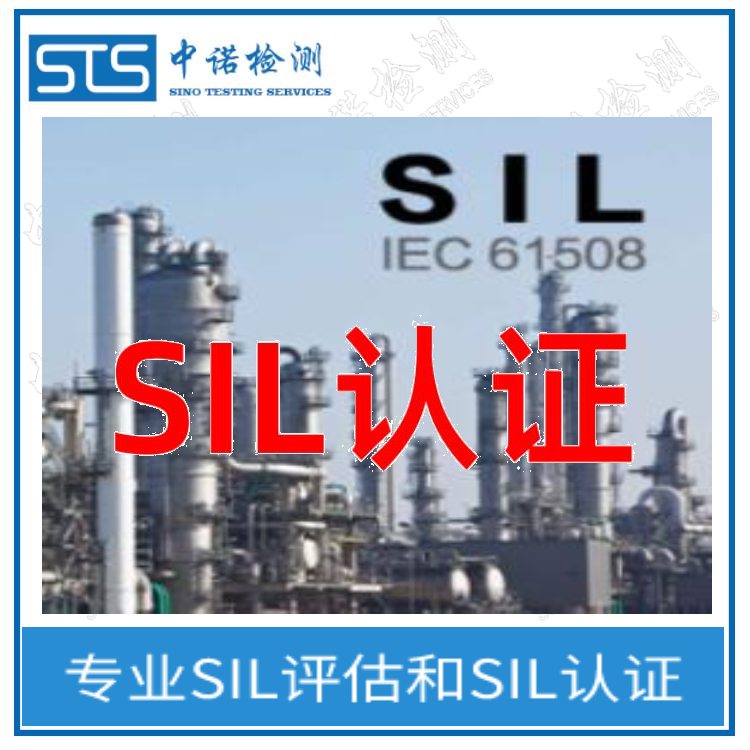
SIL Functional Safety Certification is applicable to all equipment used for implementing process control safety functions, mainly categorized into electrical components and safety systems.
1. Electrical Components: Actuators, solenoid valves, field sensors, pressure transmitters, temperature transmitters, level transmitters, level switches, programmable controllers, logic solvers, field safety actuators (pneumatic/liquid/pneumatic), safety switches, safety valves, cutoff valves, solenoid valves, safety interlocks, etc.
2. Safety Systems: SIS (Safety Instrumented System), ESD (Emergency Stop System), Instrument Protection System (IPS), Burn Management System (BMS), F&G (Fire and Gas Protection System), HIPPS (High Pressure Pipeline Protection System), PSD (Process Shutdown System).
3. Other: Electronic/Electrical/Programmable electronic products with safety requirements.
SIL Certification Fees and Timeline
The cost and timeline for SIL certification are directly related to the complexity of the product and the SIL level.
SIL Certification Standards
SIL Functional Safety Certification Standards: IEC 61508, IEC 61511, IEC 62061, ISO 26262, ISO 13849, etc.
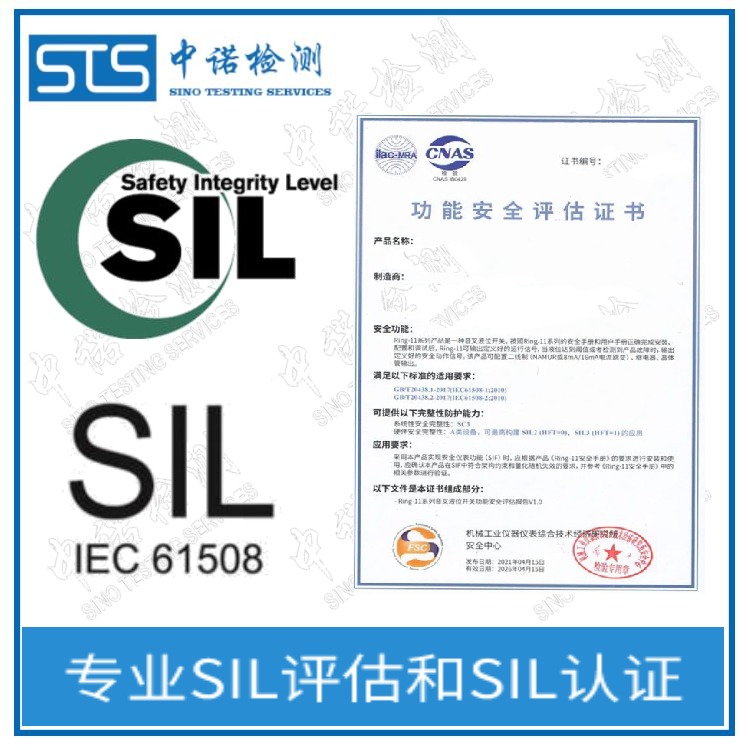
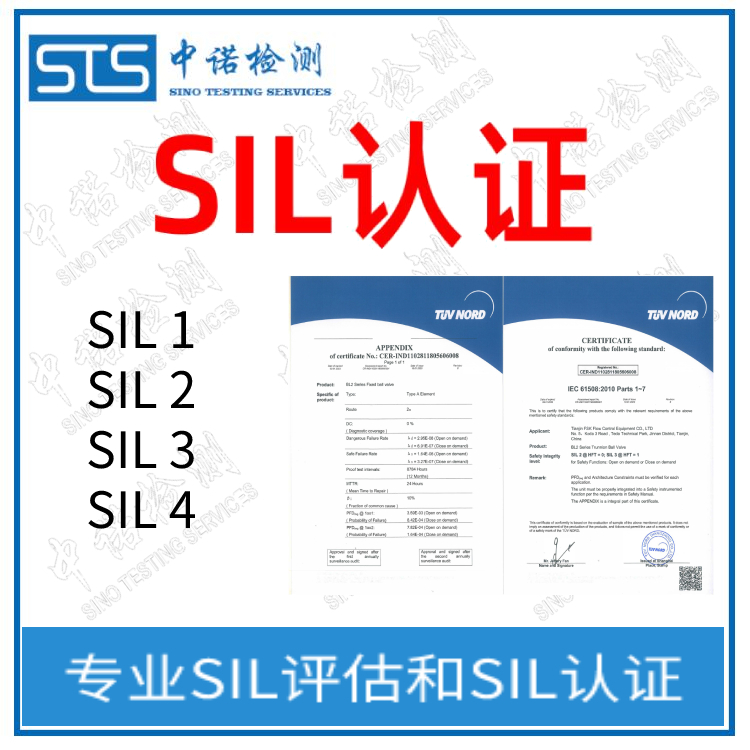
SIL certification is a third-party assessment, verification, and certification process based on standards such as IEC 61508 (GB/T 20438), IEC 61511 (GB/T 21109), IEC 61513, IEC 13849-1, IEC 62061, and IEC 61800-5-2, which evaluates and confirms the Safety Integrity Level (SIL) or Performance Level (PL) of safety equipment. Functional safety certification primarily involves document management (FSM) assessments for the development process of safety equipment, hardware reliability calculations and evaluations, software assessments, environmental testing, and EMC electromagnetic compatibility testing. SIL certification is divided into four levels: SIL1, SIL2, SIL3, and SIL4, encompassing both product and system levels, with SIL4 having the highest requirements.
WeChat Official Account

Scan to follow Official Account