







Provide SIL certification, SIL grading, and other consulting services - Shenzhen ZhongNuo Testing Technology Co., Ltd.
SIL functional safety certification is one of the crucial certifications for modern enterprises. In the modern industrial production characterized by mechanization, while instruments and machinery enhance production efficiency, the complexity of production processes and the precision of equipment can lead to uncontrollable variables and factors during the mechanized production process. For instance, equipment malfunctions, instrument shorts, and system failures can cause explosions, fires, and toxic gas leaks, posing severe threats to people's safety of life and property as well as the environment, even leading to catastrophic consequences.
How can we minimize or control this series of disasters and their consequences within an acceptable range?
Therefore, the SIL certification was born.
In fact, equipment failures occur at various stages of the product lifecycle, just with varying probabilities. SIL certification involves intervening at the outset of product design, managing the entire lifecycle of the product according to specific standards and mature regulations, thereby minimizing the likelihood of failures. This approach aims to control risks effectively.
SIL Functional Safety Certification is applicable to all equipment used to implement process control safety functions, mainly divided into electrical components and safety systems categories.
1. Electrical Components: Actuators, solenoid valves, field sensors, pressure transmitters, temperature transmitters, level transmitters, level switches, programmable controllers, logic solvers, field safety actuators (pneumatic/ hydraulic/ electric), safety switches, safety valves, cutoff valves, solenoid valves, safety interlocks, etc.
2. Safety Systems: SIS (Safety Instrumented System), ESD (Emergency Stop System), Instrument Protection System (IPS), Burn Management System (BMS), F&G (Fire and Gas Protection System), HIPPS (High-Pressure Pipeline Protection System), PSD (Process Shutdown System).
3. Other: Electronic/Electrical/Programmable electronic products with safety requirements.
What is the failure rate of SIL certification?
During the SIL certification process, a concept we often refer to is the equipment failure rate, which is a core term in SIL certification. It can be said that without determining the failure rate, the SIL certification is incomplete and inadequate. So, what exactly is the concept of failure rate?
Firstly, to understand failure rate, we must grasp what is meant by failure. According to GB/T 20438.4 and also the definition in IEC 61508, failure is "the termination of the ability of a functional unit to perform a required function, or the operation of the functional unit in a non-required manner." A more intuitive way to understand this is: normally, y = f(x), but after failure, it becomes y ≠ f(x), where f() represents the pre-set function, and y stands for our safety expectations. This also explains why "function" is the same word used for both function and function in English.
This statement might be too formal and not easily understood by the general public. So, speaking in colloquial terms, let's liken it to a lighting system. If the lighting system doesn't light up or fails to do so according to our set requirements, it's considered malfunctioning.
So said, you might know that when a product doesn't function according to our specified requirements, we can say it's failed. Then, what's the probability of this failure? That's the failure rate.
After understanding what a failure is, one can begin to classify the types of failures. In the concept of functional safety, failures can be divided into two main categories based on their generation causes: systematic failure and random hardware failure. Among them, random hardware failure is quantifiable. The calculation process of PFDavg is based on a probabilistic analysis of random hardware failure.
In the SIL certification, we aim to determine the product's failure rate by analyzing its theoretical model and leveraging empirical data from its market sales. This, combined with other parts of the SIL certification, forms a comprehensive system to ensure the reliable and safe execution of safety functions.
Safety Integrity Level (SIL), also known as SIL, is differentiated by the probability of hazardous failure occurring per hour.
There are four SIL levels specified in the international IEC standards, with SIL 4 indicating a high degree of integrity and SIL 1 representing a low one. For each safety integrity level, design specifications that can reduce design errors are stipulated.
The safety level required for the production process is assessed and determined by a specialized production technology company. Generally, for production processes with higher safety requirements, the required safety level is SIL 3.
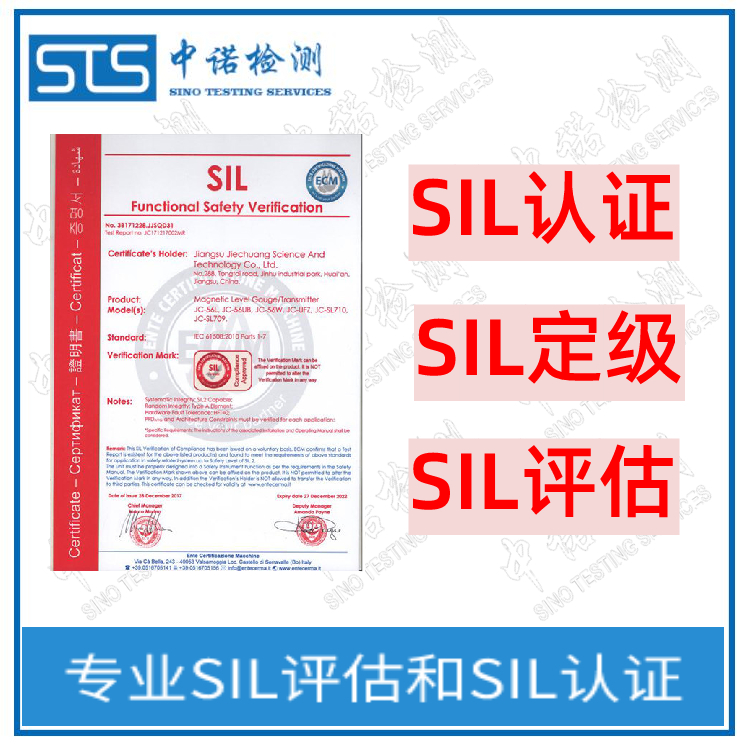
SIL certification is a third-party evaluation, verification, and certification based on standards such as IEC 61508 (GB/T 20438), IEC 61511 (GB/T 21109), IEC 61513, IEC 13849-1, IEC 62061, and IEC 61800-5-2, assessing and confirming the Safety Integrity Level (SIL) or Performance Level (PL) of safety equipment. Functional safety certification primarily involves document management (FSM) evaluation for the development process of safety equipment, hardware reliability calculations and assessments, software evaluations, environmental testing, and EMC electromagnetic compatibility tests. SIL certification is divided into four levels: SIL1, SIL2, SIL3, and SIL4, encompassing both product and system levels, with SIL4 being the most stringent.
WeChat Official Account

Scan to follow Official Account