



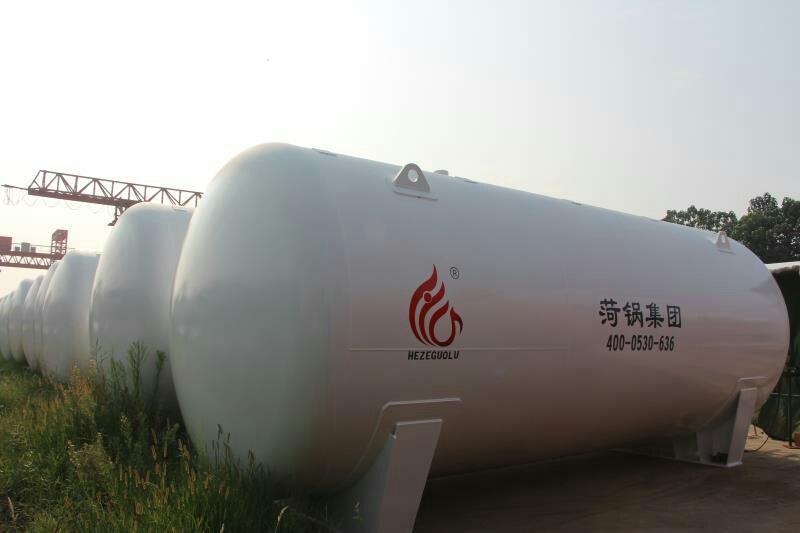


















Export 30 cubic meter LNG Storage Tanks, Manufacturer Supplies 5-150 cubic meter LNG Storage Tanks
LNG stands for Liquefied Natural Gas. Natural gas is a combustible gas naturally extracted from gas fields, primarily composed of methane. LNG is produced by cooling gaseous natural gas to -162°C under atmospheric pressure, causing it to condense into a liquid.液化天然气 significantly reduces storage and transportation space and costs, and it boasts high calorific value and superior performance.
LNG is a clean and efficient energy source. Importing LNG aids energy-consuming countries in diversifying their energy supply and ensuring energy security, while exporting LNG helps natural gas-producing countries effectively exploit their natural gas resources, increase foreign exchange earnings, and boost national economic development. Consequently, LNG trade is emerging as a new hot spot in the global energy market.

Overview of Liquid Low-Temperature Storage Tanks - LNG Storage Tanks
With the rapid development of the national economy and the widespread adoption of low-temperature technology, the application of low-temperature liquids has expanded significantly, including liquid hydrogen, liquid oxygen, liquid nitrogen, liquid argon, liquid helium, and liquefied natural gas. The production, application, and research of low-temperature liquids all necessitate their storage and transportation. Many important scientific research projects require operations in low-temperature environments. The demand for low-temperature storage and transportation containers is constantly increasing across various industries, particularly in industrial, agricultural, defense research, and medical fields.
Due to the low boiling point and small latent heat of vaporization of low-temperature liquids, a considerable cost is incurred to obtain low-temperature liquefied gases. Therefore, the effective storage and transportation of low-temperature liquids hold significant economic value. In the application of low-temperature technology, the following situations often arise:
(1) Centralized production followed by distribution to various users, such as the centralized production and distribution of liquid oxygen, liquid nitrogen, liquid argon, liquefied natural gas, liquefied petroleum gas, and liquid helium.
(2) Products produced for short-term use are intended for long-term application, such as the case where many testing and medical units produce liquid oxygen with their own liquid oxygen generators.
(3) Long-term production for short-term, concentrated use, such as for large-scale low-temperature testing or rocket launches, involves the supply of liquid helium, liquid hydrogen, liquid oxygen, and liquid nitrogen using this method.
To accommodate the above situations, effective storage and transportation of low-temperature liquids are essential. For departments that use gases, using liquid transportation is also quite economical. For instance, a 3650 L liquid oxygen storage tank holds liquid oxygen with a total weight not exceeding 1250 kg. If stored as gas, it would require 500 steel cylinders, weighing 35500 kg. Also, a 175L liquid oxygen tank with an evaporator, mounted on a small cart, is convenient to carry and can replace 20 oxygen cylinders for welding purposes. In summary, almost all applications involving low temperatures rely on the storage and transportation of low-temperature liquids, and naturally, the equipment used for storing these liquids. Therefore, the storage and transportation of low-temperature liquids are a fundamental task in low-temperature engineering and also the fastest-developing technology in the field in the past 30 years.

Export 30 cubic meter LNG tanks, manufacturers supply 5-150 cubic meter LNG tanks
Product Description

Brand Hekou Group Model CFW-60/0.8
Material: Stainless Steel, Diameter: 2916mm
Application Range -162℃ Volume 60000L
Heat Exchange Area - See drawing m², Ambient Temperature - See drawing °C
Wall Thickness: 8mm, Outer Dimensions: φ2916*14929mm
Origin: Shandong Heze
Horizontal 60-cubic-meter LNG Storage Tank, Manufacturer of Liquefied Natural Gas Storage Tanks
LNG tanks are low-temperature insulated pressure vessels that can be refilled multiple times. They feature high gas tightness, low thermal conductivity, excellent insulation properties, minimal evaporation loss, and a long service life. They have been mass-produced through a continuous production line. Heze Boiler Factory produces 3-cubic, 5-cubic, 10-cubic, 15-cubic, 20-cubic, 30-cubic, 50-cubic, 60-cubic, and 100-cubic low-temperature LNG tanks, as well as customized specifications.
The operational pressure of the LNG low-temperature storage tank is 0.6-1.44 MPa, with an operating temperature of -162°C, and it has a flat, double-walled cylindrical design. The tank is composed of two layers, with an insulating structure between them serving as the cold insulation layer. The inner tank is used for storing liquefied natural gas, while the outer shell provides protection and insulation. To minimize heat transfer from the outside to the tank, the inner and outer shells are designed separately and independently. The tank consists of a carbon steel vacuum shell and a pressure vessel placed within it. The tank can be operated under low to medium pressure as per actual design requirements. The explosion-proof diaphragm and safety valve can protect the tank in case of excess pressure. The pressure relief device is designed to protect the internal pressure vessel and vacuum shell, and its use and model are in accordance with GB150 and "Fixed Container Regulations." This includes a double safety relief valve and explosion-proof device for protecting the internal pressure vessel, and an explosion-proof cover for protecting the vacuum shell (outer shell). The tank is designed and manufactured for safety, reliable operation, and durability (capable of operation without fault for many years). When operating the tank, strict adherence to proper safety and operating procedures is mandatory.
LNG storage tanks are the main equipment at LNG gasification stations, directly affecting their normal production and accounting for a significant portion of the construction cost. They can be categorized into underground tanks, above-ground metal tanks, and metal prestressed concrete tanks. For LNG storage tanks, there are currently vacuum powder insulation tanks, positive pressure packed insulation tanks, and high vacuum layer insulation tanks. Medium and small-scale gasification stations typically opt for vacuum powder insulation low-temperature tanks. The tanks are divided into inner and outer layers, with the gap filled with pearly sand and vacuumed to reduce the transmission of external heat, ensuring that the daily gasification rate of LNG inside the tank is less than 0.3%.

Horizontal 60 Cubic Meters LNG Storage Tank, Manufacturer of Liquefied Natural Gas Storage Tanks


Standard Liquefied Natural Gas Tanks - Sell Liquefied Natural Gas Tanks - Professional Liquefied Natural Gas Tank Phone - Best Quality Liquefied Natural Gas Tanks



















