



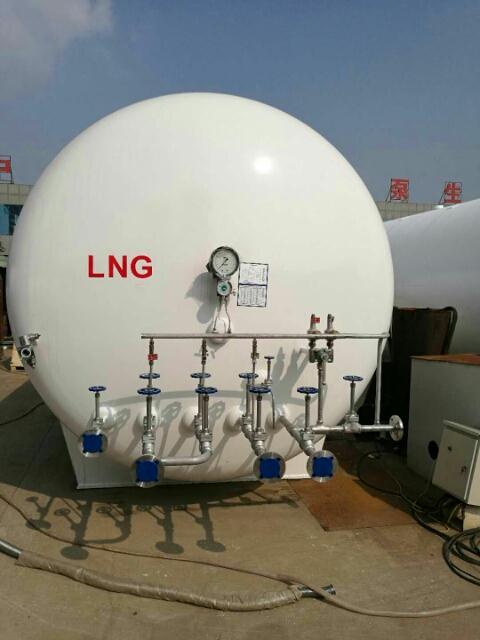

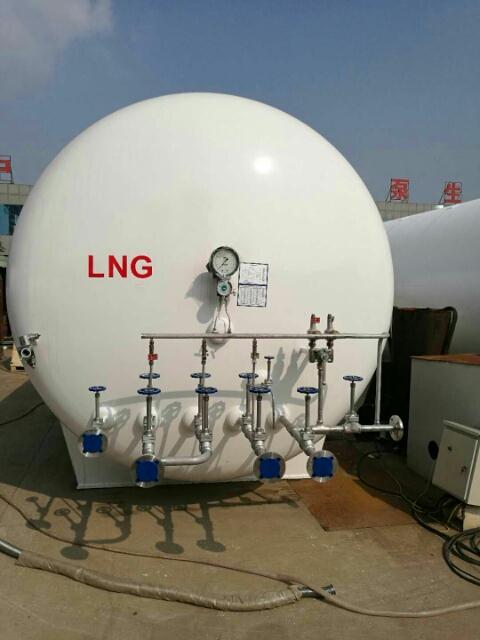
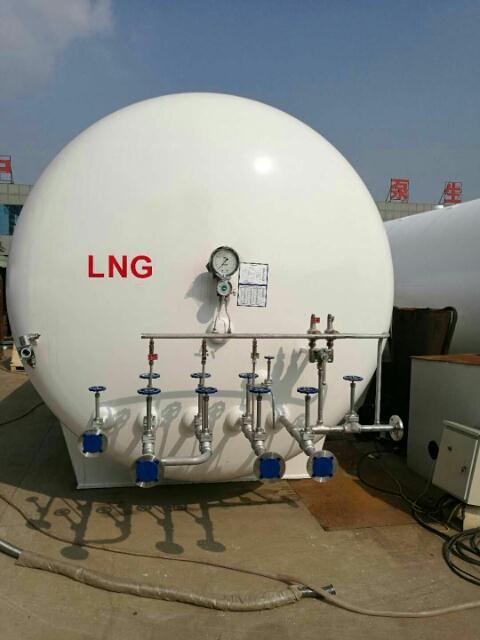



















The LNG storage tank is a double-walled structure, comprising an inner tank, an outer tank, internal and external supports, an insulating layer, a pressure safety system, a vacuum pump, and a pipeline system. All vacuum-insulated structures rely on vacuum. Due to the high degassing rate and suction resistance of the insulating space materials, and the inability to exceed high roasting temperatures for sealing materials that degas slowly, suction is challenging. To achieve the required vacuum level within the design-specified vacuum time, besides the vacuum pump and suction process, it also relates to the flow area of the annular suction pipes. To ensure a high vacuum level and improve suction speed, a vacuum pump is installed at both ends of the equipment. One vacuum pump consists of three suction pipes, placed in the lower half of the annular space and extending from the bottom, while the other consists of three suction pipes as well, but placed in the upper half of the annular space and extending from the top. The two groups of suction pipes cross and overlap along the tank's length. By increasing the flow area of the suction pipes and using various auxiliary methods such as heating and nitrogen displacement, the vacuum achievement time for the annular insulating space of 100m³ is reduced to one-third of the conventional structure.
Cautionary Notes
1. Cylinders must be stored in well-ventilated areas, maintaining a distance of at least 1.5 meters from any fire or heat source. Cylinders are strictly prohibited from being heated with fire, boiled, or exposed to direct sunlight. Regular inspections of cylinder valves and pipeline joints for airtightness are required to ensure no leaks. Leaks can be checked with soap water, and it is strictly forbidden to test for leaks using an open flame.
2. When lighting, always ignite the primer first, followed by opening the gas; do not reverse the order. There should be someone supervising during use to prevent boiling water from spilling and extinguishing the flame, which could cause the gas flow to surge and lead to an explosion. After using the gas cylinder, ensure the valve is tightly closed to prevent gas leakage.
3. Do not empty the liquefied gas inside the cylinder completely; a certain residual pressure should be maintained. The residual pressure should generally be greater than 49.03 kPa (i.e., 0.5 kg/cm², gauge pressure) to prevent air from entering the cylinder. After the liquefied petroleum gas is used up, the remaining residue inside the cylinder is also a flammable substance and must not be poured out arbitrarily to avoid fire due to the leakage and evaporation of the residue.
4. LPG cylinders are pressurized containers that require proper maintenance and regular inspections. Prevent the cylinders from falling or being struck during handling and use. Do not use metal tools to敲击 open the valve, and avoid direct sunlight exposure and prolonged rain. The cylinders should be inspected every 2 years.
5. Although the explosive range of liquefied petroleum gas (LPG) is not very wide, its lower limit is small, making it easy to ignite and explode upon leakage. Additionally, as LPG is heavier than air, it tends to flow downward upon leakage in the air, accumulating in low-lying areas and posing a hidden danger of gas explosion. Therefore, in areas where gas leakage is likely, relying solely on window ventilation is insufficient; attention must also be given to lower-level ventilation.
6. When a liquefied gas leak is detected indoors, immediately open windows and doors for ventilation, allowing it to disperse towards a direction without open flames. It is strictly forbidden to ignite any fire nearby. The area should only be used after the fault is resolved and the distinctive odor has dissipated. Any leaked liquid on the ground should be covered with sand and soil before being removed to a safe location. In case of a gas cylinder fire, immediately close the valve, move it to an open area outdoors, and extinguish the fire using dry powder extinguishers, carbon dioxide extinguishers, or by covering it with a wet sack.
7. Educate children not to tamper with gas cylinders carelessly, and users must be aware of the safety knowledge for using gas cylinders.


Well-known Natural Gas Storage Tank Pricing - Professional Natural Gas Storage Tanks - Top 10 Natural Gas Storage Tank Brands - Where to Find Natural Gas Storage Tank Pricing



















