







Offer SIL Certification, SIL Grading, and other consulting services - Shenzhen Zhongnuo Testing Technology Co., Ltd.
SIL 2 and SIL 3 certifications are two different levels. According to international certification standards, the SIL 3 level is higher than the SIL 2 level. Specifically, this is represented as:
An actuator of SIL1 rating should have a failure probability controlled at ≥10^-6 to <10^-5 per hour of continuous operation.
SIL2 is from ≥10^-7 to <10^-6. SIL3 is from ≥10^-8 to <10^-7.
Certainly, the product requirements for SIL3 level are much higher than those for SIL2.
Most products currently require only SIL2 or SIL3 certification levels to meet the requirements.
SIL Certification Fees and Timeline
The cost and timeline for SIL certification are directly related to the complexity of the product and the SIL level.
SIL Certification Standards
SIL Functional Safety Certification Standards: IEC 61508, IEC 61511, IEC 62061, ISO 26262, ISO 13849, etc.
What is the failure rate of SIL certification?
During the SIL certification process, a concept we often refer to is the equipment failure rate, which is a core term in SIL certification. It can be said that without determining the failure rate, the SIL certification is incomplete and inadequate. So, what exactly is the concept of failure rate?
Firstly, to understand failure rates, we need to know what "failure" means. According to GB/T 20438.4 and also the definition in IEC 61508, failure is "the termination of the ability of a functional unit to perform a required function, or the operation of the functional unit in a non-required manner." A more intuitive understanding would be: normally, y = f(x), but after failure, it becomes y ≠ f(x), where f() represents the predefined function, and y denotes our safety expectation. This also explains why "function" is the same word used for both "function" and "function" in English.
This statement might be too formal and not easily understood by the general public. So, speaking in layman's terms, let's liken it to a lighting system. If the lighting system doesn't light up or doesn't light up according to our set requirements, it's considered to be malfunctioning.
So said, everyone may know that when a product doesn't function according to our set requirements, we can say it has failed. Then, what's the probability of this failure? That's the failure rate.
After understanding what a failure is, we can begin to classify the types of failures. In the concept of functional safety, failures can be divided into two main categories based on their cause of generation: systematic failure and random hardware failure. Among them, random hardware failure is quantifiable. The calculation process of PFDavg is based on a probabilistic analysis of random hardware failure.
In the SIL certification, we aim to determine the product's failure rate by analyzing the theoretical model and utilizing empirical data from the product's market sales, thereby integrating it with other parts of the SIL certification to form a comprehensive system, ensuring the reliable and safe execution of safety functions.
The significance of obtaining SIL certification for products
1. The impact of SIL certification on product accumulation:
We guarantee the accuracy of the product's specific functions.
(2) Enhance product acceptance and recognition within the industry.
(3) Certified products offer enhanced safety, thereby boosting the competitiveness of the products.
(4) Customers generally perceive: Certified = Acknowledged = The.
2. The cumulative impact of SIL certification on the enterprise:
(1) Enhance the company's safety experience and level.
(3) The corporate R&D process is more standardized and verifiable.
(4) Enhanced safety guarantees are in place during incidents.
(5) Throughout the certification process, ensure the company maintains a high level of R&D.
If a project, system, or product achieves SIL certification, its quality and safety are also recognized and acknowledged. This not only enhances the company's market competitiveness but greatly strengthens customers' confidence in the product. Therefore, it is necessary to obtain SIL certification for a product that significantly impacts life and property safety.
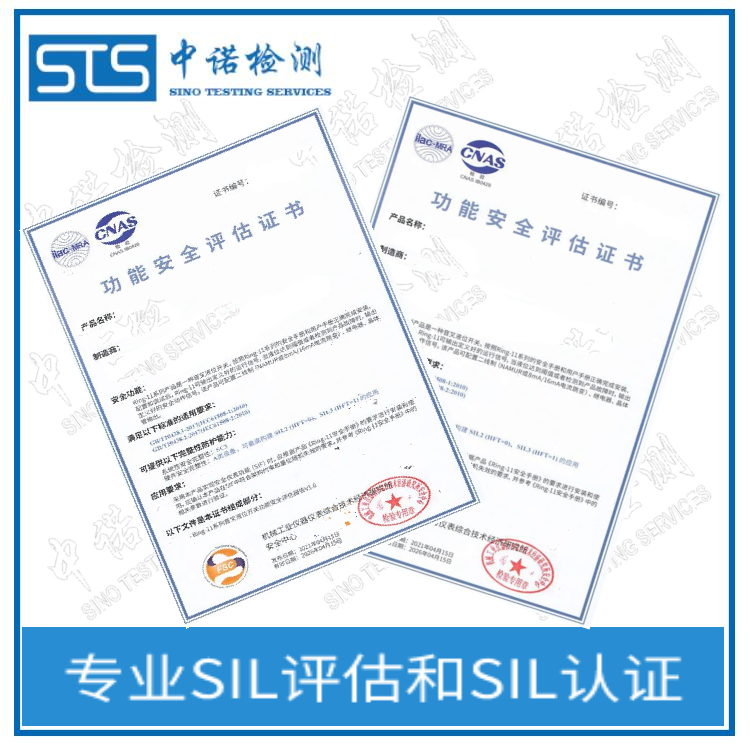
SIL certification is a third-party assessment, verification, and certification that evaluates and confirms the Safety Integrity Level (SIL) or Performance Level (PL) of safety equipment based on standards such as IEC 61508 (GB/T 20438), IEC 61511 (GB/T 21109), IEC 61513, IEC 13849-1, IEC 62061, and IEC 61800-5-2. Functional safety certification primarily involves assessments of document management (FSM) for the development process of safety equipment, hardware reliability calculations and evaluations, software assessments, environmental testing, and EMC electromagnetic compatibility testing. SIL certification is divided into four levels: SIL1, SIL2, SIL3, and SIL4, encompassing both product and system levels, with SIL4 being the most stringent.
WeChat Official Account

Scan to follow Official Account