







Offer SIL Certification and SIL Grading Consultancy Services — Shenzhen Zhongnuo Testing Technology Co., Ltd.
The SIL level assessment covers the following content:
1. System Evaluation
-Risk analysis, classification based on risk diagram (ASIL/SIL/PL)
Review of specifications and safety requirements
Concept and Design Analysis
- Verification and Confirmation
2. Software and Tool Assessment
- Testing of development tools and other communication protocols
Structural Analysis
3. Hardware Evaluation
Probability Analysis
Failure Analysis
4. SIL Certification
Components and Systems SIL Certification
- Safety Process SIL Certification
- Granting of system, semiconductor, development tools, and process testing symbols
5. Additional Services
- Risk Applicability and Risk Analysis
- Test and evaluate hardware and software for security during the development process
Conceptual Evaluation (Initial Inspection)
Functional Safety Management (FSM)
Safety, Reliability, and Availability Analysis
Qualified Assessment in Compliance with Relevant Safety Standards
These services cater to manufacturers of automotive (including electric) components, elevators, power plants, machinery, and systems in the process industry. They provide support for fulfilling due diligence obligations and ensure the correct application of the standard, contributing to enhanced safety levels and helping to minimize residual risks. Standards such as IEC 61508 and others can be seamlessly integrated into existing quality management systems. The implementation of regulations and provisions within these standards provides a reliable basis for decision-making, particularly regarding safety structures, testing procedures, and tools. Development outputs can be verified at an early stage, thereby reducing development time and costs. Moreover, certification enhances the company's image, boosting its competitive standing in the market.
What are the two main aspects that the SIL certification primarily evaluates?
The product itself, as well as the conformity of the hardware and software functionalities of the intended certified product, to the requirements of IEC61508 or more detailed industry-specific functional safety standards, such as hardware failure rates and failure modes.
Another key focus of our evaluation is the quality management system used during the development process, the qualifications of the R&D personnel, and the organizational structure, ensuring that the methods adopted and the document systems followed throughout the product development meet the relevant standards requirements.
Through these two aspects of examination, we can say that from the entire company to the R&D process and finally to the formation of specific certified products, a complete closed loop has been formed, ensuring that the product's safety features are reliably and safely implemented.
SIL Functional Safety Certification is applicable to all equipment used to implement process control safety functions, mainly divided into electrical components and safety systems categories.
1. Electrical Components: Actuators, solenoid valves, field sensors, pressure transmitters, temperature transmitters, level transmitters, level switches, programmable logic controllers, logic solvers, field safety actuators (pneumatic/ hydraulic/ electric), safety switches, safety valves, cut-off valves, solenoid valves, safety interlocks, etc.
2. Safety Systems: SIS (Safety Instrumented System), ESD (Emergency Shutdown System), Instrument Protection System (IPS), Burner Management System (BMS), F&G (Fire and Gas Protection System), HIPPS (High-Pressure Pipeline Protection System), PSD (Process Shutdown System).
3. Other: Electronic/Electrical/Programmable electronic products with safety requirements.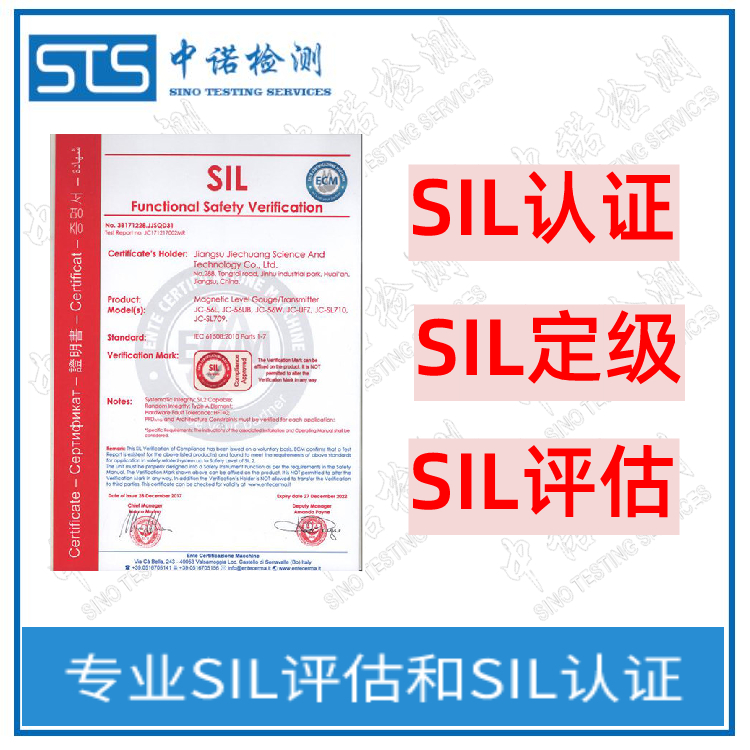
SIL certification, also known as Functional Safety Certification, focuses on the safety functions of the product. Obtaining SIL certification is to verify whether these safety functions can be reliably and safely implemented.
For instance, with a lighting fixture, we're concerned with its lighting function, whether its light intensity can reliably and safely meet our requirements.
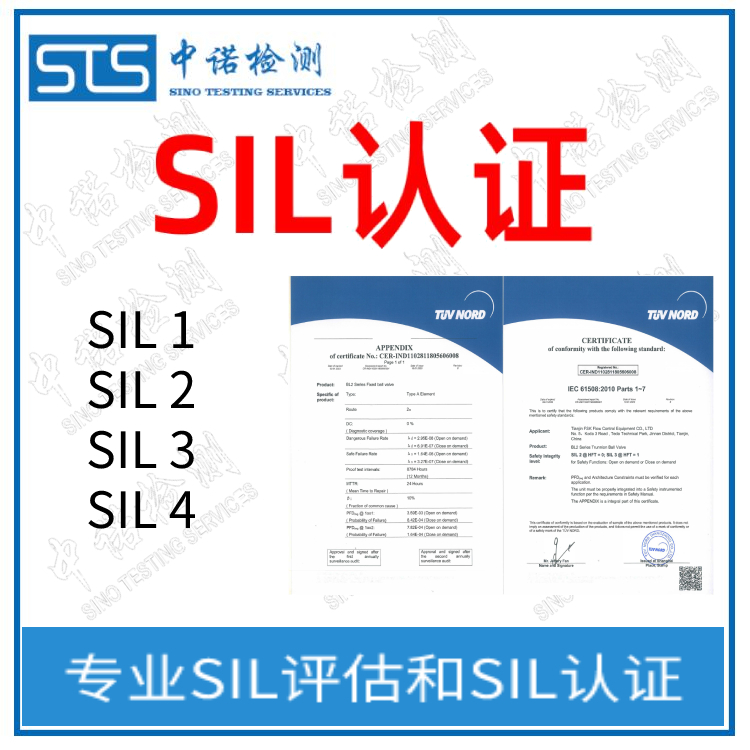
SIL certification is a third-party assessment, verification, and certification based on standards such as IEC 61508 (GB/T 20438), IEC 61511 (GB/T 21109), IEC 61513, IEC 13849-1, IEC 62061, and IEC 61800-5-2, evaluating and confirming the Safety Integrity Level (SIL) or Performance Level (PL) of safety equipment. Functional safety certification primarily involves document management (FSM) assessments for the development process of safety equipment, hardware reliability calculations and evaluations, software evaluations, environmental testing, and EMC electromagnetic compatibility testing. SIL certification is divided into four levels: SIL1, SIL2, SIL3, and SIL4, covering both product and system levels, with SIL4 being the most stringent.
WeChat Official Account

Scan to follow Official Account