









Detailed introduction of dryer sprockets, a full range of dryer accessories available with reliable quality, competitive prices. Our factory is equipped with comprehensive processing facilities and has strong technical strength. We cast and process sprockets for various types of drum dryers, dryer cast steel rings, drum dryer support and stop wheels for single and triple drum dryers.

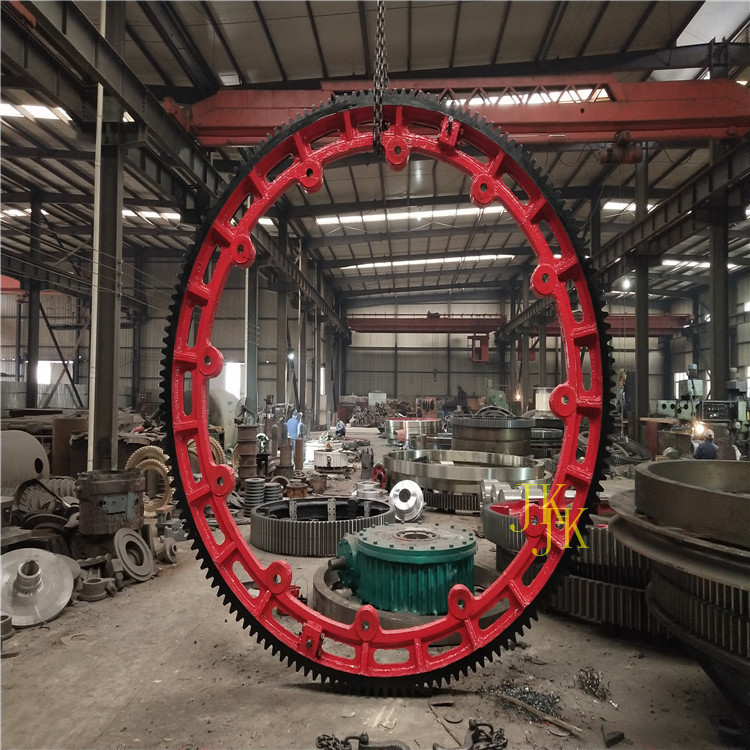
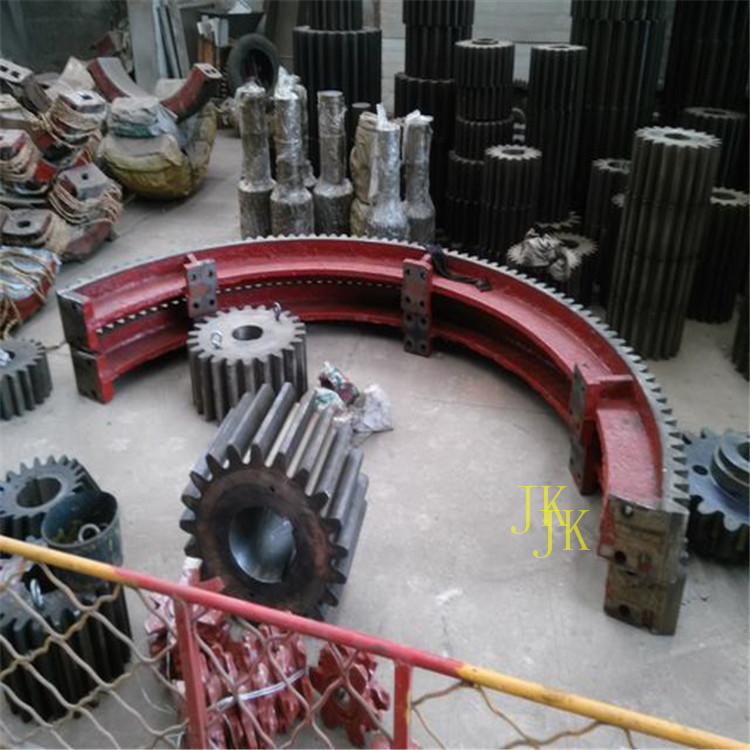
This article offers a superficial analysis based on years of production and sales experience regarding the module of the large and small gears of the dryer, the assembly of the small gears, the lubrication of the large and small gears, and the processing technical requirements for the large gear ring of the dryer. Please come or write for business negotiations if needed. Dryer large gears come in various types. Each manufacturer designing dryers considers their production and load-bearing capacity, resulting in different types of large gears. Generally, they can be categorized into flange-connected and spring-plate-connected types. The flange-connected large gear of the dryer is less commonly used, typically found on small dryers.

Spring plate connected dryer large gear, due to its structural characteristics, plays a buffering role in transmission and is widely used in practical applications. Therefore, when replacing the large and small gears of a dryer, one must first check the dryer's specifications and whether the large gear is a standard component. Many manufacturers sell standard components, but if it's not a standard component and there is no drawing, it is essential to find a professional to accurately measure the dryer's large gear's outer diameter, inner diameter, pitch distance, width, and number of teeth. Look for a professional manufacturer with design and production capabilities to customize and process. The dryer gear module is the ratio of the pitch t between the same side teeth of adjacent gears to the circumference π (m=t/π), measured in millimeters. The module is a basic parameter of the module system for gear teeth. The larger the module, the taller and thicker the teeth, and if the number of teeth on the gear is fixed, the radial size of the wheel will also be larger. The module series standard is formulated based on design, manufacturing, and inspection requirements. The size of the module determines the size of the individual tooth shape, not the size of the gear, and is unrelated to the pressure angle. The module and pressure angle are considered by designers when designing the service life of gears, as they are equal strength designs. In this case, the size of the pressure angle must be considered. For equal life designs, the module size of the driving and driven gears must be considered. If the driving gear has fewer teeth, the module will be larger, and the tooth shape will be thicker. If the driven gear has more teeth, the module will be smaller, and the tooth shape will be thinner. In the past, the lubricating oil used for the large and small gears of the dryer was 460 or 680 grade mineral oil and 220 or 320 grade asphalt gear oil. The former has good low-temperature performance but poor adhesion and severe leakage, making it difficult for the gear surface to form a protective film, leading to bright and worn gear surfaces. The latter, although with good adhesion, has poor low-temperature performance, making it difficult to add during winter, and after long-term use, the gear surface may experience some pitting due to the presence of a small amount of sulfur compounds in the asphalt. Assembly of the dryer small gear: Correctly position the small gear assembly according to the centering plate, ensuring the transverse centerline error with the large gear is less than 2mm. Adjust the top clearance between the large and small gears, which should be 0.25 module (standard tooth clearance) plus the thermal expansion of the large gear. Pay attention to measuring and determining the top clearance at the large gear's radial跳动 areas. Adjust the contact accuracy between the large and small gears, ensuring that the tooth surface contact marks along the tooth length are not less than 70% and along the tooth height are not less than 40%.













