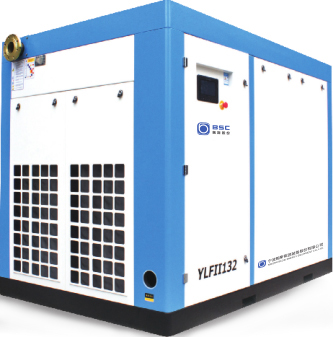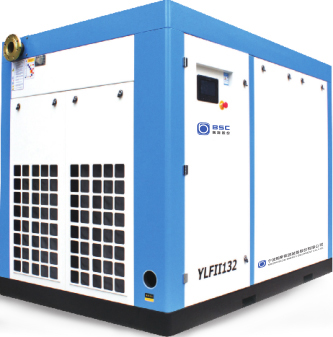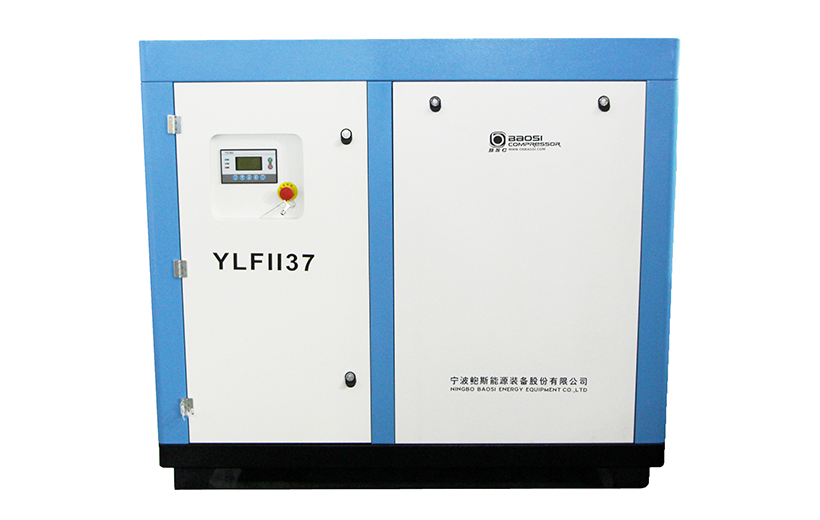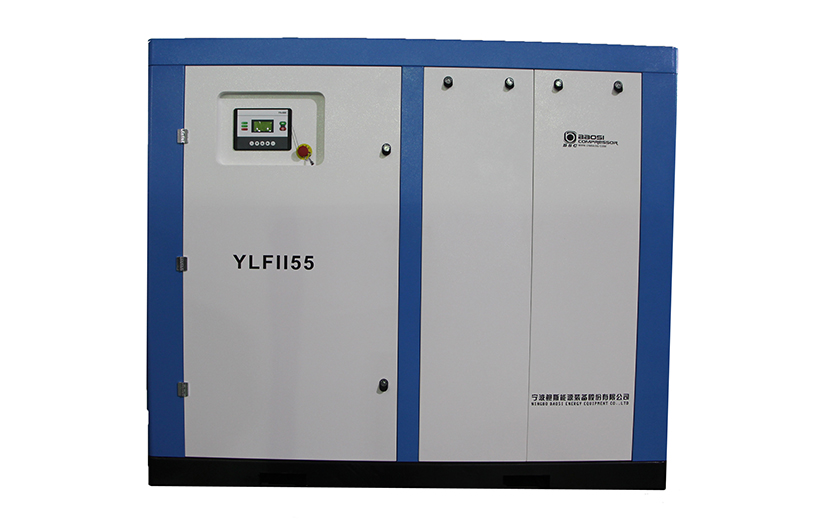
Foshan manufacturer supplies two-stage energy-saving screw air compressors. 1. The two-stage main unit features two independent compression units, upper and lower, designed with an integrated approach. 2. The exhaust end of the two-stage main unit employs a face-to-face configuration of double cone bearings, with one main unit containing 15 bearings. These are imported from brands like FAG, NTN, NSK, and have a bearing design life exceeding 60,000 hours. 3. The main unit is designed with a large rotor at a low rotational speed, with the main bearing running at 1480 RPM, resulting in low noise and minimal vibration. Energy-saving principle: After air is compressed in the first stage, a misting forced oil cooling is applied before entering the second stage, lowering the intake temperature of the second stage. This allows the air to be closer to isothermal compression throughout the compression process, enhancing the adiabatic efficiency and thereby reducing energy consumption. The two-stage energy-saving main unit employs an isentropic pressure ratio design, with each stage having a relatively low pressure ratio. This reduces the leakage rate between rotors during the compression process, significantly improving the volumetric efficiency. The volumetric efficiency of a single-stage compression unit is typically around 90%, whereas the two-stage energy-saving unit's efficiency can reach about 93%. Consequently, the two-stage energy-saving unit is more energy-efficient than a single unit. Under the same exhaust volume and pressure conditions, the two-stage unit can reduce energy consumption by approximately 15% compared to a single-stage unit. Additionally, under the same power consumption and exhaust pressure conditions, the two-stage unit can handle approximately 15% more air volume than the single-stage unit.