









What tests are required for the Korean KCC certification of LCD displays?
Firstly, let's understand the KCC Certification:
KCC: The Korea Communications Commission (KCC), as stipulated by Article 33 of the Korean Electrical Communications Basic Act and Articles 46 and 57 of the Radio Wave Act, has established a general communication equipment certification system. This system requires that all products specified in Article 3 of the General Communication Equipment Certification Regulations, produced, imported, or sold, must obtain the KC certification prior. The KC mark is derived from the MIC mark. Due to the replacement of the former Korean Ministry of Information and Communication (MIC, Ministry of Communications and Information) by the Korea Communications Commission (KCC), the name of the certification has been correspondingly changed. The KCC certification came into effect on January 11, 2008, and will be further transformed into the KCC mark on January 1, 201X. KCC regulates the electromagnetic compatibility requirements for information products and the certification of wireless transmission and communication products, including electrical communication equipment, wireless radio frequency products, and information technology equipment.
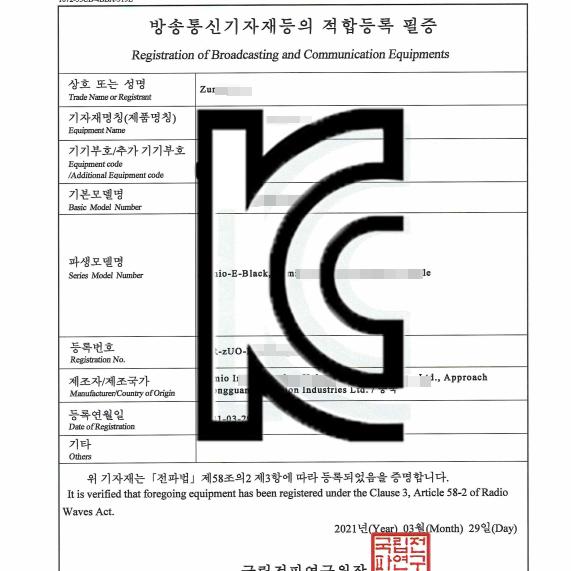
The KCC mark is a certification symbol issued by the Korea Radio Research Agency (RRA) under the Korea Communications Commission.
KCC Certification Product Range
Information Equipment (EMC Registration) - Computer peripherals including office electronic products connected to network cables, such as AC/DC, e.g., computers, printers, monitors, routers, etc.; Wireless Devices (Type Certification or Type Registration)
1) Certain automatic wireless communication receivers (type verification; only available for testing at the RRA lab):
2) Products applicable to the general public such as mobile phones, Bluetooth devices, car locks, wireless mice, etc. (Type Registration, Type Registration).
Wired communication equipment (Type Approval) (for all electronic products connected to telephone lines) such as telephones, switches, modems, faxes, etc., which require both communication testing and EMC testing. KCC certification documents
1. Copy of business license
2. Electrical schematics, wiring diagrams
3. List of key components (including LVD and EMC lists), along with KC and CB certificates and reports (with Korean discrepancies to be retested), Korean user manuals and maintenance guides, and Korean labels and warning signs. 4. Copy of trademark registration certificate (if trademark is applied for).
5. At least 2 sample units required;
6. Approximately 6 amplifier boards are available, along with about 6 transformers.
LCD display screens require the following test items for the KCC certification in South Korea; passing these tests allows for the acquisition of the KCC certificate.
Conduction interference
Radiation Interference
Electrostatic interference
Surge
Harmonic Current
Voltage Sag and Short Interruption
Electrical fast transient pulse groups
So, obtaining the KCC certification for LCD screens in South Korea is not complicated. The general procedure involves conducting a pre-test domestically, ensuring good test results and leaving a margin to accommodate differences between laboratories. Then, the samples are sent to South Korea for certification testing, where they typically pass in one go, after which the KCC certificate is obtained.

If you need Korean KC certification or KCC certification for your products, please contact the phone number on the right or scan the WeChat QR code for more information.













