










Scope of Application
1. Secondary grouting of equipment foundation and steel structure column base plate.
2. Anchor grouting of foundation bolts.
3. Concrete structure reinforcement grouting.
Sleeve grouting material manufacturer wholesale Jining city grouting material C60 equipment installation

Grinding and polishing: The purpose of grinding and polishing is to further process the sawn rough board to achieve the required thickness, flatness, and glossiness. Cutting processing: Cutting processing is the process of shaping and cutting rough or polished plates according to the required specifications and dimensions using a cutting machine. Chiseling processing: Chiseling processing is a traditional processing method that processes rough blanks into desired products through methods such as wedging, chiseling, chopping, trimming, and polishing. Burnt processing: Burnt processing, also known as fire burning processing or spray burning processing, is the process of using the difference in thermal expansion coefficients of different mineral particles that make up granite, and using flame spraying to cause the surface particles to expand, break, and fall off, forming undulating and orderly rough surface patterns.
Construction preparation
1. Quality management at the construction site should have corresponding construction technical standards, a sound quality management system, construction quality control, and quality inspection systems. Before grouting, there should be a construction organization design or construction technical plan, which should be reviewed and approved.
Before grouting construction, mixing equipment, grouting devices, templates, and maintenance items should be prepared.
3. In addition to complying with the relevant provisions of the current national standard "Code for Acceptance of Construction Quality of Concrete Structures" GB 50204, formwork support should also comply with the following regulations:
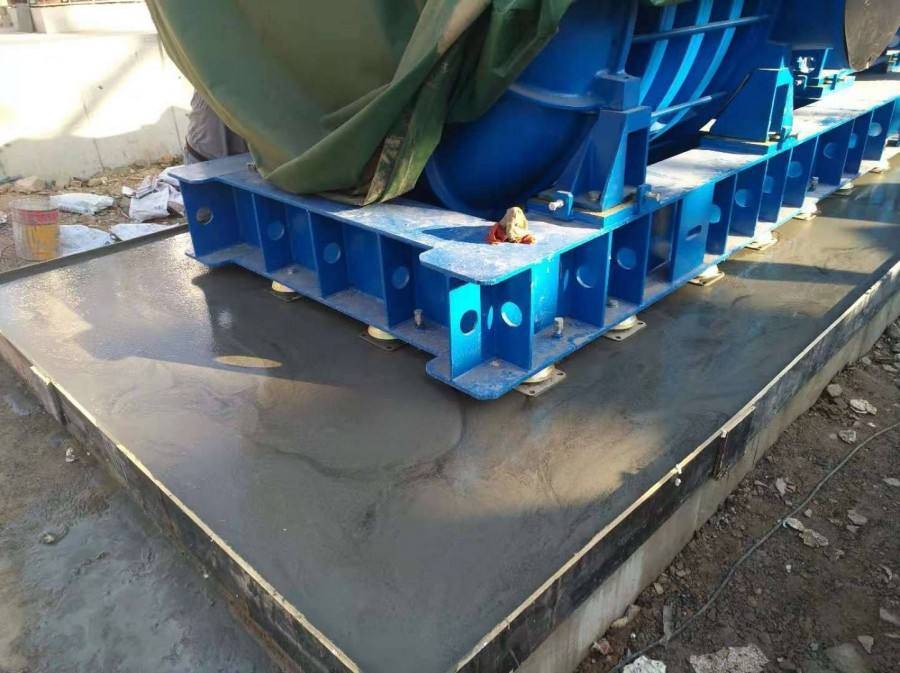
① During secondary grouting, the horizontal distance between the formwork and the equipment base should be controlled at around 100mm; The top elevation of the template should not be lower than 50mm above the surface of the equipment base.
② When renovating and reinforcing concrete structures, sufficient grouting holes and exhaust holes should be left in the formwork support. The diameter of the grouting holes should not be less than 50mm, and the spacing should not exceed 1000mm. The grouting holes and exhaust holes should be 50mm higher than the high point of the holes.
Sleeve grouting material manufacturer wholesale Jining city grouting material C60 equipment installation

The processing process of granite standard slabs uses a crane to load the raw materials onto a waste truck, which is then transported by a shuttle truck to the frame type sand saw working position for sawing into rough slabs. The slabs are then sent to grinding, polishing, cutting and other processes for processing into smooth slabs, and finally inspected, packaged and stored. The specific process is as follows: hoisting of raw materials → sawing → washing and inspection → rough grinding → fine grinding → fine grinding → polishing → cutting and repairing → inspection and packaging. The process flow of granite sheet processing: Granite sheet processing is an automatic processing line, and the various processes are connected by rollers, unloaders, and flippers. The process is as follows: hoisting of raw materials → sawing into thin plates → cutting → grinding and polishing → cutting → grinding, chamfering, milling groove repair, cleaning, drying → inspecting packaging.
construction method
▲ Mixing
When mixing cement-based grouting materials, water should be added according to the required amount of water for the product.
2. Cement based grouting materials should be mechanically mixed. When mixing, it is advisable to first add 2/3 of the water and mix for about 3 minutes, then add the remaining amount of water and mix until uniform. If there are specific mixing requirements for AGM-340 products, they should be mixed according to their requirements.
3. The mixing site should be close to the grouting site.
▲ Anchor grouting of foundation bolts
1. The construction process of anchoring anchor bolts should meet the following requirements: ① Cleaning hole 1 ② Cleaning accumulated water in the hole 1 ③ Removing oil stains and rust on the surface of the bolt 1 ④ Inserting bolt adjustment and fixing 1 ⑤ Mixing AGM-340 grouting material 1 ⑥ Building 1 ⑦ Maintenance 1 ⑧ Installing equipment.
When drilling anchor bolts, the horizontal deviation of the bolt holes shall not exceed 5mm, and the vertical deviation shall not exceed 5 °. The wall of the bolt hole should be rough, and the hole should be cleaned thoroughly without any floating dust, oil stains or other impurities. Before grouting, soak it in water for 8-12 hours to remove any accumulated water in the hole. When the ambient temperature is below 5 ° C, measures should be taken to preheat and maintain the temperature above 100 ° C.
Before grouting, the oil stains and rust on the surface of the anchor bolts should be removed.
When pouring the mixed cement-based grouting material into the bolt holes, the position of the bolts can be adjusted as needed. Vibration is strictly prohibited during the grouting process, and bolts cannot be adjusted again after grouting is completed.
5. The upper surface of the grouting layer inside the hole should be about 50mm lower than the surface of the foundation concrete.
In recent years, Latvia and Estonia have achieved significant economic development, and Lithuania's economy has also made some progress, as the construction industry in these countries is also very active. Dolomite was used in medieval Europe to build castles, churches, and noble houses, but now it has gradually been replaced by marble and granite. Lithuania's Stone In 1994, UNESCO declared Vilnius, the capital of Lithuania, a World Heritage Site. Vilnius will become a European cultural center along with the Austrian city of Linz in the 9th year, and the 29th year will also be the one-year anniversary of Vilnius' establishment.
▲ Secondary grouting
The appropriate grouting method should be selected for secondary grouting according to the actual situation of the project. The process flow should meet the following requirements: ① Cleaning the equipment foundation ② Soaking in water 24 hours in advance ③ Clearing accumulated water before grouting ④ Preparation of construction equipment ⑤ Mixing AGM-340 grouting material ⑥ Secondary grouting ⑦ Curing.
Before grouting, the equipment base plate and concrete foundation surface in contact with the grouting material should be cleaned thoroughly, and there should be no loose crushed stones, floating slurry, oil stains, wax, etc. 24 hours before grouting, the surface of the foundation concrete should be fully wetted, and the accumulated water should be removed 1 hour before grouting.
During secondary grouting, grouting should be carried out from one side until it overflows from the other side, and grouting should not be carried out simultaneously from opposite sides. After grouting begins, it must be carried out continuously and the grouting time should be shortened as much as possible.
When the track foundation or grouting distance is long, it can be constructed in sections according to the actual engineering situation.
5. Vibration is strictly prohibited during the grouting process. If necessary, a grouting booster should be used (pushing the grouting material along the bottom of the grout flow direction, and it is strictly prohibited to push it from the middle or upper part of the grouting layer).
After the equipment foundation grouting is completed, it is advisable to cut a 45 ° angle outward along the edge of the bottom plate 3-6 hours after grouting.

The result is that the temperature difference between the pore walls increases, radiation heat transfer increases, and convective heat transfer inside the pores also increases. When there is little left of the skeleton and the pores are connected, convective heat transfer significantly increases. In reality, insulation materials have strength requirements and maximum moisture absorption, which inevitably limits their porosity and density. Therefore, the density of insulation materials should be limited within a suitable range. The influence of humidity on thermal conductivity: In the environment where insulation materials are located, humidity has a significant impact on the free moisture inside the material. The moisture content of the material is expressed in terms of weight humidity and volume humidity. The moisture condition of insulation materials has a significant impact on thermal conductivity, and the moisture-proof structure of field protection structures is very important. It is necessary to ensure that the insulation materials are not severely affected by moisture and can timely discharge moisture outward.













