








Cinnamomum camphora pest and disease control:
1. Pest Control: The main pest threats to camphor trees include camphor aphids, scale insects, camphor longhorn beetles, and camphor leafroller moths. For camphor aphids, there are multiple generations per year with a long period of damage, and severe infestations can lead to plant death. A 2,000-fold solution of 90% or 50% emulsion can be applied to kill them. For scale insects, a 1,000-fold solution of 50% emulsion or a 3,000-fold solution of 50% wettable powder of anti-aphid agent can be used for control. For camphor longhorn beetles, the larvae can be killed by manually removing infested branches and injecting appropriate chemicals through the excrement holes. For camphor leafroller moths, on small-scale forest areas, you can collect and burn dead branches and leaves in winter to destroy overwintering pupae, or spray a 40% emulsion at 200 to 300 times the concentration for control.
2. Disease Control: The main diseases affecting camphor trees are black spot and disease. These diseases cause grayish-brown spots to appear on the underside of young leaves near the main vein, which later spread across the entire leaf's underside, and may also affect the branches and trunks. To combat this, it is required that relevant personnel ensure a clean environment within the area and conduct proper thinning. Upon discovering a few infected plants, they should be immediately uprooted or burned to prevent widespread infection. During disease outbreaks, apply a 0.3-0.5°Bé lime sulfur solution every 10 days, for a total of three to four applications. For black spot disease, camphor seedlings can contract the disease when 1-4 leaves have grown, turning from the tip to the root into a blackish-brown color. Typically, it is recommended to remove and burn the infected seedlings first, followed by spraying 0.5% or two to three times to prevent the spread of the disease.
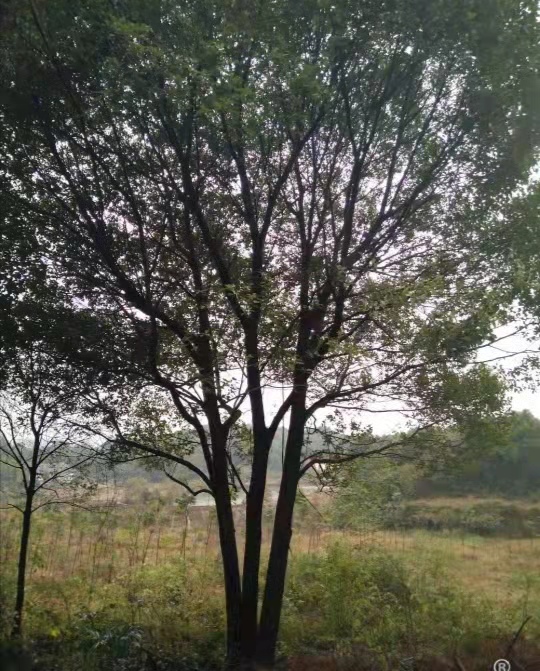
The camphor tree boasts an imposing and majestic silhouette, remains evergreen throughout the year, features an expansive canopy with lush foliage, providing dense shade over the ground. Its branches and leaves are not only graceful but also fragrant, making it an excellent species for avenues, shade trees, scenic forests, windbreaks, and soundproofing belts. The camphor tree has strong resistance to toxic gases like carbon dioxide and fluorine, and is an ideal material for factory landscaping. Its broken branches and leaves emit a fragrance that has a certain repellent effect on mosquitoes and insects. With fewer pests and diseases during the growing season, it is also a significant species for environmental protection.
Cinnamomum camphora Seedling Transplanting Precautions:
1. Minimize root damage, include a large soil ball. Seal the cutting end of the tree with yellow mud slurry (mix yellow heart soil with an appropriate amount of water) first, then tightly wrap it with plastic film. Additionally, use straw rope to wrap it for moisture retention, and thoroughly spray the branches and leaves to maintain moisture and prevent sunburn.
2. Prepare the site 2-3 days prior to transplanting, dig the holes, which are generally 2.6m x 2.4m x 1.2m in size. The actual excavation can be a few tens of centimeters larger than the root circumference.
3. Treat the cut and broken roots of the transplanted trees with a strong root-increasing powder mixture of 25g mixed with 30kg of water, spray again after 5-10 minutes, and it is also recommended to apply yellow mud paste after spraying the root-increasing powder.
5. Protect the bark and rootcortex during transplantation.
6. The best time for transplanting is when the buds are just beginning to sprout.
7. When transplanting camphor trees, retain the root ball with a diameter of about 30cm. After digging up, leave 1 to 3 leaves, and prune off the rest. Be careful not to remove the top bud to avoid a multi-headed canopy. Pruning quantity: For trees transplanted 3 to 6, 7 to 10, and 11 to 14 years, prune away 1/2, 3/5, and 4/5 of the total branches, respectively. Pruning method: Remove all lateral branches below 1/3 of the tree, and select 3 to 7 evenly distributed lateral branches above 2/3 of the tree. Additionally, for inter-provincial or inter-regional transportation, to improve survival rate, remove a certain number of thin lateral branches. When pruning, ensure the cut is close to the trunk, leaving no stubs and not tearing the bark. After large seedlings are placed in the hole, backfill and compact the soil as you go until the soil is full at the mouth of the hole, achieving tight soil at the bottom and loose at the surface. After transplanting, water thoroughly once to set the roots. In case of drought, water thoroughly every 7 days, repeating 3 to 4 times consecutively.
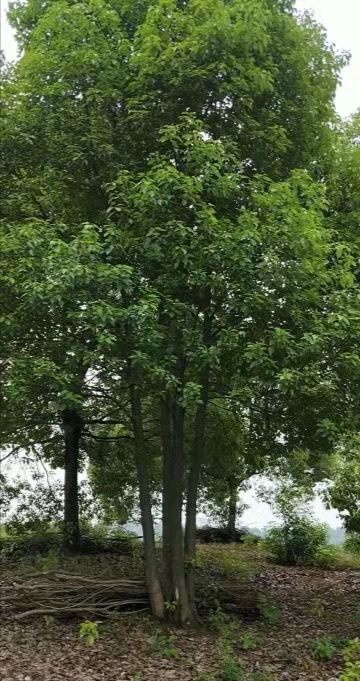
Morphological characteristics:
1. Evergreen large tree, up to 30 meters tall, diameter up to 3 meters, crown broadly ovate; branches, leaves, and wood all have an odor; bark is yellow-brown with irregular longitudinal cracks. Apex bud broadly ovate or spherical, scales broadly ovate or nearly round, slightly covered with silky hair on the outside. Branches are cylindrical, light brown. Leaves are alternate, ovate-elliptic, 6-12 cm long, 2.5-5.5 cm wide, acute at the apex, broadly cuneate to nearly round at the base, entire margin, cartilaginous, sometimes wavy, green or yellow-green above with a glossy appearance, yellow-green or gray-green below, dull, both sides or below slightly covered with fine pubescence when young, with base trichomes, sometimes transitioning to不明显 5 veins at the base, midrib prominent on both sides, 1-3-5 lateral veins on each side of the upper part. Basal lateral veins have a few branches towards the leaf margin, lateral veins and branches with prominent adaxial tubercles and distinct adaxial furrows, often covered with soft hair inside the furrows; petiole slender, 2-3 cm long, concave on the ventral side and convex on the dorsal side. Young bark is green and smooth, gradually becoming yellow-brown or gray-brown with longitudinal cracks as it ages; winter bud is ovate.
2. The panicle is axillary, 3.5-7 cm long, with peduncles, the rachis peduncle 2.5-4.5 cm long, and is densely pubescent with grey to light brown fine hairs, more so at the nodes. Flowers are greenish white or tinged, about 3 mm long; pedicels are 1-2 mm long. The calyx is pubescent on the outside, densely pilose on the inside, the calyx tube is inversely conical, about 1 mm long, and the calyx lobes are elliptical, about 2 mm long. There are 9 fertile stamens, about 2 mm long, with short hairs on the filaments. There are 3 staminodes, located in the inner whorl, arrowhead-shaped, about 1 mm long, and pilose.
3. Ovary spherical, about 1mm long, style about 1mm long. Fruit ovoid or nearly spherical, diameter 6-8mm, purple-black; receptacle cup-shaped, about 5mm long, top flat, width up to 4mm, base width about 1mm, with longitudinal grooves. Flowering period April to May, fruiting period August to November.