








Cinnamomum camphora cultivation management:
Tree seedling planting requires weeding and cultivation once a year, ideally during the dormant period of trees in autumn and winter, with a depth of 20-30cm. This not only promotes soil weathering and eliminates pests and diseases but also, since trees are in a dormant state, damage to some roots will not significantly affect their growth. Additionally, combining cultivation with fertilization enhances the effect, where base fertilizer should be applied to conserve water, retain heat, and promote root development, creating conditions for the trees' growth the following year. Moreover, intercropping with low-growing crops can be used for nurturing management, as these crops can loosen the soil around the trees, increase fertility, and, especially during hot weather, prevent the evaporation of ground moisture.
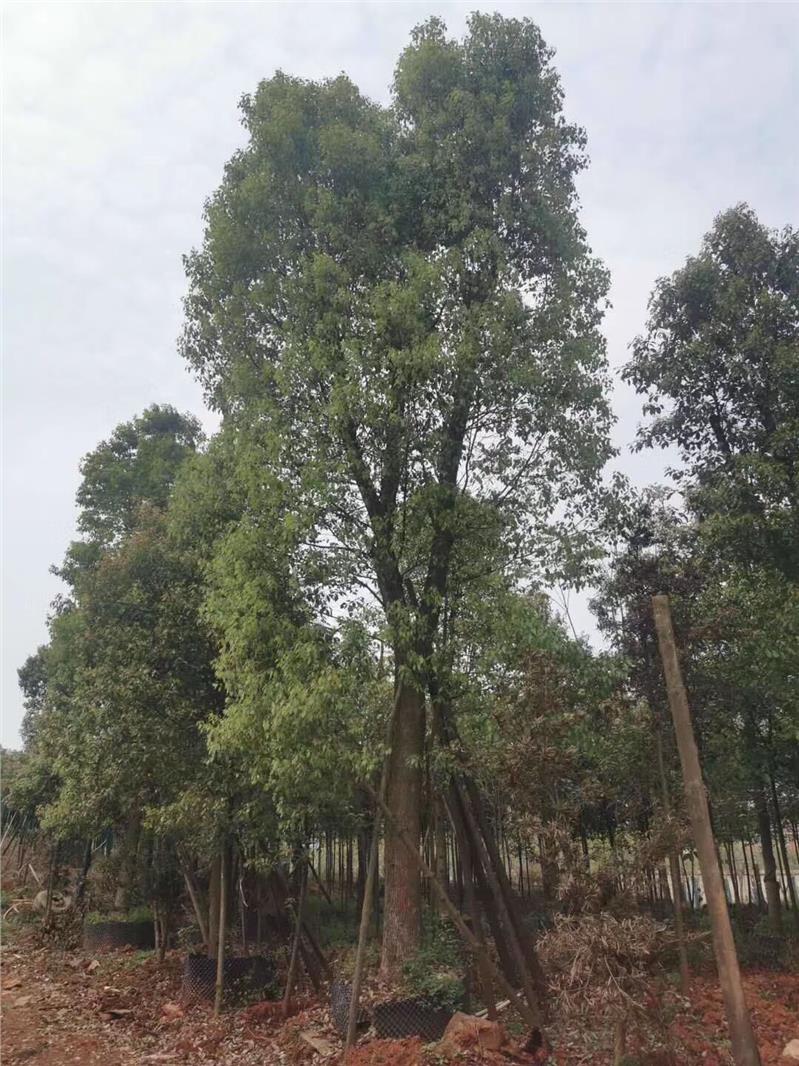
Cinnamomum camphora (Linn) Presl, also known as camphor tree, is a evergreen large tree in the Lauraceae family, Cinnamomum genus, and is a subtropical evergreen broad-leaved species. It is primarily distributed south of the Yangtze River, with Taiwan, Fujian, Jiangxi, Hunan, and Sichuan being the main cultivation areas. It thrives in warm and humid climates and is not tolerant of cold. It is suitable for regions with an average annual temperature of 16-17°C or higher and a low temperature of -7°C or above. The camphor tree is not picky about soil and grows well in deep, fertile clay loam, loamy sand, and acidic or neutral soils. It can also survive in saline-alkali soils with a salt content below 0.2%.
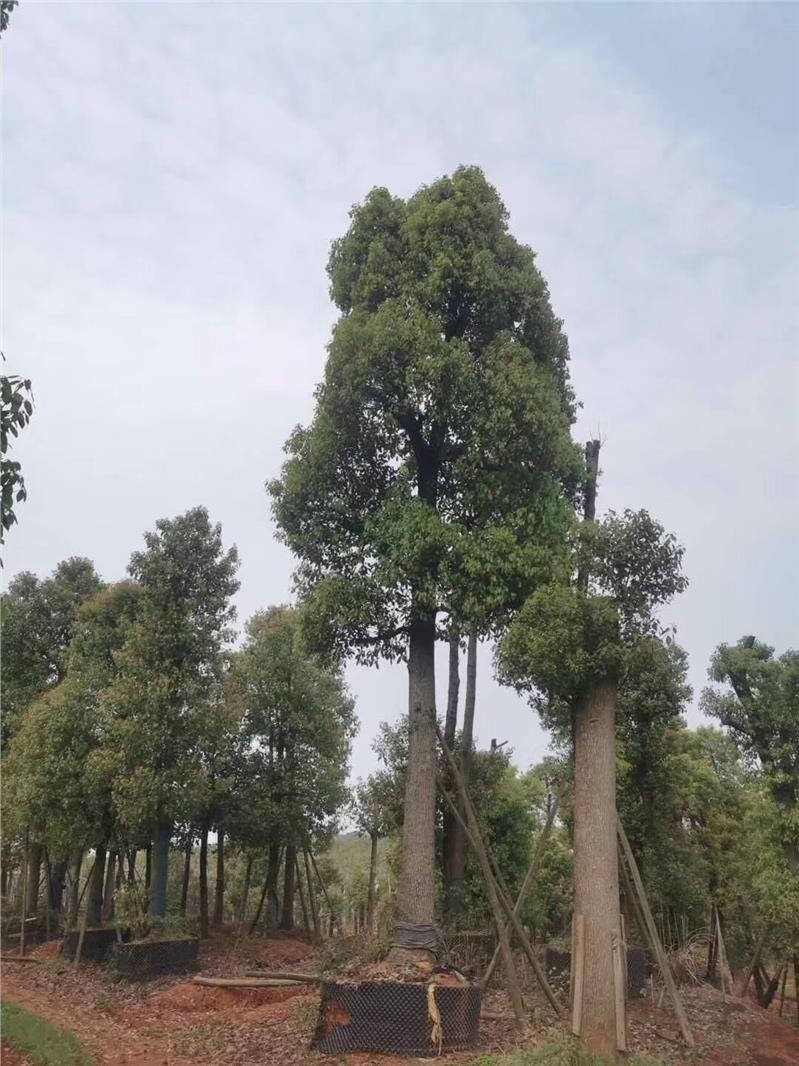
Cinnamomum camphora Large Seedling Transplanting Precautions:
1. Minimize root damage, with a large ball of soil attached. First, seal the cut of the tree trunk with yellow clay slurry (mix yellow heart soil with an appropriate amount of water). Then, tightly wrap and secure it with plastic film, and use grass rope to wrap and keep it moist. Thoroughly spray the branches and leaves to retain moisture and prevent sunburn.
2. Prepare the land 2-3 days prior to transplantation, dig holes, typically 2.6m x 2.4m x 1.2m in size, with the actual excavation being a few tens of centimeters larger than the root circumference is acceptable.
3. Apply a 25g mixture of strong rooting powder to 30kg of water and spray the cut and broken root areas of the transplanted trees. Repeat the spraying 5-10 minutes later, and you may also apply yellow mud paste after the rooting powder is sprayed.
5. Protect the bark and root bark during transplanting.
6. The best time for transplanting is when the buds are just beginning to sprout.
7. When transplanting camphor trees, include root ball soil with a diameter of about 30 cm. After removing the seedlings, retain 1 to 3 leaves and prune the rest, ensuring not to top the tree to avoid multiple crowns. Pruning quantities: For trees transplanted 3 to 6, 7 to 10, and 11 to 14 years, respectively prune 1/2, 3/5, and 4/5 of the total branch count. Pruning method: Remove all lateral branches below one-third of the tree's height, and select 3 to 7 evenly distributed lateral branches above two-thirds. Additionally, for inter-provincial or inter-regional transportation, to enhance survival rates, prune a certain number of fine lateral branches. When pruning, the cut should be close to the trunk, leaving no stubs and not tearing the bark. After the large seedling is placed in the hole, backfill and compact the soil as you go until the soil is full at the top of the hole, ensuring tight soil inside and loose on top. After transplanting, water thoroughly once to set the roots. In case of drought, water thoroughly every 7 days, repeating this process 3 to 4 times.
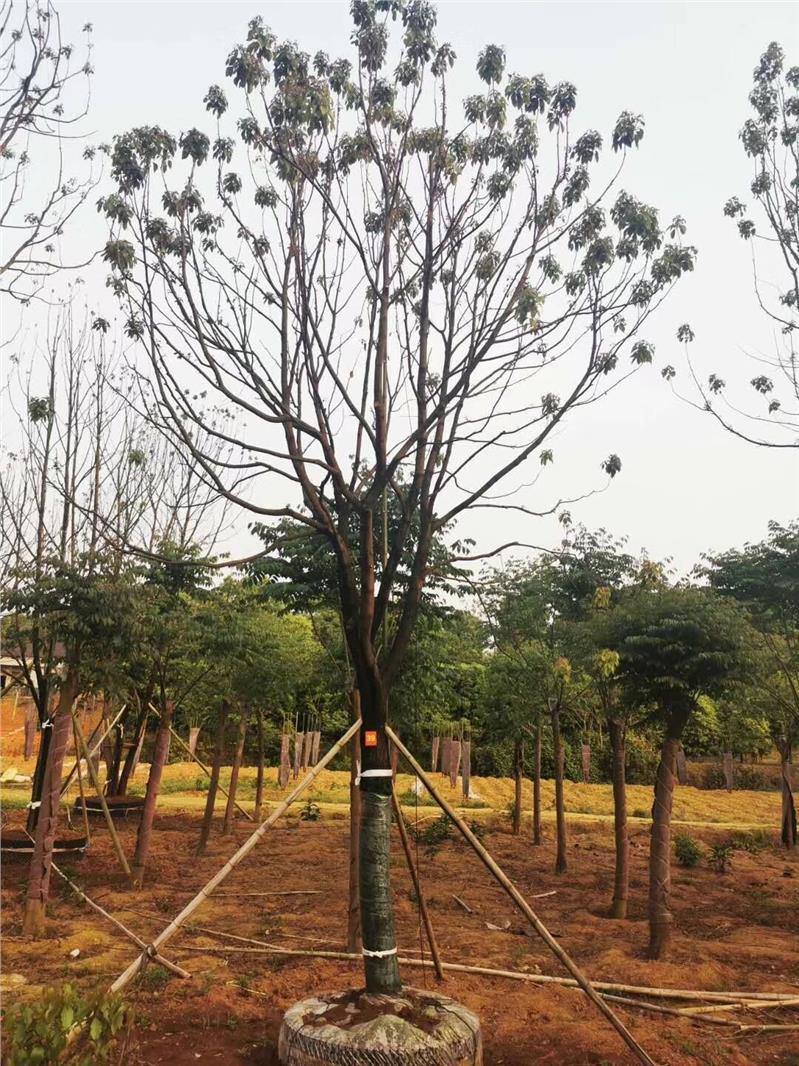
Cinnamomum camphora value:
1. Landscape Value: The camphor tree has a relatively fast growth rate, strong vitality, lush foliage, and belongs to a type of evergreen plant. It is capable of smoke adsorption, dust retention, water conservation, soil fixation against erosion, and environmental beautification, making it an excellent species for urban greening. Additionally, the camphor tree has a high resistance to various toxic gases, strong dust adsorption capability, and can absorb harmful gases, suitable for greening in urban and industrial mining areas.
2. Economic Benefits: Camphor wood is of superior quality, with a dense, rot-resistant, anti-termite structure and a fragrant scent, making it a preferred material for many furniture manufacturing enterprises. The roots, wood, branches, and leaves of the camphor tree can all be extracted for camphor oil, which is used in medicine, preservation, insecticidal applications. Camphor oil can also be used as raw material for soaps, pesticides, perfumes, and artificial lacquers.
3. Medicinal Value: The bark of camphor tree has properties for promoting Qi flow, suitable for lower limb ulcers; the fruits of camphor tree are warm in nature with a slight pungent taste, known for reducing fever and treating symptoms like measles,百日咳百日咳 whooping cough, and dysentery; the roots of camphor tree are pungent and non-toxic, effective in expelling dampness and wind.