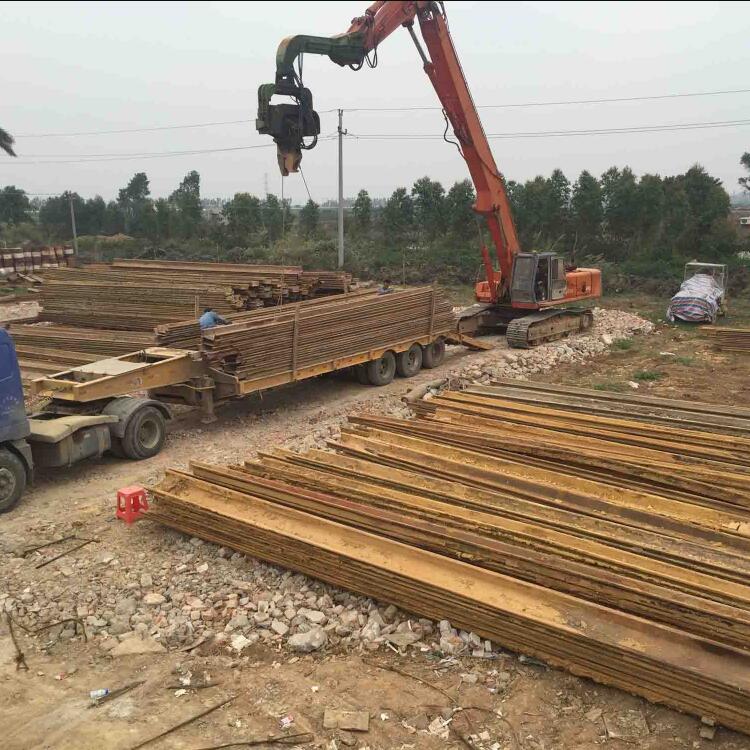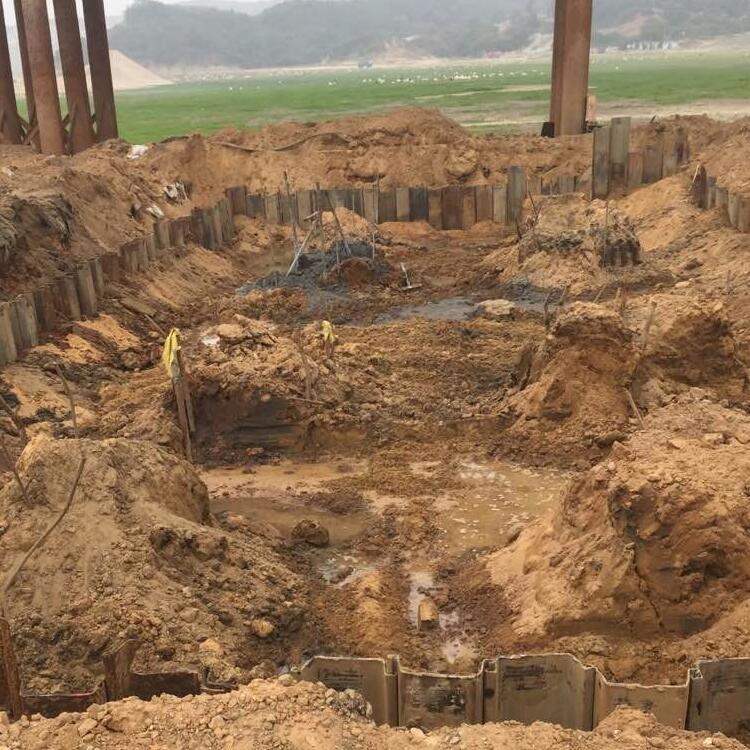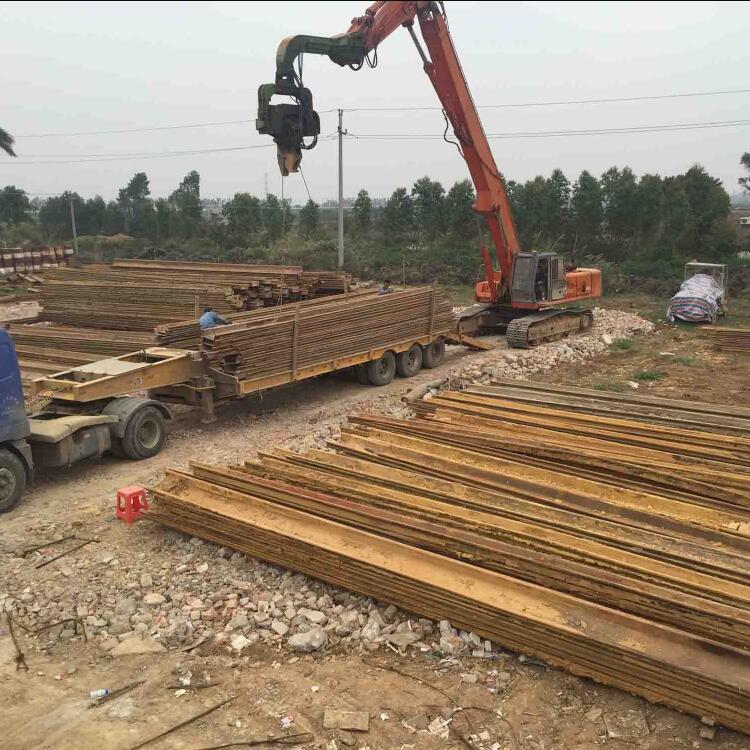

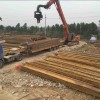
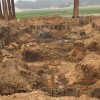
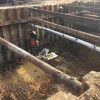







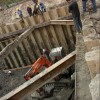
Larson steel sheet piles are a type of construction material featuring interlocking devices at both ends, allowing them to be connected with other panels. The formed steel sheet wall can serve as a safe support, water and sand barrier in water or underground environments. Due to its unique structure, it boasts distinctive advantages: high strength, lightweight, excellent waterproofing properties; durability with a lifespan of 20-50 years; and reusability, typically for 3-5 cycles. Their environmental benefits are significant, as they can greatly reduce the amount of soil excavation and concrete used during construction, effectively protecting land resources. In fact, Larson steel sheet piles also have strong emergency rescue capabilities, particularly in flood prevention, landslides, collapses, and sand drift emergencies, where they show rapid results. Of course, the simplicity of their construction, shortened project duration, lower construction costs, and weather independence are major advantages of the steel sheet piles. During use, they can simplify the complex procedures for inspecting materials or system performance; ensuring good adaptability and interchangeability. Next, the editor from Xianji.com will introduce you to the relevant knowledge about Larson steel sheet piles, including: construction techniques, precautions, potential issues, and their solutions. Check it out!
Larson steel sheet pile construction technique
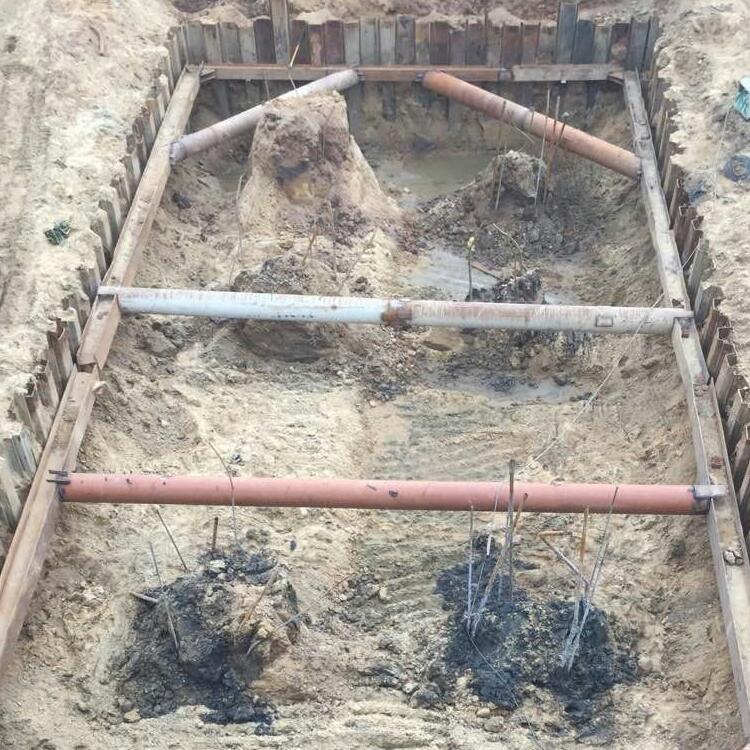
Construction process: Survey and stakes layout → construction piles → installation of frames → insertion and driving of steel sheet piles → excavation of foundation pit to sub-base level → drainage system setup → backfilling → removal of steel sheet piles.
One, Measurement and Trenching
Prior to excavation, the centerline of the sewage pipeline and the excavation boundary shall be marked according to the coordinates and dimensions shown in the drawings. Temporary benchmarking points should also be set as a reference for elevation control during pipeline construction. The centerline should be extended to both wooden stakes for easy real-time checks. The measurement and marking must be reviewed and confirmed by the supervising engineer before proceeding to the next stage of construction.
Two, construction pile
Measure the fixed orientation and lay out the position for the insertion of Larsen steel sheet piles. Utilize a crawler-type hydraulic single-drum vibratory pile driver (with clamps) to first drive the piles, setting one Larsen pile every approximately 9 meters. Place a crossbar between the two middle piles to create a guide clamp. During the sinking process, the crane delivers the vibration box to the storage area of the steel sheet piles, fits the pile into the clamp, and tightens it. Then, hoist it to the sinking position, vertically insert it into the pile hole, check for accuracy, and proceed to sink the pile using the vibratory hammer.
Installation Rack
A steel sheet pile is placed horizontally between two piles to create a guide clamp. During pile driving, the vibration box is moved to the storage area of the steel sheet piles, where it is inserted into the pile clamp and secured. It is then hoisted to the pile driving position, vertically inserted into the pile slot, and checked for accuracy before starting the vibration hammer to drive the pile.
Four: Sheet Piling Driving and Piercing
1. During pile driving, the crane delivers the vibration box to the steel sheet pile storage area, fits the steel sheet pile into the pile clamp and secures it, then hoists it to the pile driving location, vertically inserts it into the pile hole, checks for accuracy, and then activates the vibration hammer to drive the pile.
2. During the vibration insertion into the soil layer, if encountering underground debris and small pebbles or sand, you can vibrate and lift the sheet pile to remove them before reinserting. Repeat this up and down vibration insertion multiple times until fully inserted. During the pile driving process, the descent speed of the hook should be carefully controlled to maintain the suspended state of the pile sinking, ensuring its verticality.
3. On-site staff must follow instructions. When lifting 9m steel sheet piles, the rope must be attached to a secure part between 1.8m and 1m on the pile to prevent failure and slippage. The operator of the control box should closely monitor the crane's rotation direction, securely fasten each pile individually, and frequently check the rope to prevent damage and accidents.
4. After driving the Larsen steel sheet piles and anchor piles, weld steel brackets at the top of the Larsen piles, and place and secure steel sheeting for support, along with welding cross bracing for additional reinforcement.
V. Excavation of Foundation Trench
1. Main Equipment:
A. Earthmoving equipment includes excavators, dump trucks, and more.
B. General equipment includes: shovels (both pointed and flat heads), wheelbarrows, thin white wire or #20 galvanized wire, and steel measuring tapes, etc.
2. Construction Method:
A. Prior to earthwork excavation, remove and dispose of all underground and overhead obstructions within the construction area according to the construction plan requirements.
B. The location or control lines (stakes) of the building or site, standard level stakes, and the dimensions of the open trench white lines must be inspected and approved; pre-inspection procedures must be completed.
C. When working at night, adequate lighting facilities should be provided; clear signs should be set up at hazardous areas, and the excavation sequence should be arranged reasonably to prevent incorrect or excessive excavation. The excavated soil should be transported to the disposal site using dump trucks.
D. Roads and unloading facilities that construction machinery will pass through on-site should be inspected in advance, and necessary reinforcement or widening preparations should be made.
E. In areas where mechanical construction cannot be performed, and for tasks such as adjusting the slope of the embankment and cleaning the bottom of the pit, manual labor should be utilized in conjunction.
F. Based on the site conditions, we plan to use the Kobe 260 excavator for excavation. Due to the excavation width of 3~3.5m, a single-pass excavation method must be employed during mechanical excavation. Layered excavation is not feasible as the excavator cannot rotate at the layer position to remove soil. Continuously measure the foundation pit edge line and base elevation to ensure the soil is in place without over-excavation, with a 10cm allowance for manual cleanup.
G. Prevent excavator impact on piles and disturbance of the foundation bearing layer.
H. Install temporary drainage ditches and a sedimentation pond inside and outside the foundation pit (1m from the edge of the pit), and assign a dedicated person to handle drainage.
Section 6: Drainage System Setup
1. Based on geological survey data, the underground water level at this site is high, and groundwater can be observed during the excavation process. Therefore, appropriate drainage and water lowering measures must be taken before and during the excavation to ensure the safety of the foundation pit construction. Temporary ditches, water lowering wells, and sedimentation pits should be set up around the foundation pit to promptly remove the water.
2. Four 100mm pumps are used for drainage within the foundation pit, with an additional 15 50mm pumps for water extraction from the dewatering wells, and 5 spare 50mm pumps are prepared.
Section 7: Refill
Upon completion of the wastewater pipeline construction and reaching the backfilling conditions, clean up the foundation pit debris, and use medium to coarse sand that meets the design requirements for layered compaction backfilling and watertightness. Perform the backfilling in layers from one end to the other, starting from the bottom up. During the backfilling process, care must be taken to protect the structure from damage.
Section 8: Removal of Sheet Piling
1. Excavation backfilling must be completed before removing the steel sheet piles; the pile removal is carried out using a 20-ton crawler crane for lifting.
2. Prior filling of gaps between steel sheet piles is mandatory before removing the piles.
3. When removing each steel sheet pile, ensure the recovery rope is properly pulled, keeping the hook perpendicular to the horizontal. Slowly pull the pile out. Equip with a winch in narrow areas, drag it out after removal. Keep one truck loaded and return an empty one, maintaining a tidy construction site.
4. Assign personnel to monitor the桩拔除 process; if the monitor issues a warning, the桩拔除 speed must be slowed down or suspended until appropriate measures are taken before resuming.
Section 9: Simplified Calculation of Sheet Piling Load
1. Based on the soil stratum descriptions provided in the geological survey data from the design drawings, the soil parameters in this calculation are taken as follows according to experience:
A. Steel sheet pile top elevation: H1=18.0m, groundwater level: H2=17.0m
B. Ground Elevation: H0 = 17.7m, Excavation Trench Bottom Elevation: H3 = 13.4m
C. The natural bulk density weighted average value of soil inside and outside the pit is #r1, r2 both: 20 KN/m3, internal friction angle Φ: 20°; cohesion value c: 0 KPa; void ratio e: 0.89.
D. Ground overload q: 20.0 KN/m².
E. Excavation Depth of Foundation Pit b = 4.3m
2. Support calculation water level is considered at 17.00m.
3. Sheet Pile Calculation
Internal Force Calculation
The calculation of earth pressure for this project considers the active earth pressure supported by the steel sheet pile as the effective active earth pressure. Taking the ground elevation of 17.70m as the reference, the effective earth pressure at each elevation point is calculated. The ground overloading is set at 10KN/m2, which translates to a soil height h0=q/γ=10/20=1m.
Active and passive earth pressure coefficients
Safety Precautions for Larson Steel Sheet Piling Construction
Although the steel sheet pile is a temporary construction for this project, the construction quality directly affects safety during the construction period. Therefore, we treat it as a permanent structure standard for construction, and take the following measures:
1. Steel sheet pile joints must be smooth and tight, with locking edges interlocking, and supports reinforced securely to ensure the steel plates are vertical. The steel sheet piles, after being inspected and approved by the supervising engineer, can then proceed with excavation of the foundation pit.
2. The project department establishes a construction management organization led by the project manager, with responsibilities assigned to individuals. From raw material procurement to on-site management, every task is supervised, and the person responsible for any issue is held accountable.
3. Strictly follow relevant construction specifications and standards, implementing a three-level inspection system internally. Only after the previous process is approved can the next process be carried out.
4. Prior to commencing work,召集construction crew for a technical briefing, ensuring that everyone is familiar and proficient with the construction procedures and key points. Implement a quality management responsibility system; any work that does not meet quality standards must be redone.
5. Ensure proper protection for steel sheet piles, with prominent construction signs in place. Prohibit heavy vehicles from approaching the steel sheet piles to prevent encroachment and ensure construction safety. Additionally, be vigilant during excavation of the foundation pit and strictly prohibit machinery from contacting the steel sheet piles.
6. Take careful maintenance of the sheet pile and prepare spare materials.
7. During construction, the team leader coordinates all activities to ensure a smooth and orderly progress.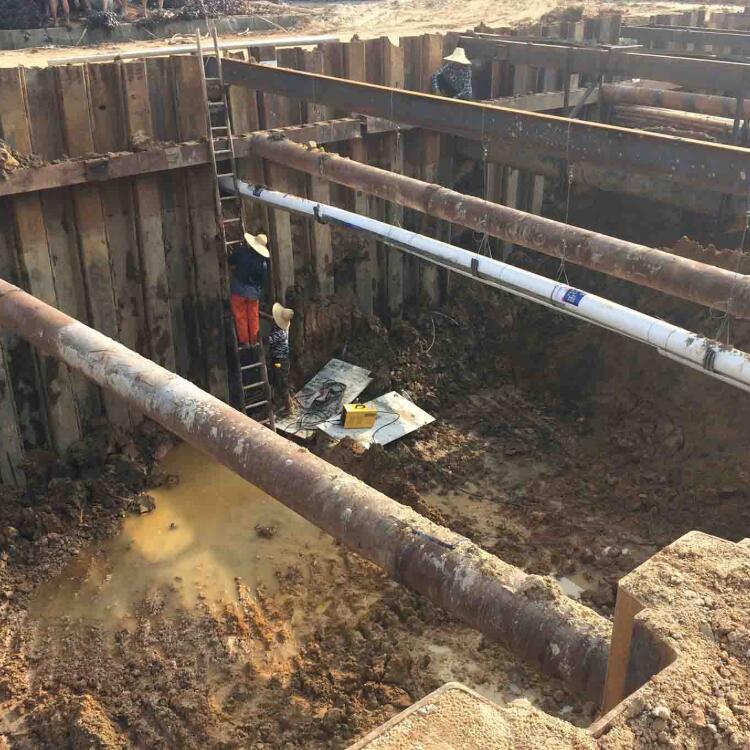
Potential Issues and Solutions in Larsen Steel Sheet Piling Construction
One: Obstacle in Piling
Excessive resistance during pile driving, making it difficult to penetrate.
Reason: Piling in sand or gravel layers; Corrosion and deformation of steel sheet pile locking joints; Encountering large obstacles;
Preventive Measures:
1. Conduct a detailed geological analysis to determine the conditions within the plate pile penetration depth range.
2. Inspect each steel sheet pile before driving, remove those with corroded or severely deformed locking slots, and apply grease within the locking slots.
3. In cases where steel sheet piles cannot be installed due to large obstacles like concrete blocks, a zigzag construction method is used with 3-meter-long and 3-meter-wide sections. If obstacles prevent installation, a long-arm excavator is used to dig out, and the steel sheet piles are driven while being excavated until they reach a depth of 15 meters.
Two: Pile Body Tilt Phenomenon
Reason: During the driving of sheet pile, due to the greater resistance at the connection lock joint compared to the resistance around the sheet pile, the driving force against the sheet pile is less in the direction of movement, causing the pile head to shift towards the direction of lesser resistance.
Preventive Measures:
1. Continuously inspect, control, and correct the verticality of sheet pile during construction with instruments.
2. Gradually correct the tilt by securing the pile with wire ropes, pulling while hammering.
Section 3: Pile Body Twisting Issue
Reason: The steel sheet pile locking joint is hinged, which, under the action of insertion and hammering, will cause displacement and torsion, affecting the position of adjacent sheet piles already driven, resulting in a zigzag central axis.
Preventive Measures:
1. Secure the front locking slots of the steel sheet piles with a locking board in the direction of pile driving
2. Utilize the guide rail to ensure verticality.
3. In cases of severe body twist, the steel sheet piles in the twisted section can be removed. After implementing the aforementioned measures, re-drive the piles.
Four: Piling Submersion Issue
Reason: Due to the inclined and curved steel sheet piles, the resistance at the connecting lock joints has increased, causing adjacent steel sheet piles to sink along with it.
Preventive Measures:
Correct steel sheet piles promptly when they tilt.
2. Weld the sheet pile with the sinking section to one or more pieces of shaped steel.
3. Apply lubricant at the locking mouth to reduce resistance.
4. After the sheet pile is submerged together, additional sheet piles of the same type should be welded at the top to compensate for the insufficient length.
V. Difficulty in Piling Removal
Reason: Rust and severe deformation of the connection lock; steel sheet piles driven into compacted sand soil layer; insufficient support during excavation, resulting in significant deformation of the steel sheet piles.
Preventive Measures:
1. Re-tamp the vibration hammer to overcome resistance caused by the adhesion to soil and rust between the tamping surfaces.
2. Driving piles in the reverse order of extraction.
3. The soil on the side bearing earth pressure is denser; driving another sheet pile in parallel near it will facilitate the easy extraction of the original pile.
4. Side slot, pour in bentonite slurry, and reduce resistance during pile removal.
@
Steel Sheet Piling Construction Precautions:
Steel sheet pile construction takes into account the site characteristics of the engineering location, combining the properties of steel sheet piles and construction methods. The choice of Lassen IV and VI steel sheet piles is moderate in width and has good bending resistance. The length of the steel sheet piles is determined based on geological data and working conditions, with specific selection details in the "Special Technical Instructions for Excavation Protection." For steel sheet pile construction, there are usually material inspections and外观 inspections; unqualified steel sheet piles are strictly prohibited. To ensure the correct alignment and verticality of the piles during construction, control the precision of pile driving, prevent buckling deformation of the sheet piles, and enhance the penetration ability of the piles, it is generally necessary to set up a certain stiffness and sturdy guide frame, also known as "construction bracing." What should be noted and what technical specifications should be followed during construction? Wuxi Hengyong experts tell you:
On the construction site, "Three Connections and One Leveling" must be ensured. Depending on the site conditions, it is advisable to first lay a ground concrete base to facilitate construction. Drainage ditches and sedimentation ponds should be set up around the site, and water from the pile holes should be pumped out, sedimented, and meet environmental protection standards before being discharged into the storm drain. The出土route on the construction site should be unobstructed. Lines should be accurately laid according to the construction drawings, marking the center line of the pile and the pile diameter, and a thorough technical review should be conducted. Only after obtaining the necessary permits from relevant departments can excavation of the pile soil begin. Before digging the pile, four pile center control points should be marked out from the pile center to all four sides with sturdy wooden stakes.
Prior to the steel sheet pile construction, the site technical supervisor and construction crew should inspect the construction preparation hole by hole, conduct technical safety briefings and safety education step by step, ensuring that safety and technical management is implemented in terms of thought, organization, and measures. A designated person should be responsible for recording the vertical centerline, axis, pile diameter, length, and subsoil quality of the pile holes according to pile location numbers. Hidden acceptance records of steel cage and concrete piles should be made, and upon completion, these records should be compiled, distributed to relevant units, and archived by the technical department. The height of the wall formwork sections should be determined based on the soil conditions, typically ranging from 50 to 100 cm. Construction personnel must be familiar with the geological conditions of the holes they are digging, and they should regularly inspect and pay attention to changes in soil layers. When encountering issues like flowing sand or excessive groundwater that could affect excavation safety, effective protective measures must be taken immediately before continuing with the deeper excavation.
Process line measurement and layout → excavation of pile holes → support wall formwork → pouring of support wall concrete → template removal (these four processes are repeated in a cycle until the designed depth is reached) → installation of steel cage → pouring of pile concrete.
The excavation and hole-cutting wall should be 100 to 150mm thicker than the lower wall, and should be elevated 200 to 250mm above the ground level or as per design specifications. The overlap length between the upper and lower walls should not be less than 50mm. To ensure the integrity of the wall concrete, φ8 rebars should be evenly distributed as tie rods, to prevent separation and sinking. If there is a detailed design drawing for the wall, construction should be carried out as per the design requirements.
When pouring concrete for the retaining wall, use the method of knocking the formwork and inserting bamboo poles and wood sticks to compact it. Do not pour concrete when the桩孔 water level submerges the formwork. According to the soil conditions, try to use rapid-setting agents to achieve the design strength requirements as soon as possible. If honeycomb or leakage is found in the retaining wall, block or divert it promptly to prevent water from outside the hole from flowing into the hole through the retaining wall, ensuring the strength and safety of the retaining wall concrete. For each section of the formwork installation, a person should be designated to strictly check the center position and the thickness of the retaining wall. Use a cross to align the axis mark, suspend a plumb bob at the center of the cross intersection, and recheck the position of the formwork to ensure its verticality. After meeting the requirements, wooden wedges can be driven into the soil to support the formwork, stabilize it, and prevent displacement of the formwork during concrete compaction. The reinforcing cage made on-site should comply with relevant specification requirements.
Demolition of the internal formwork for the retaining wall concrete, depending on temperature and other conditions, is generally performed 24 hours later, allowing the concrete to gain sufficient strength to support soil. After the formwork of the retaining wall concrete is removed, the centerline position is marked on the wall, and the relative level elevation is marked inside the circular retaining wall using a level, serving as the basis for controlling the position and verticality of the pile hole and determining the depth and elevation of the pile top. The marked centerline position and relative level elevation should be checked and re-verified regularly.
Larson steel sheet piles, as a new type of building material, serve as retaining walls for soil, water, and sand during bridge cofferdam construction, large-scale pipeline laying, and temporary trench excavation. They also act as protective walls, retaining walls, and revetments at docks and cargo handling sites, playing a crucial role in engineering projects. What should be taken into account when removing the steel sheet piles after the construction is completed? Let's listen as the editor of Yanxin Senyu explains each point step by step:
1. Installation and disassembly of pile drivers and auxiliary arms should be conducted on a flat and hard surface.
2. When working in pairs or with a guide, please operate according to the prescribed signal communication.
3. When loading and unloading pile drivers, please use a crane. The hook must have a anti-catch device.
4. Prior to the steel sheet pile installation, please check the motor brake, hydraulic lines, and all bolts, nuts, and pins for looseness daily. Inspect the oil (lubricant) level and for leaks in the pile driver.
5. Assembly and disassembly of the auxiliary arm, by hydraulic excavatorKey to the installation and removal of excavator buckets.
Please inspect if the jaw tooth blocks are excessively worn.
7. Please regularly clean the accumulated soil at the pile head. If the pile head is deformed, do not remove it.
8. When loading or unloading hydraulic pipes and connectors, please ensure the engine of the hydraulic excavator is turned off. Perform the operation after the internal pressure of the hydraulic system has been released. If internal pressure remains, oil leakage may occur. For methods to release internal pressure, refer to the "Operation Manual" issued by the hydraulic excavator manufacturer.
9. In handling hydraulic hoses, if leakage of high-pressure oil comes into contact with the skin or eyes, it poses a serious danger. Therefore, please wear protective goggles and thick gloves. In case of high-pressure oil喷射, block the nozzle with a plug and take measures to stop the spray.
10. Do not power on the equipment before replacing the vibration damping rubber when it starts to crack.
Here are the key points to note when removing sheet pile construction, as introduced by Yanxin Senyu. Yanxin Senyu adheres to the guiding principle of technological advancement in factory operations, with a commitment to "Quality and Customer First." We boast extensive experience in sheet pile construction and excellent equipment processing and manufacturing capabilities. We are fully equipped to design and manufacture various Larsen sheet piles based on the special requirements selected according to customer needs. We eagerly look forward to a sincere and cooperative partnership, creating great achievements together.
On the construction site, "Three Connections and One Leveling" must be ensured. Concrete lining work should be carried out first according to the ground conditions on-site for convenience. Drainage ditches, waste water pits, overflow areas, sedimentation holes should be set up around the site to meet environmental protection requirements prior to discharge into the sewers. The route for excavation on the construction site should remain unobstructed. Accurately lay out according to the plans, release the centerline pile positions and pile diameters, and undergo technical review for excavation through related procedures. Before excavating the pile holes, piles will be stacked at the center position, with four control points at the center of each side, marked with wooden piles.
Prior to steel sheet pile construction, technical staff and construction workers on the construction site should undergo a hole construction preparation check, step-by-step technical testing, safety education, and safety measures. Technical management is organized in thought and action, with implemented measures. The person responsible for the pile location prepares the pile hole centerline, pile diameter, pile length, and bedrock soil records. Hidden acceptance records for pile reinforcing cages and concrete, as well as knitting and sorting literature distribution to relevant units, are sent to the technical department for archiving upon completion. According to soil conditions, wall formwork is divided at a height of 50 to 100 centimeters. It is essential to be familiar with the excavation work of the construction personnel, and to perform frequent checks. When facing significant groundwater influences on excavators, pay attention to soil changes, and after encountering flowing sand, immediately take effective protective measures before continuing excavation.
The excavation process should have a higher retaining wall thickness for holes with a wall thickness less than 100-150mm, and the site should be elevated 200-250mm above ground or as per design requirements. The overlap length between the upper and lower stop walls should not be less than 50mm. To ensure the integrity of the steel sheet pile retaining wall, considering the soil conditions, we must use a uniform arrangement, φ8 reinforcing steel tie rods, to prevent sinking and disconnection, as per the design requirements of large-scale painting walls.
When pouring concrete walls, use the actual interlacing method with bamboo sticks and wooden poles for formwork and percussion. Do not fill concrete when the pile holes are submerged and the formwork is immersed. Depending on the soil conditions, try to use accelerators to reach the design strength requirements as soon as possible. Detect honeycombing, leakage, clogging, or shifting in the Great Wall timely to prevent water from entering the external water holes of the wall, ensuring the strength and safety of the concrete wall. For every part of the formwork installation, have someone else strictly inspect the center position and wall thickness. Cross-reference the center with the plumb bob's center marked by the alignment axis to check the formwork position and ensure it is vertical. If it meets the requirements, use wedges to support the formwork in a stable position to prevent displacement and ensure the integrity of the concrete pounds. When making steel reinforcement cages on-site, comply with relevant regulatory requirements.
We possess a domestic research and development center for marine engineering steel sheet piles, which has significantly reduced steel consumption for clients and contractors while ensuring superior performance, saving substantial funds. Consequently, we have achieved outstanding results in major project tenders, frequently winning bids. Our steel sheet piles excel in various fields such as marine and inland port construction, wavebreaks, deep foundation support, utility tunnels, subways, bridges, and tunnels, demonstrating their wide application!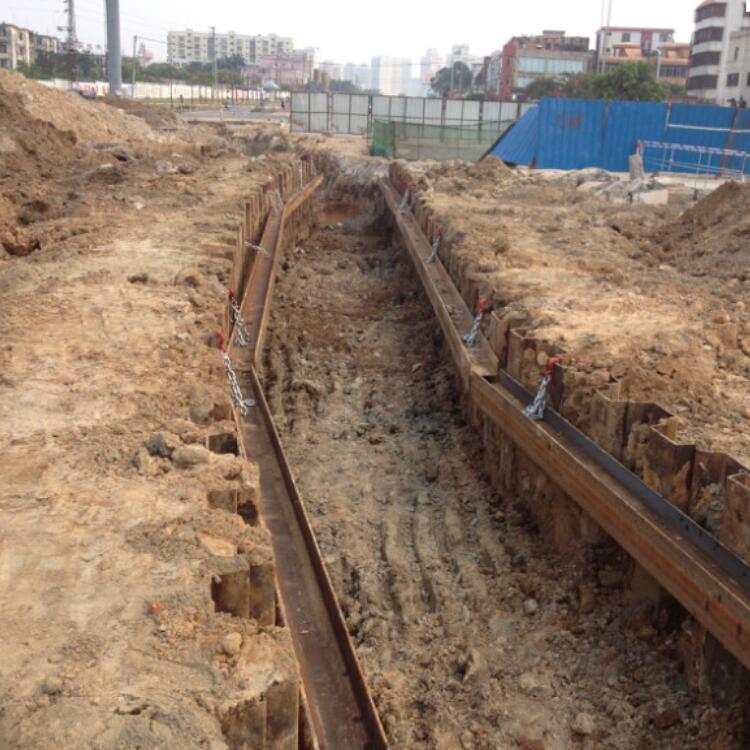
WeChat Official Account

Scan to follow Official Account