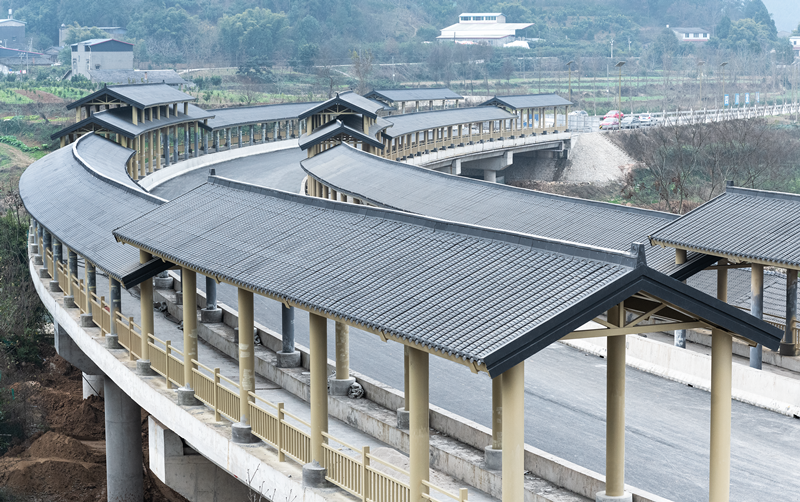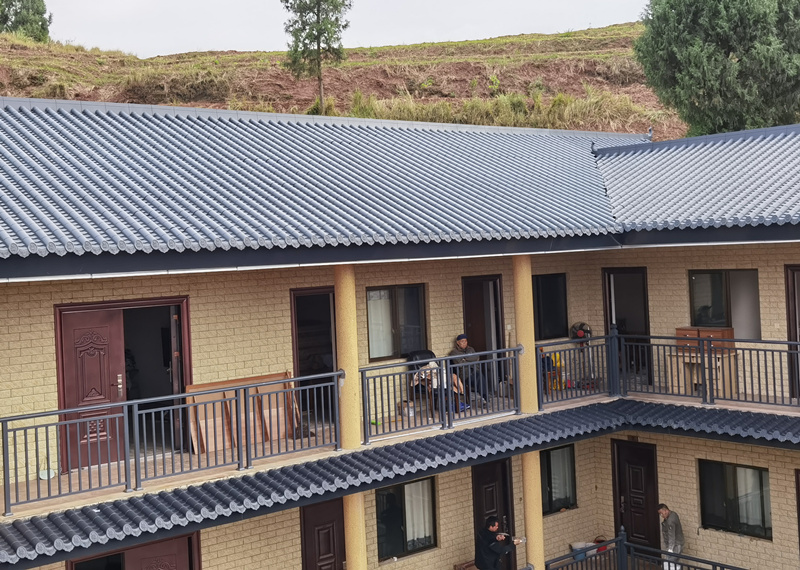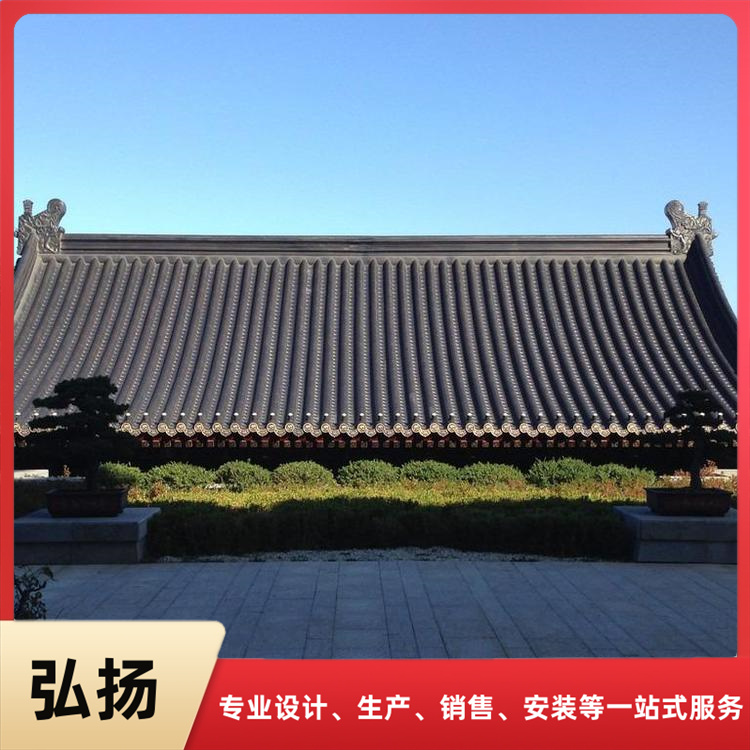
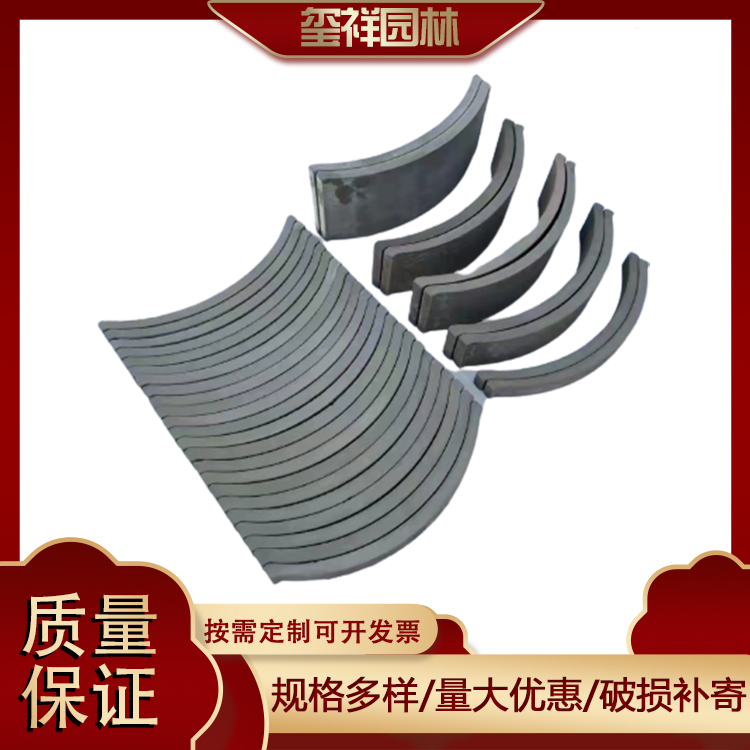









Xiao Qing tiles are being used for the renovation of the ancient town, reviving the old streets with new looks.
Xiao Qing tiles have inherited 3,000 years of architectural history, evolving through various sizes and craftsmanship. Known for their beauty, simplicity, and rainproof insulation, they have become an indispensable main material in traditional Chinese architecture. There's an ancient term "Han tiles," akin to Jingdezhen, referring to the blue tiles of Shu Han. In terms of material, aesthetics, and application, they surpass those of other regions.

Small grey tiles can be shaped into various styles of roofs, including interlocking tile roofs. The characteristic of interlocking tile roofs is that the tiles are also used in a "yin-yang" arrangement, with the bottom and top tiles placed alternately. Interlocking tile roofs are mainly found in small buildings and residential houses in Hebei and Shandong, while large buildings do not use interlocking tiles. In these areas, one can tell if a building is residential or a temple or palace by looking at whether the roof is interlocking or round tile. In the southern region, both residential and temple roofs are predominantly made of interlocking tiles (butterfly tiles), which include two methods: one with and one without lime application. In the no-lime method, the bottom tiles are placed directly on the rafters, and then the top tiles are placed directly on the grooves between the bottom tiles, without any lime in between. Craftsmen in the capital often refer to this as the southern dry masonry tile, using materials such as small grey tiles (grey tiles, cloth tiles).

A Siheyuan, also known as a four-room courtyard, is a traditional Chinese compound building with a layout of houses surrounding a courtyard on all four sides, enclosing the courtyard in the center, hence the name. It is essentially a three-room courtyard with an added gate house to form a sealed structure. If shaped like the Chinese character "口," it is called a one-jin courtyard; shaped like "日," it is a two-jin courtyard; and shaped like "目," it is a three-jin courtyard. A formal Siheyuan, with one house per household, can vary in size from small to large. The house owner can build according to the size of the land and the number of family members, ranging from a single-jin to three or even four jins, or even constructing two Siheyuans with a side courtyard. The smaller ones have 13 rooms; one or two courtyard structures have 25 to 40 rooms. The rear walls of the side rooms are the courtyard walls, with brick walls added at the corners. The grand Siheyuan is enclosed by walls from the outside, with tall walls and no windows to showcase its secrecy. In terms of style, many royal palaces and temples were also designed and constructed following the layout of the Siheyuan.