
Refrigerated Storage
The temperature in a refrigerated cold storage room typically ranges from -22 to -25 degrees Celsius. It maintains this low temperature through various refrigeration equipment, i.e., artificial refrigeration. Many foods like ice cream and seafood require storage at -25 degrees Celsius to prevent spoilage; otherwise, ice cream loses its fragrance and seafood becomes much less flavorful. The characteristics of low-temperature storage rooms include: gradually placing foods into the cold storage without a specific design or technology for the cooling process during this time. There are strict requirements for the storage room temperature, which should be between -22 and -25 degrees Celsius, making it a typical low-temperature storage room. The mechanism of frozen storage differs significantly from that of preservation storage. Extremely low temperatures can cause the death of cellular tissues in foods like meat and seafood, greatly affecting freshness. Therefore, for the storage of fruits, vegetables, and meats, the cost of installing a refrigerated cold storage room is not determined by the lowest possible temperature.

Refrigerated storage facilities, generally referring to facilities equipped with various cooling devices that can be manually controlled to maintain a stable low temperature. Their basic components include: the refrigeration system; electrical control equipment; storage rooms with certain insulation properties; and auxiliary buildings, etc.
The refrigeration system primarily includes various refrigeration equipment, which is the heart of the cold storage, producing the required cooling capacity to ensure a constant cold source within the storage. The electrical control unit acts as the brain of the cold storage, a food refrigeration warehouse, commanding the refrigeration system to maintain a steady supply of cooling.
A warehouse with certain thermal insulation properties serves as a storage facility for preserving perishable agricultural products. Its role is to maintain the stability of a low-temperature environment, often referred to as thermal preservation. A well-insulated warehouse structure can retain the cold generated by refrigeration equipment within the storage area, minimizing its outward leakage. Conversely, this means to minimize the inward leakage of external heat into the warehouse. This is a key distinction between cold storage facilities and ordinary buildings.
A fresh produce and vegetable cold storage is a cold storage facility used for the preservation of fresh produce and vegetables.
The fruit and vegetable cold storage utilizes the characteristic of water releasing or absorbing a large amount of latent heat during the phase change from solid to liquid. In winter, it manifests as ice using water as its matrix, while utilizing the vast latent heat released during freezing to maintain the cold storage temperature, preventing the fruits and vegetables from freezing damage. In summer, these ice blocks serve as the cold source to maintain the necessary low temperature and high humidity conditions for the storage of fruits and vegetables.
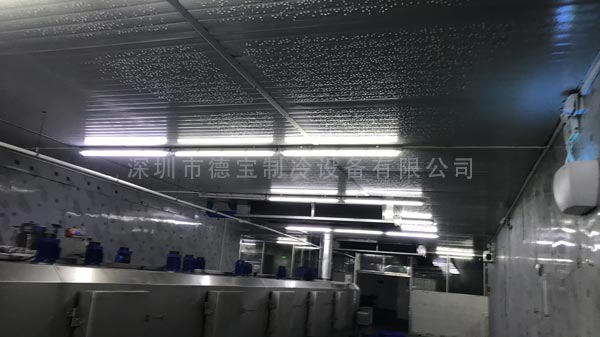
Fruits and Vegetables Cold Storage
2. Moisture and vapor barrier for cold storage insulation
Moisture and vapor barriers are essential for the cold storage insulation structure; otherwise, the thermal insulation properties of the materials will degrade. This is why the cold storage maintains good insulation initially but loses effectiveness over time. Since moisture vapor penetrates from the hotter to the cooler side, the moisture and vapor barrier should be installed on the side with higher insulation layer temperature.
3. Evaporation Pressure and Temperature of Cold Storage
Evaporators: The evaporation temperature corresponds to the evaporation pressure. Once the evaporation pressure is known, the installation quote for a refrigerated cold storage can be obtained by referring to a table. Under the condition that the cold storage room temperature remains constant, by reducing the temperature difference (the difference between the evaporation temperature and the room temperature), the evaporation temperature can be correspondingly increased. This will enhance the cooling capacity of the cold storage refrigeration unit, which in turn improves the cycle efficiency and saves electrical energy.