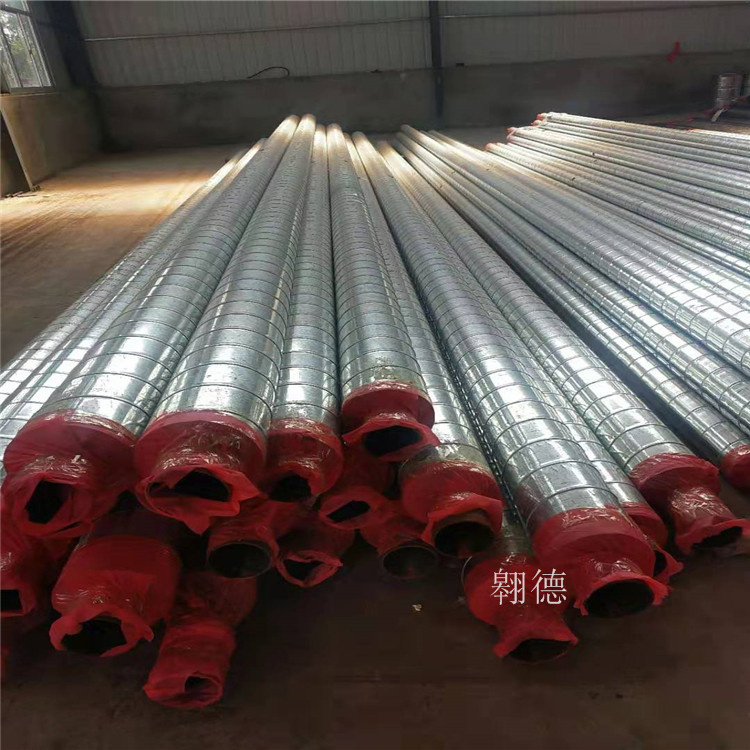


Steel sleeve steel fixed section (reinforced fixed) takes advantage of the high strength and good sealing properties of steel sleeve pipes, successfully overcoming the difficulties of waterproofing and leakage prevention. The outer protective layer made of steel pipes has the characteristics of high strength, resistance to damage, and the ability to bear the load above the sleeve, ensuring a long service life. To achieve this, anti-corrosion treatment is required for the steel outer sleeve, ensuring the integrity of the heating pipeline and enabling wider application in various temperature environments, particularly suitable for high-temperature steam pipeline projects. The sliding supports and internal fixation in steam pipelines use special materials for insulation measures to prevent the formation of thermal bridges, thus controlling the temperature of the outer anti-corrosion layer. The fiber-wound reinforced glass steel outer sleeve has good rigidity and waterproof performance, and its excellent corrosion resistance allows it to adapt to various complex soil environments. The anti-corrosion of the outer steel sleeve can be achieved by combining anti-corrosion coatings with cathodic protection, significantly increasing the anti-corrosion lifespan. The drainage system adopts a fully enclosed design, with flexible layout, reasonable structure, and reliability. The on-site joint insulation of steel sleeve steel保温 pipes must be carried out only after passing the pressure test, and the on-site joint insulation work. This aspect is unique to the construction of pre-fabricated buried insulation pipelines, and the quality of construction directly affects the service life. It is suitable for insulation and heat preservation projects for various media within the temperature range of -50℃ to 150℃. It is widely used in insulation and heat preservation projects in industries such as urban centralized heating, greenhouses, cold storage, coal mines, oil ports, chemical industries, etc. Polyurethane rigid foam insulation materials used in the construction industry are an important branch of the polyurethane industry, characterized by multifunctionality, combining insulation and waterproofing functions. Since their application in the European construction industry since the 1960s, these products have a history of 40 years, and some have even been legislated as insulation and waterproofing materials for construction. In recent years, with the rapid development of China's building energy-saving market, polyurethane rigid foam insulation products have been widely used in the field of building insulation and waterproofing, and have become the leading market for insulation.