










Shandong Jiaozhou Jumeng Machinery Co., Ltd.
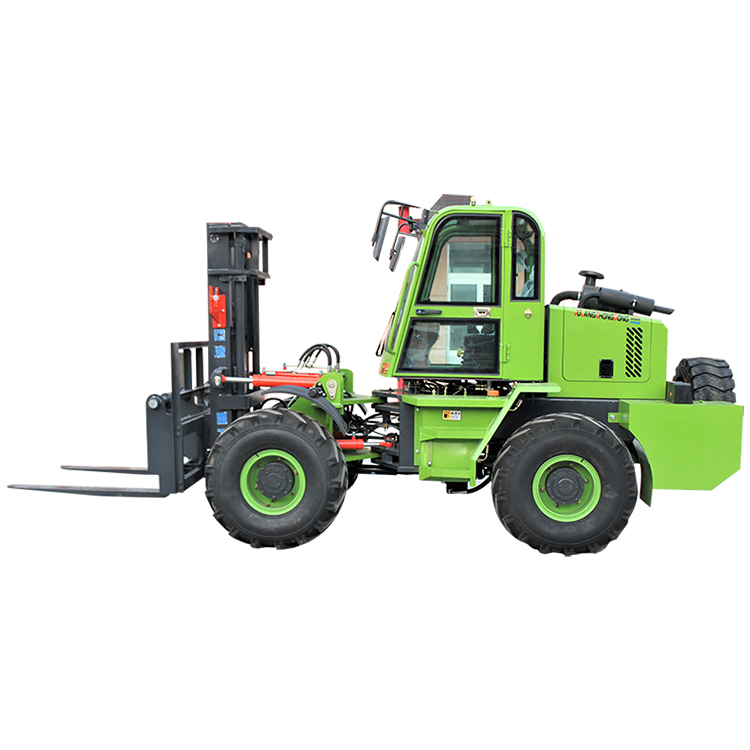
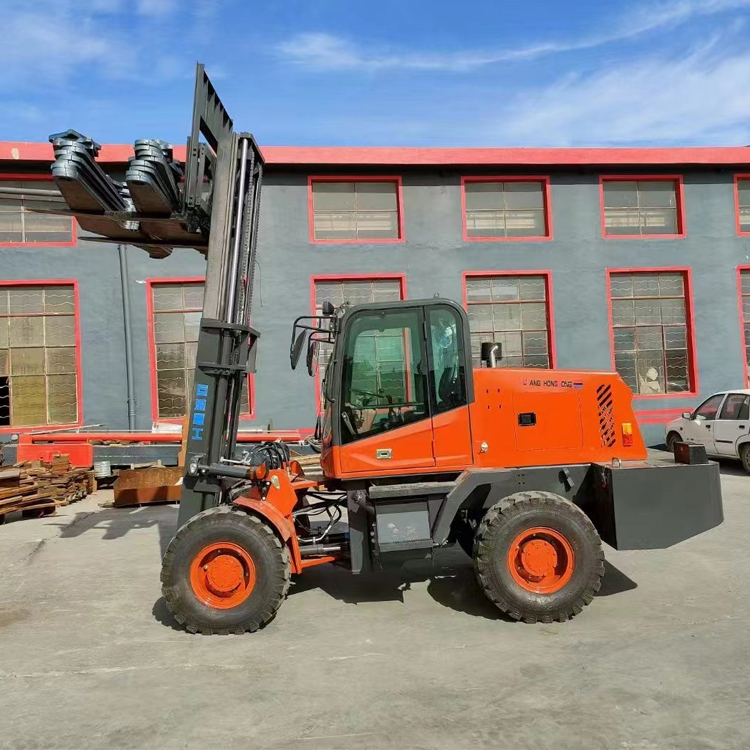
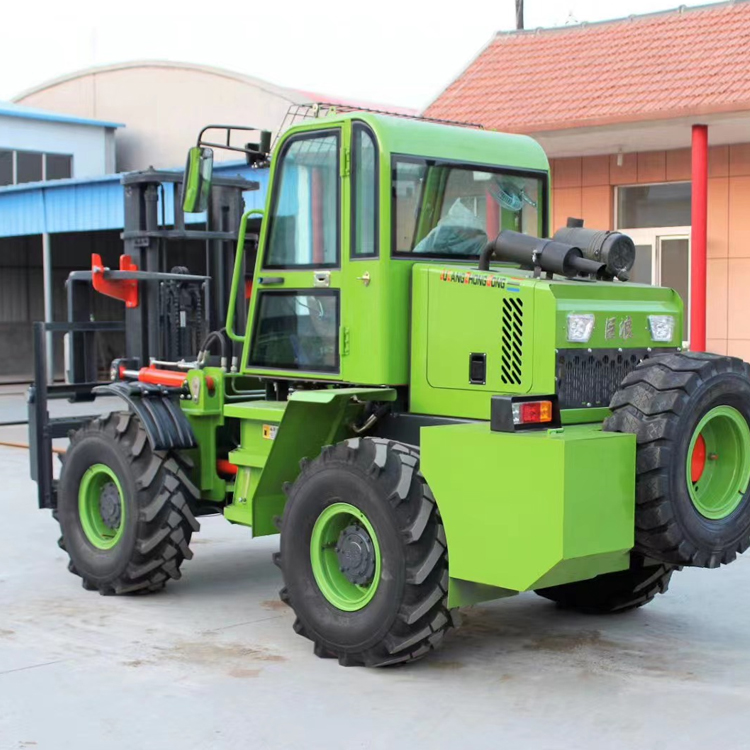
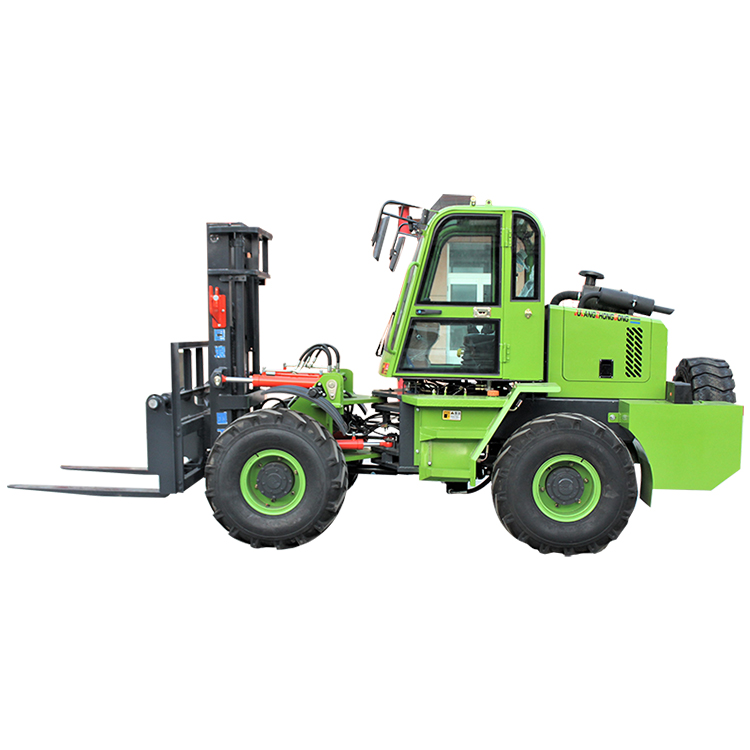
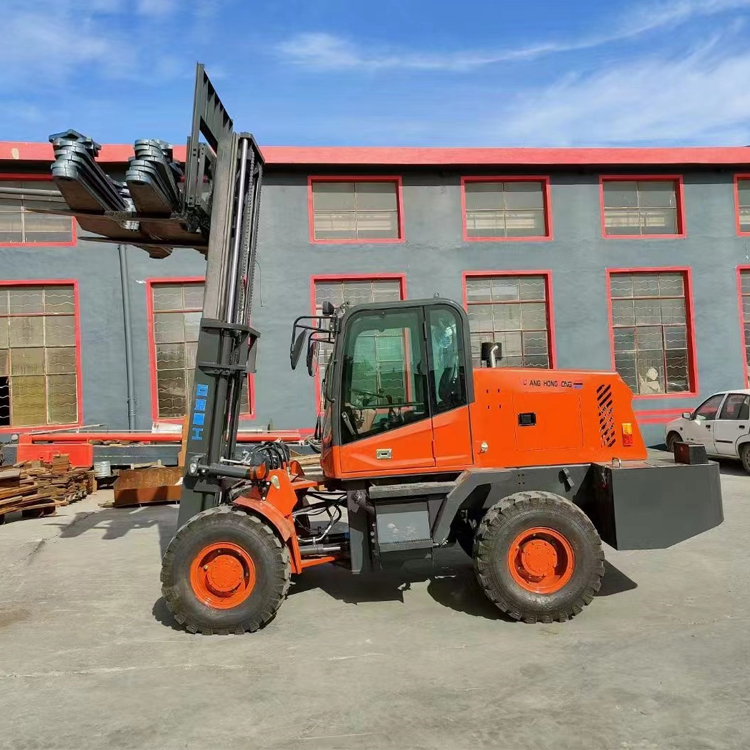
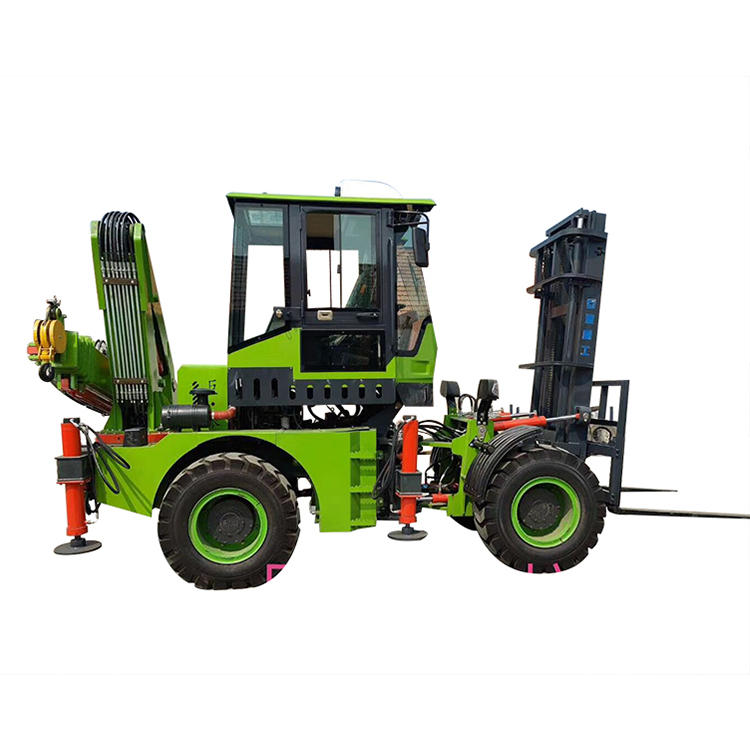
An off-road forklift is an engineering vehicle capable of safely loading, unloading, stacking, and transporting goods on sloped or uneven surfaces. It can be equipped with a cargo fork lift and various attachments, thereby significantly enhancing the operational efficiency of the off-road forklift itself. Moreover, there are many structural types of off-road forklifts, and their development pace is also very fast internationally. Additionally, it possesses the following five characteristics:
(1) Features excellent traversability and off-road capabilities, achieving all-wheel drive goals. No differential is set between axles, but large-diameter, wide-base off-road tires are used. The vehicle's ground clearance can reach over 300mm in smaller dimensions, and the departure angle can exceed 30°.
(2) Equipped with a articulated frame. The frame's swing angle typically reaches ±30° to +40°, featuring a simple steering system and eliminating the need for expensive steering drive axles. This allows for a smaller turning radius, easier wheel steering, and enables the frame to swing horizontally, making it easy for the off-road forklift to accurately align with materials. For light-duty off-road forklifts, an integral frame can be used, with single-axle drive and a differential lock on the drive axle.
(3) Full-wheel braking. Apart from small-tonnage forklifts using shoe-type brake systems, most are equipped with disc brakes, and forklifts with higher tonnage may also use wet brakes. The parking brake is primarily an independent hand brake.
(4) The front and rear axles of the 2t to 3t articulated off-road forklifts are interchangeable.
(5) The rear axle of the off-road forklift is fixed to the frame, while the front axle can pivot vertically relative to the frame by ±8° to +12°. Between the frame and the front axle, there is a support hydraulic cylinder. When the forklift is lifting, the cylinder is manipulated to keep the lifting beam in a lateral vertical position; during travel, the hydraulic cylinder's upper and lower chambers are connected through damping holes to enhance the vehicle's smoothness.
(6) Larger wheelbase and track width. Enhances the forklift's lateral and longitudinal stability.
(7) Features excellent maneuverability. Speed can reach up to (30~40) km/h. The power factor is above 0.65, with good acceleration performance and a climbing ability of 25°~30°.
(8) Larger doorframe tilt angle. Necessary for safe operation and driving on uneven surfaces, typically ranging from 10° to 15° forward tilt and 15° rear tilt.
(9) Driver's seat arrangement: To ensure the operator has a good view during loading operations, the driver's seat is typically positioned forward. For articulated forklifts, place as close to the front chassis as possible. According to different operation requirements, install a cab with a FOPS/ROPS canopy.
(10) Walking System: Similar to loaders, it features various transmission types including mechanical (Me), hydraulic shift mechanical (HyC), hydrostatic (T/C), and hydrostatic (HYD). However, the differences lie in: all use full power matching method, with the ultimate load being the full load climbing slope condition.