















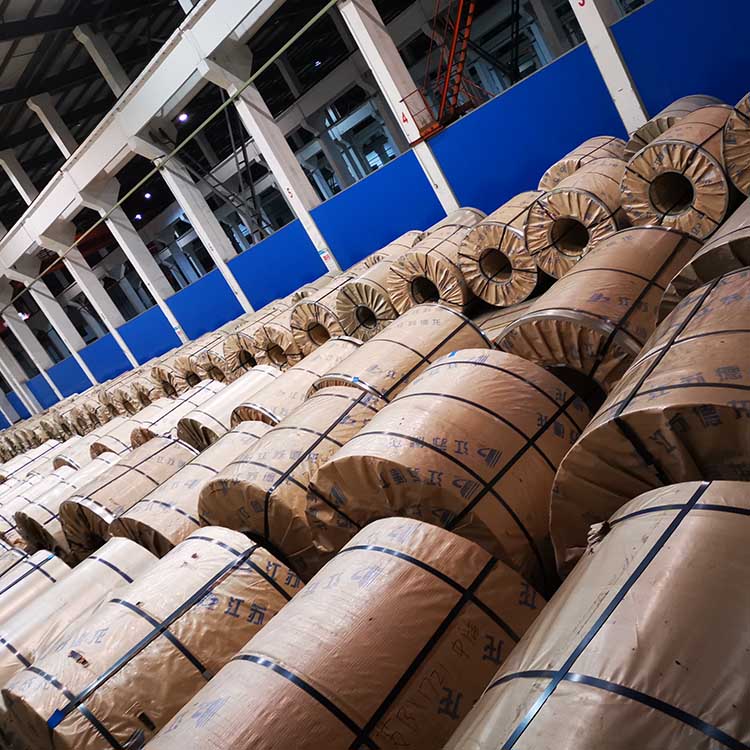
2205/S31803/S32205 Stainless Steel
The dual-phase stainless steel alloy S32205 (S31803) is composed of 22% chromium, 2.5% molybdenum, and 4.5% nickel-nitrogen alloy. It boasts high strength, excellent impact toughness, and good overall and localized stress corrosion resistance. The yield strength of S32205 (S31803) dual-phase stainless steel is more than double that of conventional austenitic stainless steel, allowing designers to reduce weight in product design. In this aspect, the alloy is more competitive than 316 and 317L. S32205 is particularly suitable for use within a temperature range of -50°F / +600°F, and it can also be considered for use beyond this range, although with some limitations, especially when applied to welded structures.
The S31803 alloy has excellent weldability. The performance required for the S31803 alloy is to maintain the same corrosion resistance, strength, and toughness as the base metal in the welded metal and heat-affected areas. Welding S31803 is not particularly challenging, but its welding procedure must be designed to ensure a good phase balance after welding, preventing the precipitation of harmful metal or non-metallic phases.
S31803 Stainless Steel
Features:
1. The S31803 dual-phase stainless steel alloy outperforms 316L and 317L austenitic stainless steels in terms of pitting and crevice corrosion resistance. It boasts excellent corrosion resistance and, compared to austenitic grades, a lower coefficient of thermal expansion and higher thermal conductivity.
2. The S31803 dual-phase stainless steel alloy, compared to austenitic stainless steel, offers twice the pressure resistance. When compared to 316L and 317L, designers can reduce its weight. The S31803 alloy is particularly suitable for temperatures ranging from -50°F to +600°F. Under strict limitations (especially for welded structures), it can also be used at lower temperatures.
Chemical Composition:
C≤0.030
Mn≤2.00
Si≤1.00
p≤0.030
S≤0.020
Cr 22.0~23.0
Ni 4.5~6.5
Mo3.0~3.5
N0.14 to 0.20 (Austenitic-Ferritic Type)
S31803 duplex stainless steel has more than double the yield strength of standard austenitic stainless steel, a feature that allows designers to reduce weight in product design, making the alloy more cost-effective than 316 and 317L. This alloy is particularly suitable for temperatures ranging from -50°F to +600°F. Applications outside this temperature range can also consider this alloy, but with some limitations, especially when used in welding structures.
Applied
· Pressure vessels, high-pressure storage tanks, high-pressure pipelines, heat exchangers (for chemical processing industry).
· Oil and gas pipelines, heat exchanger fittings.
Wastewater Treatment System.
· Pulp and paper industry classifiers, bleaching equipment, storage and treatment systems.
· Rotating shafts, squeezing rollers, blades, impellers, etc., for high-intensity, corrosion-resistant environments.
· Cargo container for ship or truck
Food Processing Equipment
Standard
ASTM/ASME...........A240 UNS S32205/S31803
EURONORM...........1.4462 X2CrNiMoN 22.5.3
AFNOR...................Z3 CrNi 22.05 AZ
DIN.........................W. Nr 1.4462
Corrosion resistance
Uniform Corrosion
Due to its high chromium content (22%), molybdenum (3%), and nitrogen content (0.18%), S31803 exhibits superior corrosion resistance compared to 316L and 317L in most environments.
Local corrosion resistance
S31803 dual-phase stainless steel's high content of chromium, molybdenum, and nitrogen provides excellent resistance to pitting and crevice corrosion in oxidizing and acidic solutions.
Stress corrosion resistance
The dual-phase microstructure of stainless steel enhances its resistance to stress corrosion cracking. Under certain conditions of temperature, tensile stress, oxygen, and chloride presence, austenitic stainless steel can experience chloride stress corrosion. Due to the difficulty in controlling these conditions, the use of 304L, 316L, and 317L is limited in this aspect.
Corrosion-resistant fatigue
The high strength and corrosion resistance of S31803 duplex steel contribute to its excellent corrosion fatigue strength. Machining equipment is susceptible to the effects of corrosive environments and loading cycles, making the characteristics of S31803 particularly suitable for such applications.
Performance:
The chemical composition of S31803, after being subjected to a solution heat treatment at 1900°/1922°F (1040°/1080°C), achieves an ideal microstructure of 50 α / 50 γ. If the heat treatment temperature exceeds 2000°F, it may lead to an increase in ferrite content. Like other duplex stainless steels, the S31803 alloy is susceptible to intermetallic phase precipitation. The intermetallic phase precipitates between 1300°F and 1800°F, with a faster precipitation rate at 1600°F. Therefore, we conduct tests on S31803 to ensure the absence of intermetallic phases, referring to ASTM A 923 for the tests.