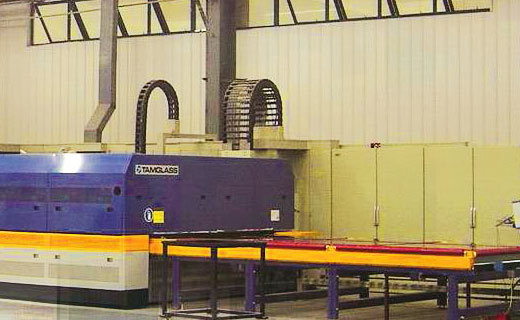
Semibotched, tempered glass
Semi-tempered glass is produced using a process similar to that of fully tempered glass, but with a slower cooling rate, resulting in slightly lower surface stress than fully tempered glass. Semi-tempered glass significantly outperforms annealed glass in terms of mechanical strength, wind resistance, impact resistance, and thermal shock resistance, making it particularly suitable for framed glass curtain walls. It is not a safety glass. Fully tempered glass is created by heating glass to near its softening point in a tempering furnace, then rapidly and uniformly cooling it, which forms uniform compressive stress on the surface and tensile stress within, enhancing its mechanical strength and effectively improving its wind resistance, impact resistance, and thermal shock resistance.
The production of semi-tempered glass employs a process similar to that of fully tempered glass, but with a slower cooling rate, resulting in slightly lower surface stress than fully tempered glass. Semi-tempered glass exhibits superior mechanical strength, wind resistance, impact resistance, and thermal shock resistance compared to ordinary annealed glass, making it particularly suitable for framed glass curtain walls. Semi-tempered glass is not considered safety glass.
Features:
Safety: Upon breaking, it forms uniformly rounded particles with blunt angles, less likely to cause injury.
2. Strength: Tempered glass has 4-5 times the strength of ordinary glass.
3. Heat stability: Can withstand a temperature difference of 200℃