












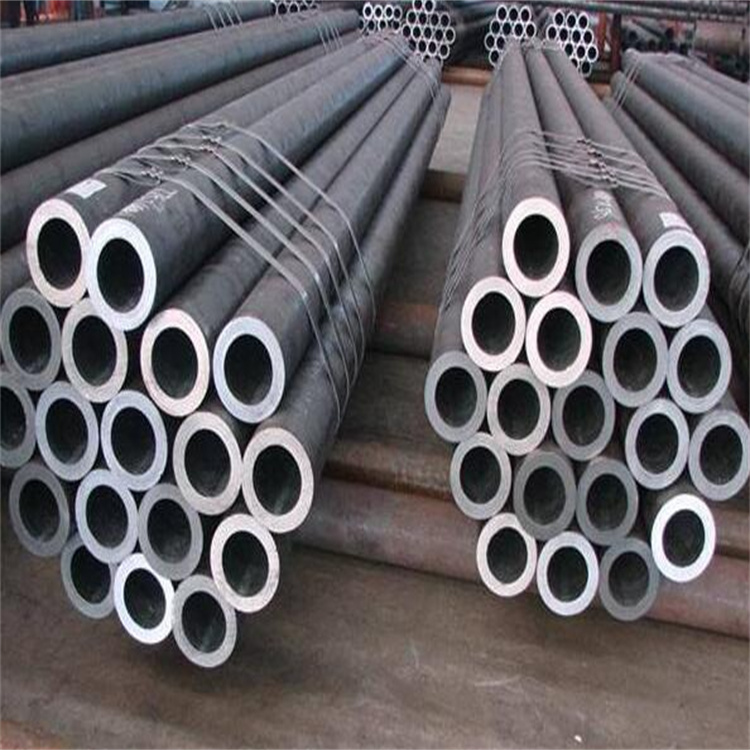

Common quality defects in large-diameter seamless steel pipes after plastic bending and unloading include: rebound, cross-sectional deformation, thinning and even cracking of the outer wall, and thickening and even wrinkling of the inner wall. During the bending process, the evaluation of the formability of the bent pipes is mainly conducted under the condition that the outer wall does not crack and the inner wall does not wrinkle, and it is mainly from two aspects: first, the shape and size accuracy of the local bending deformation part, mainly using the thinning rate of the outer wall and the cross-sectional deformation rate as evaluation indicators; second, the overall shape and size accuracy of the pipe material after bending, mainly using the rebound rate after bending as the evaluation indicator. In actual production, these defects may not occur simultaneously, but their occurrence methods and locations may vary with different bending radii and process parameters, so corresponding measures should be taken before bending processing to prevent them. Rebound directly affects the shape and size accuracy of the bent pipe parts, reduces assembly efficiency, and may cause excessive residual stress, which in turn affects the reliability of a single large-diameter seamless steel pipe or the entire structure. Due to the many factors affecting rebound, it is difficult to accurately describe the rebound law, and in actual production, measures such as annealing treatment and rebound compensation are usually adopted to compensate for the bending angle error caused by rebound, but these should be based on a large number of experiments to avoid wasting human, material, and financial resources. It is easy for the outer wall to crack or break during the plastic bending process of the pipe material, especially for thin-walled pipe bending forming, which is more common. The reasons for the cracking of the outer wall are multi-faceted, such as improper heat treatment of large-diameter seamless steel pipes; excessive pressure of the die, causing excessive resistance to material flow during the bending process of the pipe material; too small an clearance between the mandrel and the inner wall of the pipe material, resulting in excessive friction force between the mandrel and the inner wall; and excessive extension of the mandrel. To prevent this defect, it is first necessary to ensure that the pipe material has good heat treatment, and then, after excluding the factors inherent in the pipe material, check whether the pressure of the die is too high; whether the clearance between the mandrel and the inner wall of the pipe material is too small; whether the extension of the mandrel is too long; and the lubrication condition between the mandrel and the inner wall of the pipe material. Wrinkles on the bent pipe mainly occur on the inner bending side. They are usually divided into three cases: wrinkling at the front cutting point, wrinkling at the rear cutting point, and full wrinkling on the inner side of the arc. Wrinkling at the front cutting point is generally due to insufficient extension of the mandrel during installation, causing the pipe wall at the front cutting point to receive no mandrel support during bending.