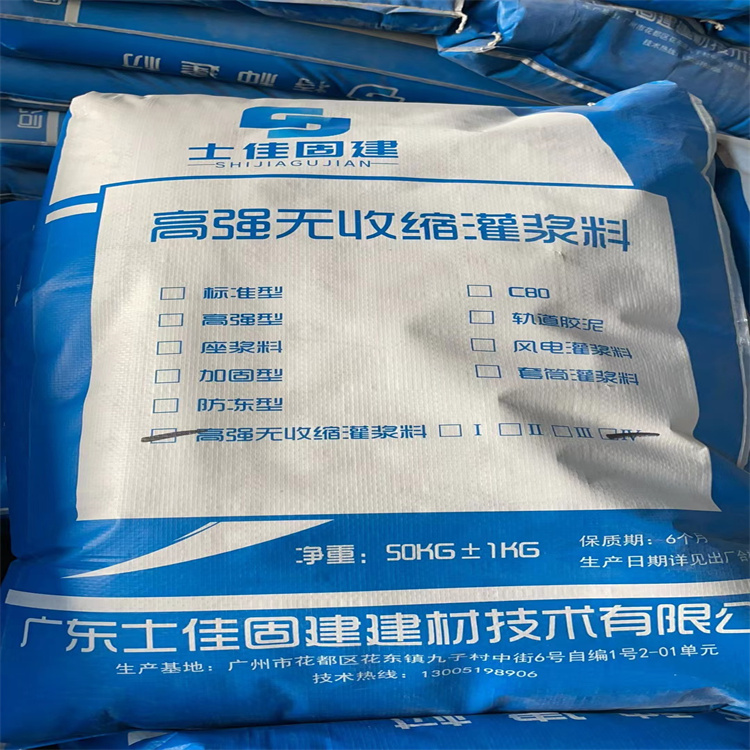


CGM High-Strength Non-Shrink Grouting Material
I. Application
A variety of machinery and equipment installation secondary grouting
Thermal Insulation Base Pad
Foot bolts for equipment anchoring
Thermal Radiation Resistance Building Structures
II. Features
Self-Flowing Non-Vibrating Grout – Self-leveling grout with non-vibration construction, ensuring no voids or leakage in grouting
Slight Expansion — No Shrinkage After Long-Term Use of Casting Material
Early and High Strength — Achieves 30 ~ 50MPa strength in 1 day after pouring
Long-lasting High Strength — No Concern of Post-processing Strength Decline
Oil-Resistant and Impermeable – Dense and Sealing for Environments with Machine Grease Contamination
Anti- 剥 (剥) - Peel Leaving...—— A solid blend of new and old interfaces
Other performance indicators
1. Reinforcement Bond Strength
The bond strength of round rebars has exceeded within a day.6.0 MPa, the bond strength of threaded steel bars in one day exceeds 13.0 MPa. Therefore, CGM grouting material can partially replace epoxy resin as the anchoring material for anchor bolts.
2. Impermeability
CGM's grouting material has significantly better water impermeability than general waterproof concrete. Multiple tests, including oil penetration rate, oil penetration depth, and strength growth rate, show that the material does not lose strength after being soaked in oil, demonstrating good resistance to oil penetration.
3. Low temperature and freeze-thaw properties
CGM boasts excellent low-temperature properties, with its 7-day compressive strength remaining above 30MPa when used at -5℃ for the refrigerator and -10℃ for the environment. After being cured at standard temperature, its compressive strength increases immediately, meeting the engineering design and construction requirements at lower temperatures. The low-temperature CGM retains nearly all its strength after freeze-thaw cycles, making it suitable for installation projects in freeze-thaw environments.
4. No cause of reinforcement corrosion
CGM grouting materials often come into long-term contact with reinforcing steel and iron equipment foundations. Tests show that its series products remain in a passivated state (0 to 300mV) in natural potential; after the test blocks are split open, the embedded reinforcing steel shows no corrosion. Therefore, it can be said that CGM grouting materials will not cause reinforcing steel corrosion.
CGM grouting material exhibits excellent fatigue resistance. After 2 million fatigue tests, its static compressive strength remains high, whereas ordinary concrete of the same grade would have failed under the same conditions after 150,000 cycles. According to domestic and international data, the elastic modulus of grouting material is generally lower than that of ordinary concrete, which is beneficial in reducing the impact pressure on the foundation from equipment vibration loads. During the expansion observation of CGM grouting material, there is some fluctuation in the expansion rate. After several tests and analyses, excluding the influence of experimental errors, it may be affected by the different hydration of minerals in cement clinker, a mechanism yet to be confirmed. In summary, CGM grouting material boasts excellent engineering properties and a wide range of applications, making it a superior grouting material.
1. CGM grouting material boasts excellent fluidity, suitable for secondary grouting of equipment, anchoring of foot bolts, and engineering maintenance.
2. The initial setting time, final setting time, and expansion rate of CGM grouting materials all meet the engineering design and construction requirements.
3. CGM Grouting Material boasts a high compressive strength, fully meeting the strength requirements of both domestic and imported equipment for grouting bodies.
4. CGM grouting material has high bonding strength with steel bars, can replace epoxy resin as anchor material for anchor bolts, and has no corrosion effect on steel bars under natural potential.
5. CGM grouting material has excellent waterproof properties, strong resistance to oil penetration and erosion, high strength at low temperatures, and good frost-thaw resistance.