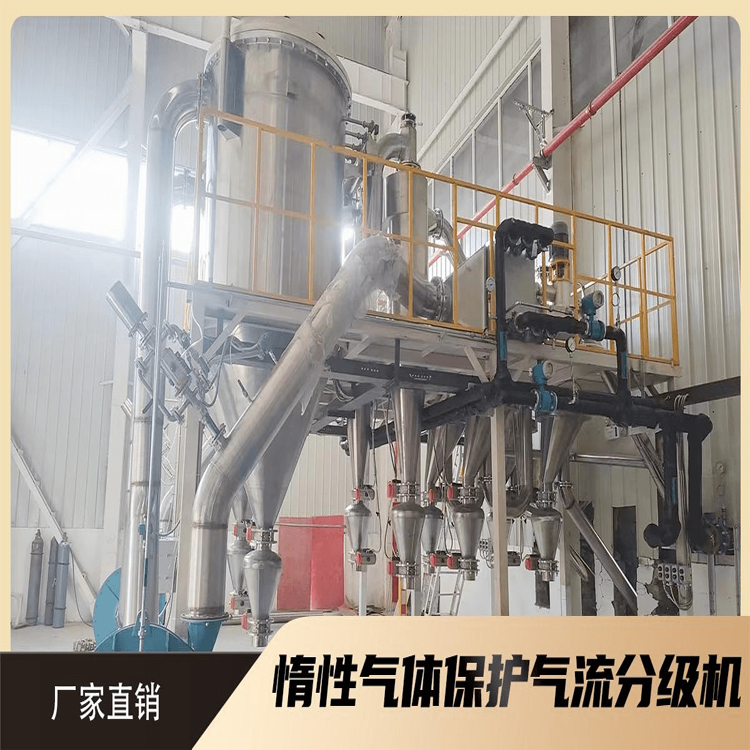
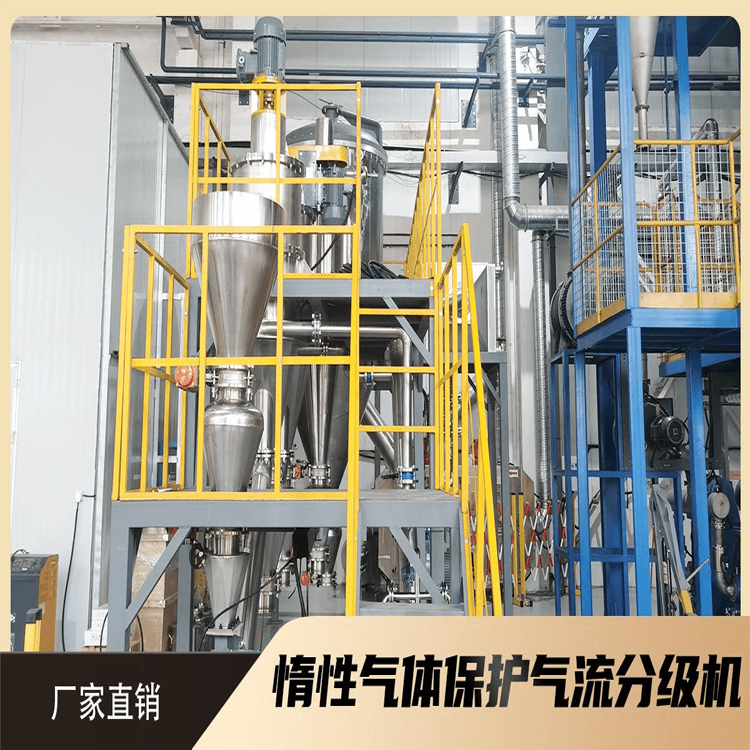
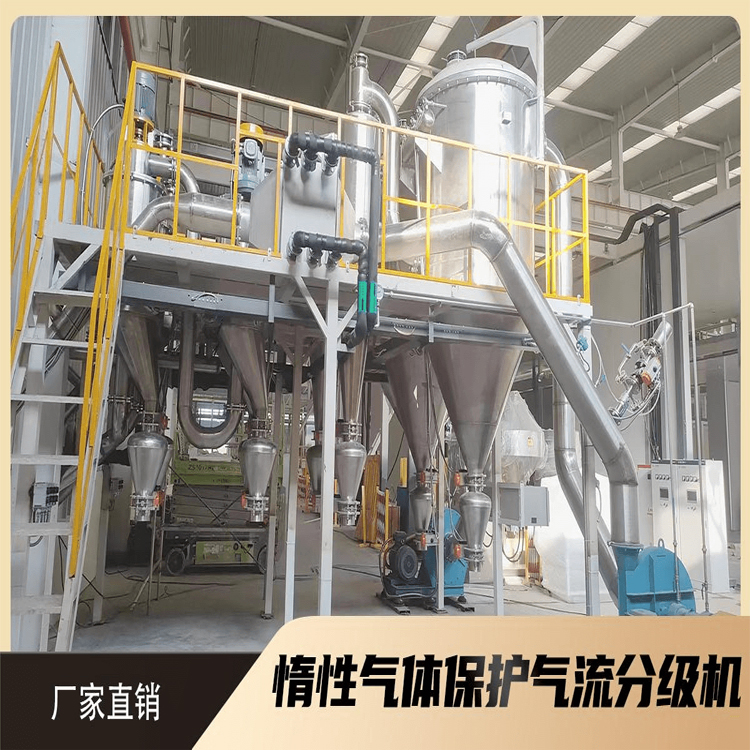
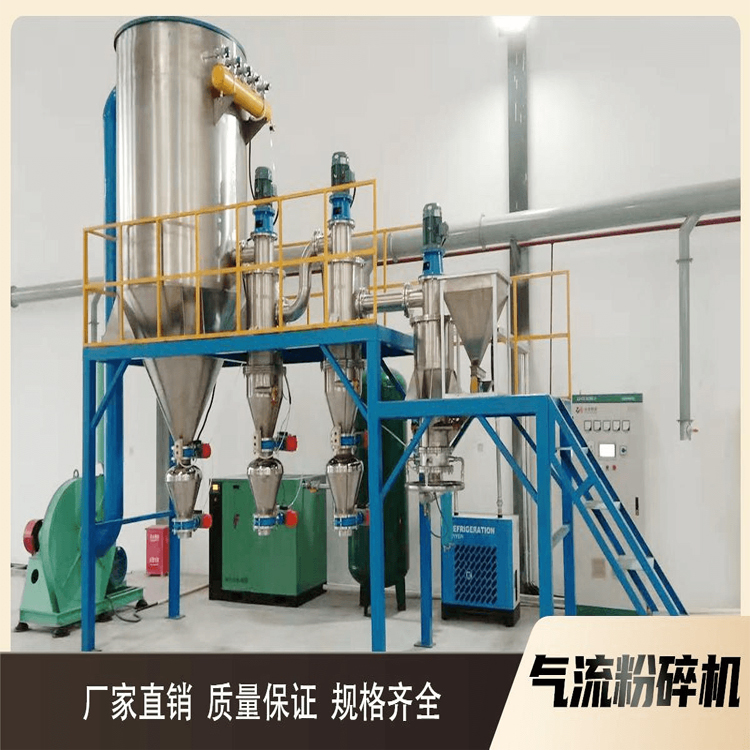
National Specialized and Innovative Enterprise - A manufacturer focused on airflow mill research and development.
15390260787
Today, we introduce the Airflow Grading Machine series.Ultrafine Powder Grading Technology and Typical Equipment
Ultrafine powders are not only the foundation for preparing structural materials but also a material with special functions, essential in numerous fields such as fine ceramics, electronic components, bioprocessing, new printing materials, refractory materials, and those related to fine chemicals. As the application of ultrafine powders becomes more widespread in modern industry, the role of powder classification technology in powder processing becomes increasingly significant.
The Significance of Ultra-Fine Pulverizer Grading
During the crushing process, only a portion of the powder often meets the particle size requirements. Failing to promptly separate the product that has met the specifications from the unqualified powder and re-crushing them together can lead to energy waste and over-crushing of some products.
Furthermore, after the particle size is refined to a certain degree, phenomena such as crushing and agglomeration occur, and even the crushing process may deteriorate due to the enlargement of particle agglomeration. To address this, during the preparation of ultra-fine powder, the product needs to be graded. This ensures that the particle size of the product remains within the required distribution range, while also separating out the product with the desired particle size from the mixture promptly. This allows for the return of coarse particles for further crushing, thereby improving crushing efficiency and reducing energy consumption.
As the required fineness of powders increases and production volumes rise, the complexity of classification technology also escalates. The issue of powder classification has become a critical bottleneck restricting the development of powder technology, and it is one of the important fundamental technologies in powder technology. Therefore, research into ultra-fine powder classification technology and equipment is highly necessary.
2. Principle of ultra-fine grinding mill classification
Graded broadly, particles are divided into several distinct sections based on their differing characteristics such as particle size, density, color, shape, chemical composition, magnetic properties, and radioactivity. Narrowly defined grading refers to the separation of particles with different sizes within a medium.Under the influence of centrifugal force, gravity, and inertial force (usually through air and water), different motion trajectories are generated, thereby achieving separation of particles with varying sizes.
3. Ultra-fine Pulverizer Classifier Types
Dry separation by medium used(Dry classification uses air as the medium, offering lower costs and ease of operation. However, it has two drawbacks: it can easily cause air pollution and has limited precision in grading. Wet classification, which employs liquids as the medium, presents numerous post-processing issues, such as dehydration, drying, dispersion, and wastewater treatment for the powdered material after grading. Despite these, it boasts high precision and non-explosive dust properties.)
Ultra-fine Pulverizers can be divided into two main categories based on whether they have moving parts:
(1) Static Grading Machines: These graders lack moving parts, including gravity graders, inertial graders, cyclone separators, helical airflow graders, and jet graders, among others. They are simple in design, require no power, and have low operation costs. They are easy to operate and maintain, but their grading accuracy is not high, making them unsuitable for precise grading.
(2) Dynamic Grading Machine: This refers to grading machines with moving parts, primarily various turbine grading machines. These machines have complex structures, require power, and have high energy consumption, but offer high grading accuracy and easy adjustment of particle size. The cutting particle size of the grading machine can be changed simply by adjusting the speed of the impeller rotation, making them suitable for precise grading.
4. Key Issues in the Grading of Ultra-Fine Pulverizers
For any grading method, the key to achieving better grading results lies in enhancing the dispersion of the graded material and selecting an appropriate grading force field.
After ultra-fine processing, the material exhibits properties different from the original material. Firstly, the specific surface area increases, and the surface energy rises. Secondly, the proportion of surface atoms or ions is significantly higher, enhancing the surface activity and the attractive force between particles, or causing them to aggregate more easily due to external impurities like moisture. Ultra-fine particles are also prone to aggregation during the crushing process due to collisions and absorption, or post-crushing due to electrostatic forces, onto larger particles. This leads to the formation of larger secondary particles in both air and liquid phases, making it more challenging to grade ultra-fine products compared to regular products.
The primary task of the grading process is to disperse the particles into a monodisperse state, thereby enhancing the flowability of the powder, which is fundamental to ultra-fine powders as it relies on the dispersion of powder particles. One could say that adequate dispersion can make the grading process twice as effective with half the effort.
After solving the problem of dispersion of powder particles, the next bigger challenge is to design a stable and adjustable force field. An ideal classification force field should possess strong classification force, stable flow field, and rapid classification. Since the behavior of powder particles varies in different media and force fields, it is essential to understand their physical and kinetic properties to design an efficient and reasonable classification force field. Currently, the force fields mainly used in classifiers are gravitational field, inertial field, and centrifugal field.
5. Typical grading equipment: Ultra-fine Pulverizer
(1) Wet-type separator
The wet classification of ultra-fine powders, as observed in the current market, is primarily divided into gravity-based and centrifugal methods.
Hydrocyclone. The grading process of the hydrocyclone involves: materials rotating at high speed inside, generating significant centrifugal force. Under the influence of centrifugal force and gravity, larger particles are thrown towards the wall, moving spirally downwards and eventually discharged through the underflow outlet. Finer particles and most of the water form a vortex, rising towards the center and discharged through the overflow pipe.
There are three commonly used hydrocyclones: small-diameter hydrocyclones, sealed hydrocyclones, and ultra-fine hydrocyclone separators. The advantages of hydrocyclones include simple construction, absence of moving parts, affordability, small footprint, and high processing capacity; however, their disadvantage lies in lower classification accuracy.
Horizontal Spiral Centrifugal Classifier. The suspension to be classified is added to the feed hopper of the spiral pusher through the central feeding tube, accelerated, and then enters the drum through the feed holes on the spiral. Under the action of centrifugal force, the suspension inside the drum quickly separates into two layers: coarser or heavier particles settle on the inner wall to form a sediment layer, while the liquid phase containing finer or lighter particles forms an inner annular separation layer. The separation liquid is discharged by overflow or centrifugal pump. The sediment...(Solid particles) are pushed to the conical end of the drum by the spiral feed pusher, where they are further dehydrated and then ejected from the drum through the slag outlet. The general particle size range is typically 2 to 5 micrometers.
(2) Dry Separator Machine
Dry separation classifiers mainly use centrifugal and inertial force fields to classify powders, and they are important fine separation equipment that is rapidly developing. Below are several representative machines.
Conical Centrifugal Airflow Classifier. The Conical Centrifugal Airflow Classifier achieves the separation of coarse and fine powders under the action of centrifugal force. The finished product of this equipment can have a fine particle size up toApproximately 0.95μm, with a grading accuracy of d75/d25 reaching 1.16. The equipment features no moving parts and its flow guide blade angles can be adjusted between 7° to 15°. The compact design ensures high grading efficiency and safe, reliable operation.
The MS (Micron Separator) centrifugal separator. The material to be graded and the primary air stream enter the machine through the feeding tube and adjustable pipe, then into the separator area via the air distribution cone. The shaft drives the separator impeller to rotate. Fine-grained material is ejected upwards through the fine-grain outlet, as the centripetal force, generated by the high-speed rotation of the separator wheel and the centrifugal force field, exceeds the centrifugal force, passing through the gaps between the blades. Coarse-grained material, due to its greater centrifugal force, is discharged through the ring-shaped body from the coarse-grain outlet at the bottom of the machine.
The MSS ultra-fine classifier is an improved version of the MS model. Its feature lies in the addition of tangential airflow injection holes on the cylindrical shell wall of the impeller section. The purpose is to喷射气流 into the machine from the holes, allowing the fine particles carried by the coarse particles thrown against the筒壁 under the action of centrifugal force to be completely separated.
The ATP Type Classifier. The ATP Type Classifier is a classifier developed and manufactured in Germany, featuring a vortex rotor design. The equipment's classifier wheel is horizontally mounted at the top of the classifier, and is used in conjunction with fluidized bed air mills, roller crushers, etc. Additionally, to overcome the issue of reduced production capacity due to high impeller speed, multiple small-diameter classifier impellers can be parallely and horizontally installed at the top of the classifier to enhance production capacity and ensure finer product output.
Inertia Separator. The inertia separator utilizes the different motion trajectories of particles due to their varying masses, leading to different inertia forces, thereby achieving particle separation. Another type of inertia separator...——Jet classification utilizes the propelling effect of jet on powdered materials, while the materials are subjected to air flow from different directions, leading to particle grading. Research finds that when using the inertial force field for classification, there are many interference factors in the flow field, making it difficult to control.
The KSF-type new ultra-fine classifier is manufactured in Japan. The classifier rotor is of impeller or cage type, with a high rotational speed, and the particle size classification is determined by the centrifugal force generated by the rotor and the aerodynamic centripetal force. Reports indicate that the machine is suitable for classifying various materials such as metal ores, non-metallic minerals, plastics, ceramics, and can produce ultra-fine products with a particle size of 0.3μm.
The LHB Type Turbine Ultra-Fine Classifier features low rotational speed (1,200~1,900r/m), fine gradation fineness d97 of 5~30μm, high gradation accuracy and efficiency, and low energy consumption.
DS Type Classifier. The DS type classifier is a non-rotating semi-free vortex classifier, handling two-phase flows containing fine particles, which are drawn into the classifier under negative pressure. After being rotated and separated along the wall of the upper cylinder, part of the air and fine powder exit the classifier through an inserted pipe; the remaining material flows into the classification zone through the central cone, being separated into coarse and fine powder under centrifugal force. The secondary air, guided by adjustable angle blades, enters the classification chamber to ensure thorough particle dispersion, enhancing classification efficiency. The coarse powder enters the discharge bin through a ring channel, while the fine powder is discharged outside the machine through the bottom of the central cone. The fineness of the classification can be adjusted by modifying the height of the central cone and the volume of the secondary air. The DS type classifier has a cutting particle size range of 1-300μm and a processing capacity of 10-4,000kg/h.
Contact us

Service Hotline
15390260787
Company Telephone
15390260787

WeChat Number
qddssyj

Address
Sichuan Mianyang Anzhou Huaiqu Industrial Park
b2b.china9.net © Zhongshang 114 Hebei Network Technology Co., Ltd.Address: Room 6009, Oriental New World Center, No.118 East Zhongshan Road, Qiaoxi District, Shijiazhuang City, Hebei ProvincePlatform Service Hotline: 4006299930