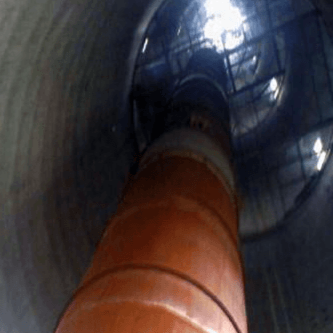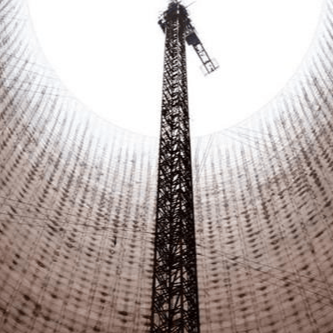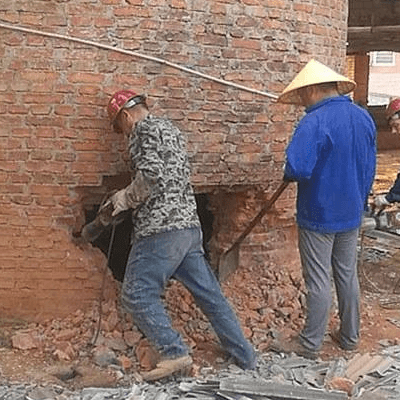
Tall structure construction, maintenance, installation, d...

Thoroughly familiarize yourself with the professional technical skills and procedures of this trade.
Individuals must be 18 years of age and pass a physical examination before engaging in high-altitude work. Those suffering from hypertension, heart disease, epilepsy, mental illness, and other conditions unsuitable for high-altitude work are prohibited from climbing.
Three: Any work surface above three meters with a slope greater than 45 degrees, or where the working ground is unstable or vibrates, should be considered as high-altitude work.
Protective gear must be worn properly, pants legs should be tucked in, a safety helmet must be worn, and shiny, hard-soled shoes are prohibited. A sufficiently strong safety belt is required, and the rope should be securely fastened to a sturdy structural component of the building or a metal framework, not to any moving objects.
Before ascending, the construction supervisor must conduct on-site safety education for all personnel.
Six, inspect all climbing tools and safety equipment (such as helmets, safety belts, ladders, platforms, scaffolding, protective boards, safety nets, etc.)—they must be safe and reliable. Strictly prohibit risky operations.
Seven, the ground in the high-altitude work area must be marked as a restricted zone, enclosed with railings, and warning signs such as "No Trespassing" and "Prohibited Access" should be displayed.
Prior to working on low-voltage (near power lines), the power should be shut off first. Work can only proceed after confirmation of the power outage, and insulating barriers should be set up. Workers must remain at least 2 meters away from the power lines (low voltage). Working under high-voltage lines is strictly prohibited.
Tools, parts, and materials used for high-altitude work must be placed in a tool bag. When ascending or descending, no objects should be held in hand, and movement must be along designated routes. Materials or tools should not be thrown from height, and tools or materials that are prone to rolling or slipping should not be stacked on scaffolding. Horseplay is prohibited. After completing the work, all objects that could fall, including tools, small materials, and parts, should be cleaned up promptly to prevent injury from falling. When handling large components, reliable lifting equipment should be used.
Ten, always be vigilant of hazard signs and areas. Adequate lighting must be provided for night-time operations; otherwise, construction is prohibited.
Eleven: Vertical operations above and below must be strictly prohibited. In case of special circumstances that necessitate vertical work, prior approval from relevant leaders is required, and a dedicated protective shed or other isolation facilities should be set up between the upper and lower levels.
Twelve: Absolutely no resting on elevated areas without guardrails. Prevent falls.
Do not allow the use of hoists and other lifting equipment for ascending or descending personnel.
When working on asbestos (glass) shingle roofs, use ladders or similar items to walk on the shingles to prevent breaking through and falling.
Do not work or pass on the top of the wall under any circumstances.
Sixteen: The load capacity of scaffolding should not exceed 270 kilograms per square meter. If an increased load capacity is required, the scaffolding should be appropriately reinforced.
Seventeen: Plywoods exceeding 3 meters in length should not accommodate two workers at the same time.
When performing high-altitude welding or oxygen cutting operations, flammable and explosive materials within the splash range must be cleared beforehand.
Step platforms, plank bridges, and transportation walkways should be cleaned at all times. In case of mud, water, ice, or snow, effective anti-slip measures must be taken, and approval from the safety officer is required before work can commence. In severe cases of icing or snow accumulation that cannot be cleared, suspend high-altitude operations.
Twenty: No overhead work is permitted outdoors when wind speeds reach level six or above.
When using a ladder, it is essential to first check the ladder's stability and whether it meets safety requirements. The ideal incline for a ladder is 60 degrees. The base width should be no less than 50 centimeters and equipped with anti-slip devices. There should be no hooks at the top of the ladder, and if the legs cannot be firmly secured, someone must hold the ladder. The rope on a step ladder must be secure.


b2b.china9.net © Zhongshang 114 Hebei Network Technology Co., Ltd.Address: Room 6009, Oriental New World Center, No.118 East Zhongshan Road, Qiaoxi District, Shijiazhuang City, Hebei ProvincePlatform Service Hotline: 4006299930