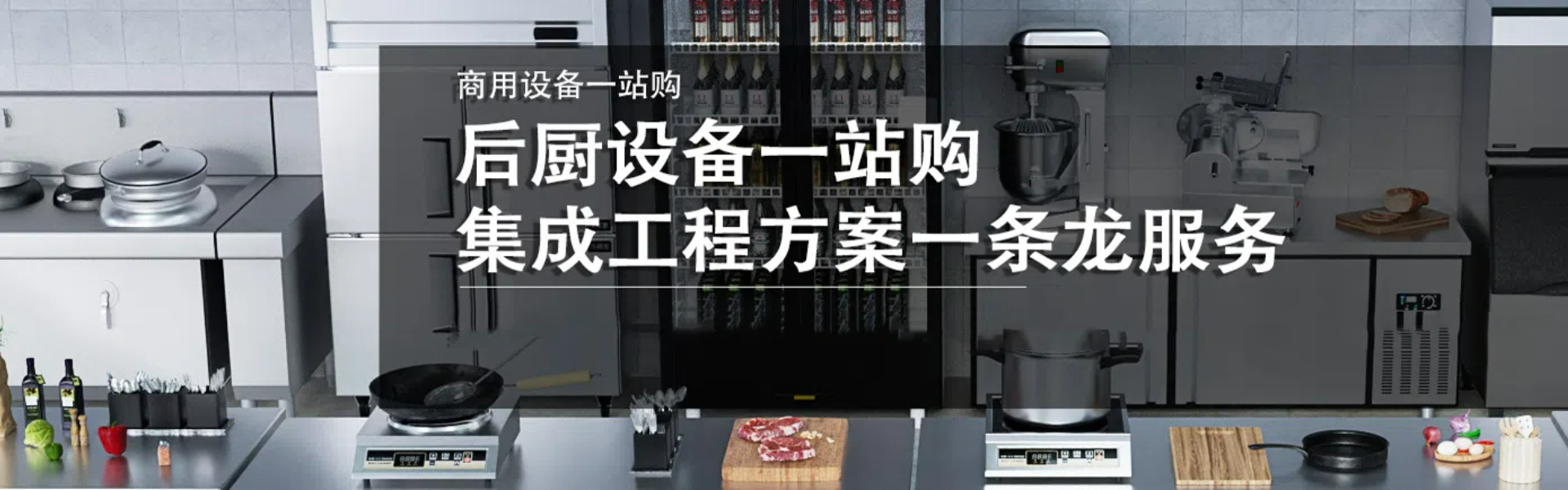
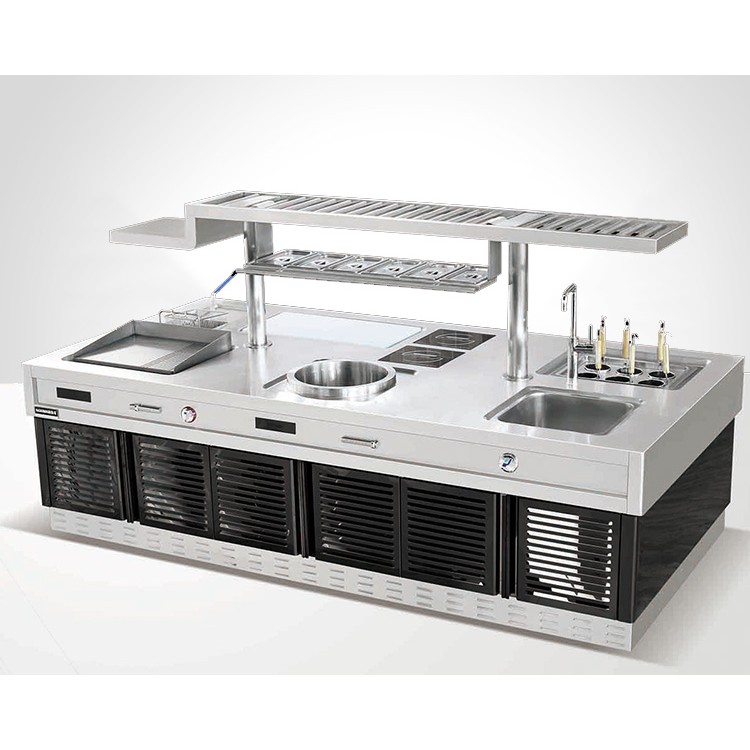
Kitchen Equipment, Kitchen Engineering, Integrated Kitche...

Stainless steel kitchen equipment offers satisfactory corrosion resistance in many industrial applications. Experience shows that, aside from mechanical failures, corrosion of stainless steel primarily manifests as: A severe form of corrosion in stainless steel is localized corrosion (i.e., stress corrosion cracking, pitting, intergranular corrosion, corrosion fatigue, and crevice corrosion). Cases of localized corrosion account for nearly half of all failure instances. In reality, many failures can be avoided through reasonable selection. Stress Corrosion Cracking (SCC): A general term for alloys that fail alternately in a corrosive environment due to the expansion of grains. Stress corrosion cracking exhibits brittle fracture characteristics but can also occur in high-toughness materials. The necessary conditions for stress corrosion cracking are tensile stresses (whether residual or applied, or both) and the presence of specific corrosive media. The formation and extension of the outline are generally perpendicular to the direction of tensile stress. The stress values that lead to stress corrosion cracking are much lower than those required for material failure in the absence of corrosive media. On a microscopic level, cracks that cross grains are called transgranular cracks, and those along grain boundaries are called intergranular cracks. When stress corrosion cracks extend to a certain depth (where the load acts on the material partially), the stress in the air reaches its fracture stress, and the material breaks through normal cracks (in ductile materials, usually through microaggregation). Therefore, the failed part due to stress corrosion cracking will include characteristic areas of stress corrosion cracking and "indentation" areas related to the aggregation of microdefects. Pitting: A form of localized corrosion that can cause corrosion. Intergranular Corrosion: The boundaries between grains with different crystallographic orientations. Therefore, they are regions where various solute elements in steel segregate or metal compounds (such as carbides and δ phases) precipitate. It is not surprising that the grain boundaries are corroded first in certain corrosive media. This type of corrosion is called intergranular corrosion, and most metals and alloys may exhibit intergranular corrosion in some corrosive media. Crevice Corrosion: A form of localized corrosion that may occur in gaps where solution stagnates or shielded surfaces. Such gaps can form at joints between metals or between metals and nonmetals. General Corrosion: A term used to describe the uniform corrosion phenomenon that occurs over the entire surface of an alloy. When complete corrosion occurs, the rural material thins due to corrosion, and even the material itself may fail. Stainless steel may exhibit general corrosion in strong acids and strong alkalis. Failure issues caused by general corrosion are not particularly concerning because the problem can usually be predicted through simple immersion tests or by referring to corrosion literature.
Clean the burner daily to ensure it remains oil-free.
Do not throw debris into the inside and outside of the furnace to ensure the smooth flow of oil and gas inside and water outside.
The hot water pot on the stove should be cleaned daily and should not contain any debris.
4. The water tank on the burner should be cleaned regularly to maintain the cleanliness of the water.
Do not use several spoons to敲打 the water outlet on the burner to prevent water from spilling when no one is around. In case of any damage or blockage to the burner, notify the engineering department immediately to avoid danger.
6. Turn off the gas or diesel switches promptly to leave the stove and prevent leaks. Do not ever use water to clean the electrical system of the stove.
7. Prevent the furnace from being struck by hard objects to avoid damage, and regularly clean the air passages in the burner to prevent the air导管 from becoming blocked.
Refrigerator Hygiene and Maintenance
Wipe down the inside and outside of the refrigerator, maintaining cleanliness.
2. Regularly defrost items stored in the refrigerator. Do not use hard objects to strike the refrigerator.
3. Raw foods should be stored separately; do not place rotten items in the refrigerator.
4. Remove rotten food promptly to avoid unpleasant odors from spreading in the refrigerator.
Do not place hot foods in the refrigerator.
Keep a close eye on the refrigerator's temperature.
Always remember to close the refrigerator door when not in use.
8. Notify the engineering department in the event of a malfunction.


b2b.china9.net © Zhongshang 114 Hebei Network Technology Co., Ltd.Address: Room 6009, Oriental New World Center, No.118 East Zhongshan Road, Qiaoxi District, Shijiazhuang City, Hebei ProvincePlatform Service Hotline: 4006299930