





- AllProduct Category
-
Inorganic Pre-Painted Board
Paint-Free Fire Retardant Board
Ice-Fire Board
Antibacterial Panel
Clean Sheet



详情描述
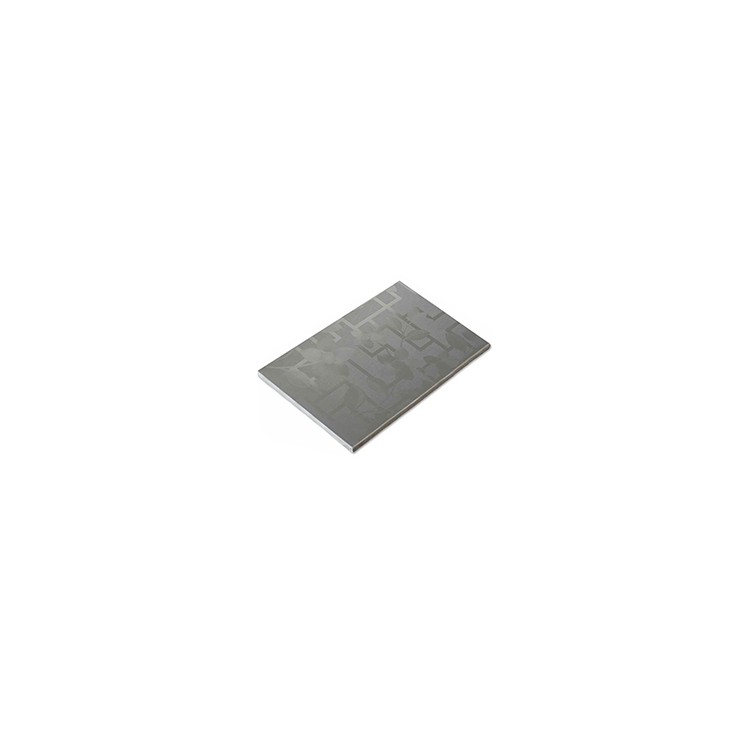
Detailed Description:
Antibacterial plank flooring, simply put, is a flooring that releases negative ions. The main component of the negative ion activator, known as the negative ion element, is a crystal structure belonging to the trigonal crystal system with a space group of R3m. It is a typical polar crystal, and the crystal lacks a center of symmetry in the R3m point group. The positive and negative charges along the C-axis cannot overlap, resulting in the formation of positive and negative poles at the ends of the crystal. Moreover, in the absence of an external electric field, these poles do not disappear, hence it is also referred to as "long poles," indicating that the negative ion element crystal is a long charged body.
The principle is:
Negative ion element
"A long electrode generates an electric field around it, possessing a dipole moment due to the lack of a symmetric center for positive and negative charges. The dipole moments are aligned in the same direction, polarizing the crystal to a high degree. This polarized state persists even when the external electric field is '0,' hence termed 'spontaneous polarization,' leading to the accumulation of charges at the crystal's positive and negative poles. The strength of the electric field or the amount of charge depends on the inter-ionic distance and bond angle within the dipole moment, with each crystal having its inherent dipole moment. Generally, long electrodes attract surrounding opposite charges, forming a surface charge layer on their surface, which屏蔽 most of the inherent electrode charges. Consequently, the static state of the crystal has a low ionization capacity (typically 50-100 ions/cm³). Upon the slightest external influence (such as temperature or pressure changes), the inter-ionic distance and bond angle change, increasing the polarization strength. This releases the charges in the surface charge layer, enhancing the electrode charge quantity, the electric field strength, and presenting a clear charged state or forming a microcurrent in a closed circuit."
Sources include:
Formaldehyde, ammonia, and other volatile organic compounds released from decorative and construction materials.
(2) Various organic compounds such as H2S and smoke in toilets and kitchens;
(3) Odor from domestic waste and other decayed substances
(4) The smell of smoke from smoking.
Negative ion activator odor elimination and deodorization mechanism:
Most odors, unpleasant smells, bacteria, smoke, and other airborne contaminants carry a positive charge. Therefore, released negative ions can neutralize them until they are charge-free and settle.
(2) Smog and harmful gases containing oxygen free radicals can be neutralized by negative ions.
(3) Negative ion generators form an electric field around each crystal particle with a microcurrent of 0.06mA, decomposing bacteria and organic matter under the influence of the electric field current.
(4) Certain harmful gases react during the shrimp processing to form low-hazard substances.
The elimination of odors is a comprehensive result of the combination of negative ion coating and sedimentation, negative ion neutralization, electric field current decomposition, and certain chemical reactions.
Four: Mechanism of negative ion activator and far infrared radiation radiation:
Negative ion activator is a far-infrared radiation material highly beneficial to human health. The human body absorbs far-infrared wavelengths at 9.6μm, while the negative ion activator emits far-infrared radiation within the range of 2-18μm, with a radiation power emission of 0.04w/cm², slightly higher than the human body's absorbed radiation power density of 0.03w/cm². These data fully confirm that the far-infrared radiation emitted by the negative ion activator coordinates well with the human body and can be fully absorbed.
V. Mechanism of Negative Ion Stimulant Bacteriostasis:
1. Due to the strong electric field of 104-107 V/m surrounding negative ion materials, bacteria are killed or their division and proliferation are suppressed by the electric field's effect and the 0.06 mV·A microcurrent it generates.


